LASIK, SMILE, SILK, and Contoura Vision can all reduce dependence on glasses, but they are not interchangeable. LASIK remains the most versatile option. Contoura Vision is a customized form of LASIK, not a separate surgery family. SMILE and SILK are flap-free lenticule procedures mainly used for myopia, often with astigmatism. SILK is newer, so its early results are encouraging, but its long-term evidence and regulatory availability are still less mature than LASIK and SMILE. The safest choice depends on your corneal scans, tear film, prescription, lifestyle, and expectations.
LASIK vs SMILE vs SILK vs Contoura Vision – The Complete Comparison Guide
If you are trying to choose the best laser eye surgery, you are asking the right question. But there is one important catch. The best surgery is not chosen by whichever name sounds newest or most premium. It is chosen by which procedure suits your eyes most safely and most accurately. Two patients can have the same spectacle number and still be better suited to two different procedures because their corneas, tear film, work demands, sports habits, and night-driving needs are different.
Patients searching terms like “lasik vs smile,” “contoura vs lasik,” or now “silk vs smile” are usually not looking for textbook theory. They want a decision-support guide. They want to know what each surgery actually is, who qualifies, how long recovery takes, how much it may cost, and which one is most likely to match their lifestyle. That is exactly how I will explain it here.
First, the most important confusion to clear up
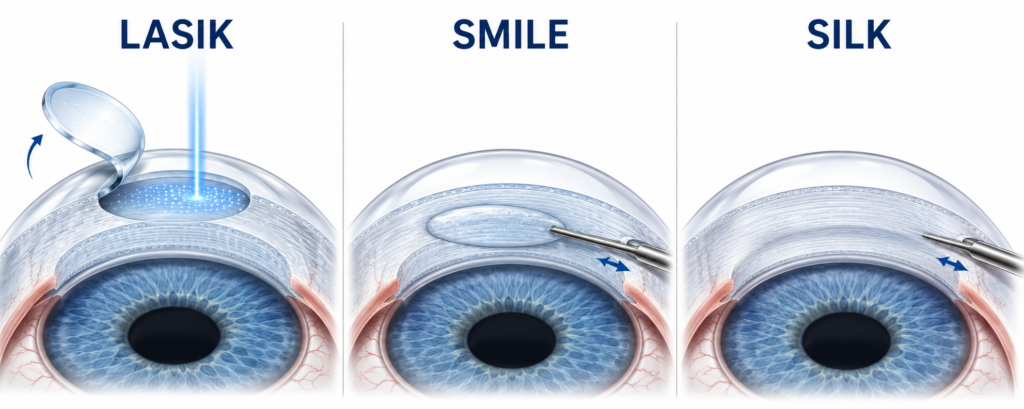
LASIK is the broad, well-established category most people already know. In LASIK, a thin corneal flap is created, the corneal tissue underneath is reshaped with an excimer laser, and the flap is laid back in place. LASIK is widely used because it offers fast recovery and can treat a broad range of refractive errors, depending on the laser platform and your eye measurements.
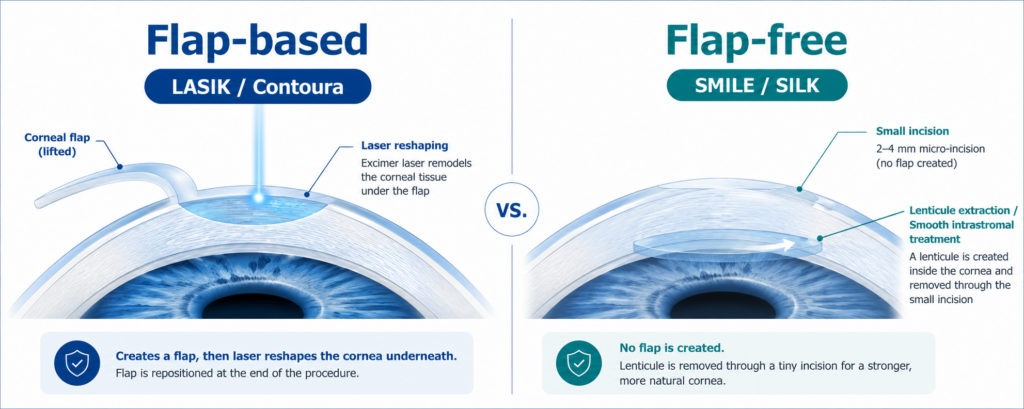
Contoura Vision is not a different family of surgery in the way SMILE or SILK are. Contoura is a topography-guided form of LASIK. In simple language, it is LASIK done with a highly detailed map of the front surface of your cornea to customize the treatment plan. It still involves a LASIK flap. That means “Contoura vs LASIK” is not really the most accurate framing. The more accurate comparison is standard LASIK versus customized topography-guided LASIK.
SMILE, or Small Incision Lenticule Extraction, is different from LASIK because it is flap-free. Instead of lifting a flap and reshaping the cornea with an excimer laser, a femtosecond laser creates a small lens-shaped piece of tissue inside the cornea, and that tissue is removed through a small incision. In the United States, FDA approval for SMILE covers myopia with or without astigmatism in adults 22 years or older with stable refraction over the past year.
SILK, which stands for Smooth Incision Lenticule Keratomileusis, is also a flap-free lenticule procedure. Like SMILE, it works by creating and removing a lenticule through a small incision. The difference is the platform and lenticule design. Johnson & Johnson describes SILK on its ELITA platform as a next-generation lenticular procedure, and published early studies report good visual and safety outcomes for myopia with or without astigmatism. However, SILK is newer than SMILE, and availability varies by country. The company also states that not all products are available in all countries, and its 2023 U.S. announcement specifically noted that ELITA had FDA 510(k) clearance for LASIK flap creation in the U.S., not approval for the SILK lenticule procedure in the U.S. at that time.
How each surgery works in plain language
Think of the cornea as the eye’s clear front window. Refractive surgery works by reshaping that window so light focuses more accurately on the retina. LASIK and Contoura reshape the cornea after a flap is created. SMILE and SILK reshape it by removing a tiny lenticule from within the cornea through a small incision, without creating a flap. That flap-versus-no-flap difference is one of the biggest practical differences between these procedures.
Why does that matter? Because the flap affects healing, dry eye, and lifestyle discussions. A flap-based surgery may still be an excellent choice, but in patients who play contact sports, work in physically demanding environments, or are especially concerned about postoperative dryness, a flap-free option often enters the conversation earlier. That does not automatically make flap-free surgery better. It simply means the trade-offs are different.
LASIK: still the all-rounder
LASIK remains the most versatile and widely recognized option for good reason. It is fast, predictable in properly selected patients, and usually offers very quick functional recovery. Many patients are able to return to desk work quickly and experience a dramatic reduction in glasses dependence very early after surgery. LASIK can also address a broader range of refractive errors than current U.S.-approved SMILE, including hyperopia on appropriate LASIK platforms.
The downside is that LASIK is flap-based. That means the surgery temporarily disrupts more corneal nerves than lenticule-extraction procedures, which is one reason dry eye symptoms may be more noticeable after LASIK in some patients. The FDA also advises that some patients may develop severe dry eye syndrome, and that this can affect comfort and visual quality.
Contoura Vision: premium customized LASIK
Contoura Vision is best understood as customized LASIK rather than a rival to LASIK itself. The treatment uses detailed corneal topography to plan the ablation, with the aim of making the correction more personalized to the patient’s corneal surface. The FDA patient booklet for topography-guided LASIK explains that the shape of the cornea is used to help plan treatment and that this method is more customized than standard LASIK.
For the right patient, this is appealing. If your surgeon believes your corneal surface data will help refine treatment planning, topography-guided LASIK may offer an advantage over a standard LASIK profile. But because it is still LASIK, it still comes with flap-related considerations, dry-eye discussions, and the same need for good corneal thickness, healthy topography, and careful screening.
SMILE: the proven flap-free option
SMILE has become a very strong option for patients with myopia, especially myopia with astigmatism, who want a flap-free procedure. It has a strong evidence base, official FDA indications in the U.S., and a large amount of real-world experience globally. It is often attractive to patients who are worried about dry eye or who prefer a smaller-incision procedure.
A number of studies and reviews have shown that SMILE tends to disturb corneal nerves and the ocular surface less than LASIK, especially in the early postoperative period. Reviews of dry eye after refractive surgery have found that SMILE often causes less postoperative dry eye than femtosecond LASIK, especially in the first several months, even though both can cause temporary dry-eye symptoms.
The limitation is that SMILE is not the most flexible option for every prescription. In current FDA labeling, it is mainly for myopia with or without astigmatism, not for hyperopia. So if you are farsighted, or if your corneal and refractive profile needs a different kind of customization, LASIK-based options may still be more suitable.
SILK: the newer flap-free entrant
SILK has generated a great deal of interest because it belongs to the same broad flap-free lenticule-extraction idea that made SMILE popular, but it is built on a newer platform. Johnson & Johnson’s professional materials describe SILK as a next-generation lenticular procedure and highlight a biconvex lenticule design intended to improve smoothness and the ease of lenticule removal. A 2025 Scientific Reports paper discussing functional vision after refractive procedures also notes that ELITA uses a biconvex lenticule shape intended to minimize corneal micro-folding.
This is promising, but it is important not to overstate the case. Early peer-reviewed studies of SILK have reported good safety, efficacy, and fast visual recovery for myopia with or without astigmatism. However, SILK does not yet have the same length of follow-up or the same global maturity of evidence as LASIK, and it does not have the same U.S. regulatory footing as SMILE for lenticule extraction. In practical terms, that means SILK is exciting, but it is still a newer option where surgeon experience, platform availability, and local regulation matter a great deal.
In India and some other markets, SILK is increasingly being discussed as a premium flap-free alternative. In clinic language, I would describe it this way: SMILE is the established flap-free option; SILK is the newer flap-free option with encouraging early data and a design philosophy aimed at smoother tissue interaction. That is not the same thing as saying it is automatically better for every patient.
Who is a good candidate?
This is where the decision becomes real. Your prescription is only one part of the story. Your surgeon will also look at your corneal thickness, corneal shape, tear film quality, pupil behavior, eye rubbing habits, and whether your power has been stable. The FDA checklist and patient guidance make it very clear that unstable refraction, pregnancy, breastfeeding, autoimmune disease, certain medications, and eye disease can all affect candidacy.
You may lean toward LASIK or Contoura if your prescription range fits, your cornea is suitable for a flap procedure, your tear film is reasonably healthy, and your surgeon believes you would benefit from a fast-recovery LASIK-based plan. Contoura becomes more attractive when you are already a LASIK candidate and the surgeon wants to use topography-guided customization.
You may lean toward SMILE if you have myopia with or without astigmatism, want a flap-free procedure, and dryness or active lifestyle issues are important to you. In many patients, this is the procedure that balances strong clinical track record with the appeal of a small-incision approach.
You may lean toward SILK if you are a suitable myopic patient in a market where SILK is available, prefer a flap-free option, and your surgeon is experienced with the ELITA platform. But because SILK is newer, I would place more emphasis on surgeon experience and pre-operative screening than on advertising language around “latest” technology.
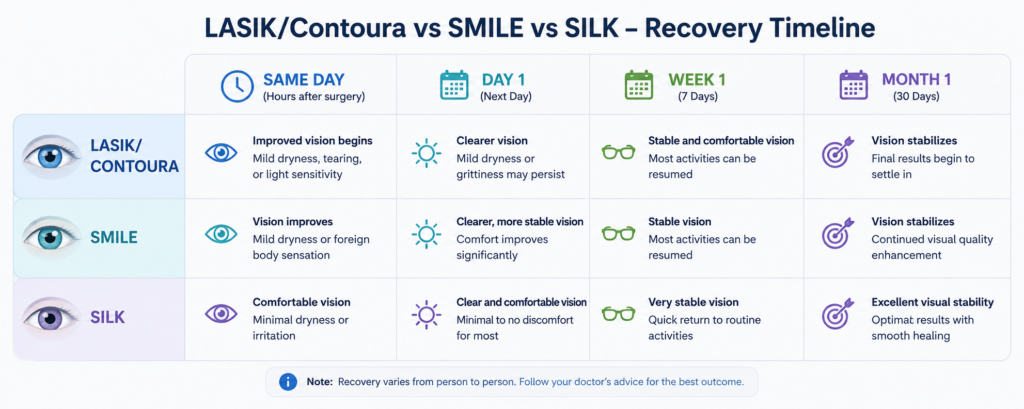
Recovery timeline: what patients actually want to know
When patients ask about recovery, they are usually asking two different questions. First, when will I be able to function normally? Second, when will my vision be fully settled?
For LASIK and Contoura, functional recovery is often very fast. The FDA says vision may be blurry right after surgery but usually improves quickly, and most patients notice substantial functional improvement early on. Because Contoura is LASIK, its recovery pattern is broadly similar to LASIK.
For SMILE, recovery is also fast, though the feel can be slightly different from LASIK. Many patients function well within a day or two, but the fine sharpening of vision may continue over days to weeks. SMILE’s smaller incision and lower surface disruption are part of why it is so attractive to patients who want a less invasive-feeling recovery.
For SILK, published studies and company materials report fast recovery and early patient satisfaction, with strong day-1 binocular vision reported in promotional materials and good short-term outcomes in peer-reviewed studies. Still, because SILK is newer, I would be more comfortable telling patients that early recovery appears promising rather than claiming it is definitively superior in every meaningful way.
In all four options, the practical rules after surgery still matter: use your drops properly, avoid eye rubbing, protect the eyes while sleeping in the early period, and attend follow-up visits. Fast recovery is not the same as “care-free recovery.”
Dry eye, night vision, and visual quality
This is where many comparison articles become too simplistic. It is not enough to say one procedure is “better.” Better for what?
If dry eye is your biggest concern, flap-free procedures usually deserve extra attention. FDA quality-of-life data show that some LASIK patients develop new dry eye symptoms after surgery, and reviews comparing SMILE with LASIK generally suggest a lesser effect on ocular surface disturbance and corneal innervation after SMILE, especially early on.
For SILK, the theory is also attractive. It is flap-free, and the platform’s design aims for a smoother stromal interface. Early studies show good visual outcomes and acceptable higher-order aberration changes, but longer and larger comparative studies are still needed before making very strong superiority claims over SMILE or customized LASIK.
Night vision symptoms such as glare, halos, starbursts, and ghosting can occur after refractive surgery, whichever procedure you choose. The FDA’s LASIK Quality of Life Collaboration Project found that some patients who had no symptoms before surgery reported new visual symptoms at three months, including halos, and up to 28 percent of participants without prior dry-eye symptoms reported dry-eye symptoms after LASIK. This does not mean most patients are unhappy. In the same project, more than 95 percent were satisfied with their vision after LASIK. It does mean you should go into surgery informed, not idealistic.
Cost comparison: what patients should really compare
Cost matters, but it should be handled honestly. There is no single national price for these procedures. Quotes vary by city, surgeon, platform, whether both eyes are included, whether medicines and scans are included, and whether enhancement coverage is part of the package. The FDA also notes that refractive surgery is usually not covered by medical insurance and remains a significant out-of-pocket expense.
In India, published private-hospital pages in 2025 and 2026 generally place standard LASIK as the lowest-priced option, topography-guided or customized LASIK in a higher band, and SMILE and SILK in the premium band. Large Indian eye-hospital sites commonly show standard LASIK beginning around the mid-₹30,000 range for both eyes at some centres, while SMILE and SILK often begin above ₹1 lakh for both eyes, with final pricing depending heavily on the centre and what is included. Those figures are useful only as a rough guide, not as a promise.
The smarter cost question is not “Which is cheapest?” It is “Which procedure gives me the best safety profile for my eyes, with a transparent quote that includes the full package?” A lower sticker price can become misleading if pre-op tests, postoperative medicines, enhancements, or follow-up visits are billed separately.
A quiz-style recommendation engine
Let us make this practical.
1. Is your power mainly myopia, with or without astigmatism?
If yes, all four may come into discussion depending on your scans. If you are significantly farsighted, LASIK-based options usually stay in the lead because current U.S.-approved SMILE is for myopia with or without astigmatism, and SILK is also mainly being used for myopia-focused correction where available.
2. Do you already have dryness, burning, fluctuating vision, or heavy digital eye strain?
If yes, treat the ocular surface first. A dry eye patient should never rush into laser surgery. Flap-free procedures may be worth stronger consideration, but untreated dryness can make any refractive outcome feel worse than it should.
3. Do you play contact sports or work in a setting where eye trauma is possible?
If yes, flap-free procedures such as SMILE or SILK may deserve more discussion than LASIK or Contoura. That does not make them automatic winners, but it changes the conversation.
4. Have you been told your corneas are thin, irregular, or borderline?
If yes, your surgeon may steer away from flap-based surgery, and in some cases away from laser surgery altogether. PRK or another alternative may be safer. This is one of the most important reasons screening matters more than branding.
5. Is your attraction mainly toward “the newest” procedure?
If yes, slow down. Newer does not always mean better for your eye. SILK is promising, but SMILE has a more established evidence base, and LASIK has the longest and broadest real-world track record. The right procedure is the one your cornea can support safely.
6. Do you want the most customized LASIK possible rather than a flap-free procedure?
If yes, Contoura should be part of the discussion. It is especially relevant for patients who are already good LASIK candidates and want a topography-guided treatment plan.
My practical take: which procedure suits which patient?
If you want the simplest clinical summary, here it is.
LASIK is often the best overall fit when you want versatility, fast recovery, and your eyes are good candidates for flap-based treatment. It remains the dependable all-rounder.
Contoura Vision is best for the patient who is already a LASIK candidate and may benefit from a more customized, topography-guided LASIK treatment. It is premium LASIK, not a separate category.
SMILE is the best-established flap-free option for patients with myopia, especially when dry eye or active lifestyle concerns are important.
SILK is the newer premium flap-free option. It is attractive when available, especially in centres with meaningful surgeon experience on the ELITA platform, but it should be chosen with an understanding that the procedure is newer and long-term comparative data are still developing.
And there is one final truth that every patient should hear: sometimes the best laser eye surgery is none of these. If your cornea is borderline, your tear film is poor, or your expectations are unrealistic, the safest advice may be to wait, treat the surface first, or choose another procedure such as PRK or even a non-corneal option. Good refractive surgery is not about selling a laser. It is about matching the right eye to the right treatment.
When to see an ophthalmologist
If you are seriously comparing LASIK, SMILE, SILK, and Contoura Vision, you are ready for a refractive screening consultation. A proper evaluation should include corneal topography or tomography, pachymetry, refraction stability, tear-film assessment, pupil analysis, and a discussion about your job, sports, night driving, and screen habits. That is how the right procedure is chosen.
Book an appointment with our ophthalmologist for a comprehensive laser eye surgery assessment. The goal should not be to find the most advertised procedure. The goal should be to find the safest and most suitable one for your eyes.
References
- FDA: LASIK Surgery Checklist.
- FDA: VisuMax Femtosecond Laser PMA for SMILE.
- FDA Patient Booklet: Topography-Guided LASIK (basis for Contoura-style treatment planning).
- Johnson & Johnson Vision Professional: ELITA Femtosecond Laser / SILK.
- PubMed Central: Safety and Effectiveness of Smooth Incision Lenticular Keratomileusis (SILK).
SEO Meta Title: LASIK vs SMILE vs SILK vs Contoura Guide
SEO Meta Description: Compare LASIK, SMILE, SILK and Contoura Vision by candidacy, recovery, cost and real-world pros and cons.
Suggested Keywords: lasik vs smile, silk vs smile, contoura vs lasik, best laser eye surgery, laser eye surgery comparison, smile vs silk recovery, contoura vision pros cons, silk eye surgery cost, lasik vs smile recovery