Dry eye syndrome, now more accurately called dry eye disease, happens when your eyes do not make enough tears, your tears evaporate too quickly, or the tear film is unhealthy. That is why eyes may feel dry, gritty, tired, blurry, or even watery. A common cause is meibomian gland dysfunction, where the oil glands in the eyelids do not work well. Treatment is not one-size-fits-all. It may include artificial tears, lid care, screen-time changes, prescription medicines, punctal plugs, or in-office procedures such as thermal treatments or IPL for selected patients.
Dry Eye Syndrome – Complete Guide to Causes, Diagnosis & Treatment
Dry eye syndrome is one of the most common reasons people visit an eye clinic. Many patients describe it in simple but frustrating words: “My eyes feel sandy.” “They burn by evening.” “My vision goes blurry on the computer.” “My eyes water all the time, so how can they be dry?” All of these complaints can fit the same condition. Dry eye is common, can affect day-to-day comfort and vision, and in more severe cases can damage the cornea if it is ignored for too long.
One important update is that eye specialists increasingly use the term dry eye disease instead of dry eye syndrome. That change reflects what research has taught us: this is not just a vague collection of symptoms. It is a real disease of the tear film and ocular surface, often driven by inflammation, tear instability, or poor function of the eyelid oil glands.
What dry eye actually means
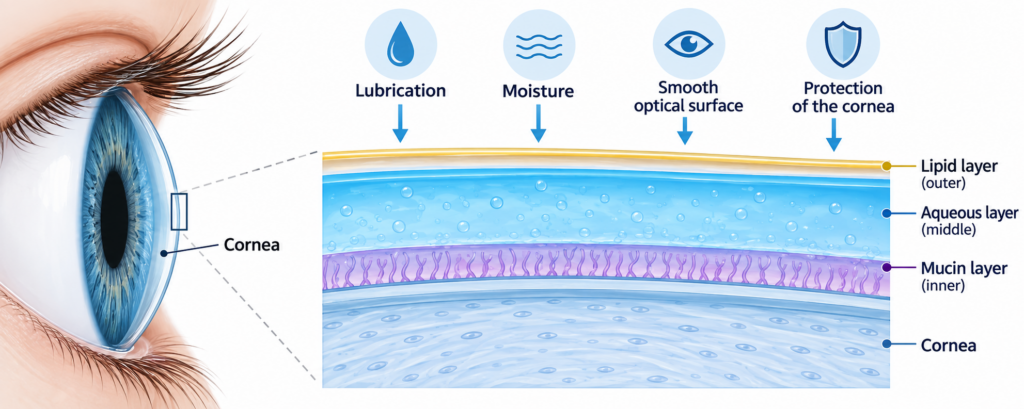
Your tears are not just “water.” A healthy tear film has several components that work together. You need enough watery tears for moisture, enough oil to slow evaporation, and enough mucus-like components to help tears spread smoothly across the eye. When any part of that system breaks down, the surface of the eye becomes unstable and irritated. That is when dryness, burning, foreign-body sensation, fluctuating vision, and redness begin.
A simple way to think about it is this: dry eye happens when the eye’s natural “tear coating” is either too little, too poor in quality, or too quick to disappear. Some people mainly do not produce enough tears. Others make tears, but those tears evaporate too fast. Many patients actually have a mixed pattern.
Why your eyes can feel dry, gritty, or watery at the same time
This is the part that confuses many patients. A dry eye can absolutely water. When the eye surface becomes irritated, the eye may respond with a flood of reflex tears. These are “emergency tears.” They come quickly, but they do not fix the underlying tear-film problem very well. That is why someone can have constant watering and still be suffering from dry eye disease.
The gritty or sandy feeling happens because the eye surface is not being coated evenly. The burning comes from surface irritation and inflammation. Vision may blur, especially while reading or using a phone or computer, because the tear film becomes unstable between blinks. When you blink again, vision may clear for a moment, then blur again. That “comes and goes” blur is a classic clue.
The two main types of dry eye
Traditionally, we divide dry eye into two broad groups.
The first is aqueous-deficient dry eye. This means the lacrimal glands are not making enough watery tears. This can happen with age, with some autoimmune diseases such as Sjögren syndrome, and with certain medications.
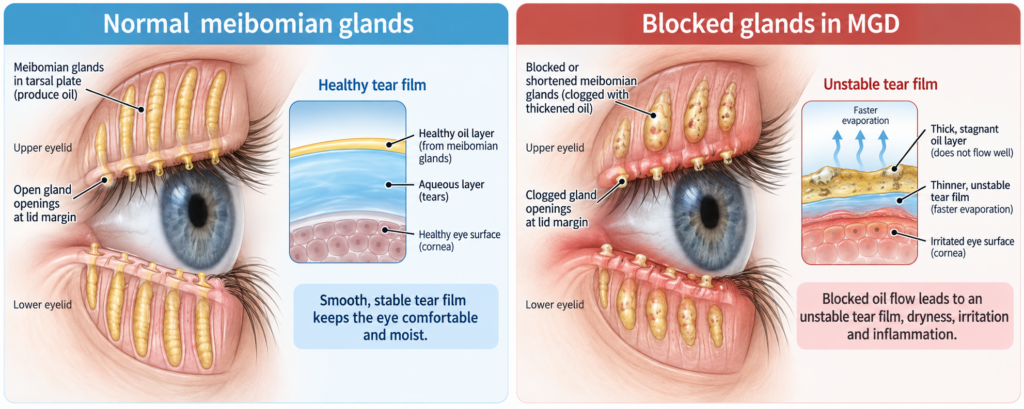
The second is evaporative dry eye. In this form, tears are present but disappear too quickly. The most common reason is meibomian gland dysfunction, often shortened to MGD. These glands sit along the eyelid margins and produce the oily layer of the tear film. When that oil becomes too thick, too little, or poor in quality, tears evaporate faster than they should.
In real life, many patients have features of both. That is why the best dry eye treatment depends on the driver behind the symptoms, not just the symptom itself.
What is meibomian gland dysfunction, and why does it matter so much?
MGD deserves special attention because it is one of the biggest reasons modern patients develop chronic dry eye. The meibomian glands are tiny oil glands in the eyelids. Their job is to release oil every time you blink. That oil keeps tears from evaporating too fast. If the glands get blocked or their oil becomes unhealthy, the tear film breaks down quickly.
This is why some people say, “My eyes feel worst on the computer,” or “Drops help for ten minutes and then the dryness comes back.” In evaporative dry eye, the problem is often not just lack of moisture. It is lack of oil-layer stability. That is also why warm compresses, lid hygiene, gland expression, and newer procedures can be very helpful in the right patient.
Common causes and risk factors
Dry eyes causes are often a mix of biology, environment, and habits. Risk goes up with age, and it is more common in women. Contact lens wear, some autoimmune diseases, thyroid disease, diabetes, and certain medicines can all play a role. Medicines linked with dry eye include some allergy medicines, antidepressants, and blood-pressure medicines.
Modern lifestyle matters too. Prolonged screen use reduces blinking and increases incomplete blinks. That leaves the tear film exposed for longer, especially in air-conditioned rooms. Reading, driving, and any task that keeps you visually fixed can do something similar. So yes, screen time dry eyes is real.
Wind, smoke, dry climates, ceiling fans, and direct air from car vents or office air conditioners can worsen symptoms. Previous eye surgery, eyelid problems, rosacea, blepharitis, and contact lens wear may also contribute.
Symptoms patients should not ignore
Dry eye does not always look dramatic. Some people have severe discomfort with only mild redness. Others have more surface damage than symptoms. Common complaints include dryness, burning, stinging, grittiness, light sensitivity, red eyes, fluctuating blur, tired eyes, stringy mucus, and excessive watering. Symptoms often get worse later in the day or during focused visual work.
If your contact lenses are becoming harder to tolerate, or your vision clears after a blink and then quickly becomes fuzzy again, dry eye should move high on the list of possibilities.
How we diagnose dry eye in clinic
A proper diagnosis starts with listening carefully. In ophthalmology, symptoms matter, but so does pattern. Are symptoms worse on screens? Outdoors in wind? First thing in the morning? With contact lenses? After refractive surgery? These details help us identify whether the main issue is low tear production, fast evaporation, eyelid inflammation, allergy overlap, or a mixed picture.
During the exam, we usually look at the eyelid margins, tear meniscus, corneal surface, and tear stability. Common tests include staining the ocular surface, measuring tear break-up time, checking tear production with a Schirmer test in selected cases, and assessing the meibomian glands. Modern dry eye workups may also include questionnaires, osmolarity, inflammatory markers, or meibography depending on the clinic.
The key point is this: not every patient with dry eye needs every test, but every patient with ongoing symptoms deserves an exam that looks beyond “just use some drops.”
Dry eye treatment: why there is no single “best” option
Patients often search for the best dry eye drops 2026 or the best eye drops for dry eyes 2026. The honest answer is that there is no single best drop for everyone. The right treatment depends on whether your main issue is aqueous deficiency, MGD, inflammation, screen-related evaporation, allergy, eyelid disease, or a combination.
For mild disease, artificial tears are usually the first step. They help lubricate the eye and improve comfort, but they do not automatically fix the underlying cause. Some are thin and watery, some are more gel-like, and some are designed to support the oil layer better in evaporative dry eye. If you need drops frequently, preservative-free options are often preferred because preservatives can irritate the ocular surface with repeated use.
This is also where patients ask about artificial tears vs eye drops. In simple language, artificial tears are lubricant eye drops. But not all eye drops are lubricant drops. Redness-relieving drops, especially decongestant “get the red out” products, may mask redness and can worsen rebound redness or irritation when overused. They are not the same as proper dry eye drops.
For nighttime symptoms, thicker gels or ointments can be useful because they stay longer on the eye. They may blur vision temporarily, so they are usually best used before sleep.
Home care that genuinely helps
When dry eye is driven by MGD or screen use, simple habits matter more than many people realize. Warm compresses can help soften thickened oils in the eyelids. Lid hygiene can reduce debris and inflammation at the lid margin. More complete blinking, especially during screen work, can improve the spread of tears and oil across the eye surface.
I usually advise patients to reduce direct airflow to the face, use regular screen breaks, remember to blink fully, and consider a room humidifier if the environment is dry. Contact lens wearers may need fewer wearing hours, a lens-material review, or a period out of lenses while the surface heals.
It is also worth saying that evidence for oral omega-3 supplements in dry eye is mixed. A large NEI-funded trial found fish-oil supplements were no better than placebo for relieving dry-eye signs and symptoms, so I would not present supplements as the main answer.
Prescription medicines and newer options
When lubricants and lifestyle measures are not enough, prescription treatment may be needed. Common options include anti-inflammatory drops such as cyclosporine or lifitegrast, and sometimes a short supervised course of steroid drops during a flare. Newer approved treatments in the United States also include varenicline nasal spray, perfluorohexyloctane, cyclosporine 0.1%, and acoltremon; availability varies by country and practice. The important point for patients is not memorizing drug names. It is understanding that modern therapy can now target tear stimulation, inflammation, or excess evaporation more specifically than before.
If your eye doctor believes your tears drain away too fast, punctal plugs may help keep tears on the eye longer. In more severe or stubborn disease, other options can include serum tears or scleral lenses, especially when the ocular surface needs stronger protection.
IPL for dry eye and other office-based procedures
For patients with meibomian gland dysfunction, office-based procedures can be very useful when home care alone is not enough. These may include manual gland expression, device-based eyelid heating, and thermal pulsation treatments. Evidence reviews suggest thermal pulsation can improve signs and symptoms in selected patients, though cost, durability, and suitability vary.
IPL for dry eye is another modern option, especially in MGD-linked evaporative dry eye and in some patients with rosacea-related eyelid disease. IPL is not a magic fix, and it is not appropriate for everyone, but current literature and recent dry-eye management reviews support it as a useful option in selected cases as part of a tailored treatment plan.
When should you see an eye doctor?
Please do not self-manage for months if symptoms are frequent or worsening. See an ophthalmologist if you are using drops regularly and still uncomfortable, if your vision fluctuates often, if you cannot tolerate contact lenses, or if your eyes are persistently red, painful, or light-sensitive. Dry eye can overlap with allergy, blepharitis, eyelid disease, infection, or autoimmune conditions, so persistent symptoms deserve a proper diagnosis.
Seek urgent care sooner if you have significant pain, sudden drop in vision, marked sensitivity to light, injury, or one very red eye. Those symptoms are not typical “routine dry eye” until proven otherwise.
The bottom line
Dry eye disease is common, but it is not trivial. It can affect comfort, reading, work, sleep, and quality of life. The most important message I want patients to remember is that dry eye is treatable, but the treatment must match the cause. A patient with blocked oil glands needs a different plan from a patient with low tear production. Someone whose symptoms are driven by screens may need blink training and environment changes, while someone with inflammatory disease may need prescription therapy. That is why a thoughtful exam matters so much.
If your eyes feel dry, gritty, tired, watery, or blurry on a regular basis, book a comprehensive dry eye evaluation with our ophthalmologist. The right diagnosis can turn a frustrating daily problem into a manageable one, and in many cases, a much more comfortable one.