
If you are planning cataract surgery, LASIK, retinal treatment, glaucoma surgery, corneal treatment, or another eye procedure in India, your health insurance may help, but only if you understand your policy clearly. Insurance for eye surgery depends on medical necessity, waiting periods, network hospitals, co-pay, sub-limits, and paperwork. Insurance coverage for cataract surgery is common, but not always from day one. Insurance for LASIK is often limited. Cashless insurance in India for eye surgery can reduce stress, but you still need to know what is covered and what you may have to pay yourself.
When you or a family member is advised an eye procedure, the first question is often not medical. It is financial. Patients commonly ask, “Will my insurance cover this?” That is a very reasonable question, but the answer is rarely a simple yes or no.
Insurance for eye surgery in India depends on several things working together. Your diagnosis matters. The exact procedure matters. Your waiting period matters. The hospital’s network status matters. Your policy wording matters. Even when a procedure is approved, your final bill may still include co-pay, deductibles, premium lens upgrades, or non-covered items.
This guide is written for patients and families. My aim is to help you understand how insurance works for common ophthalmology procedures such as cataract surgery, glaucoma surgery, retinal treatment, corneal procedures, eye trauma care, implants, and laser vision correction. I will keep the language simple and practical, just as I would explain it in the clinic.
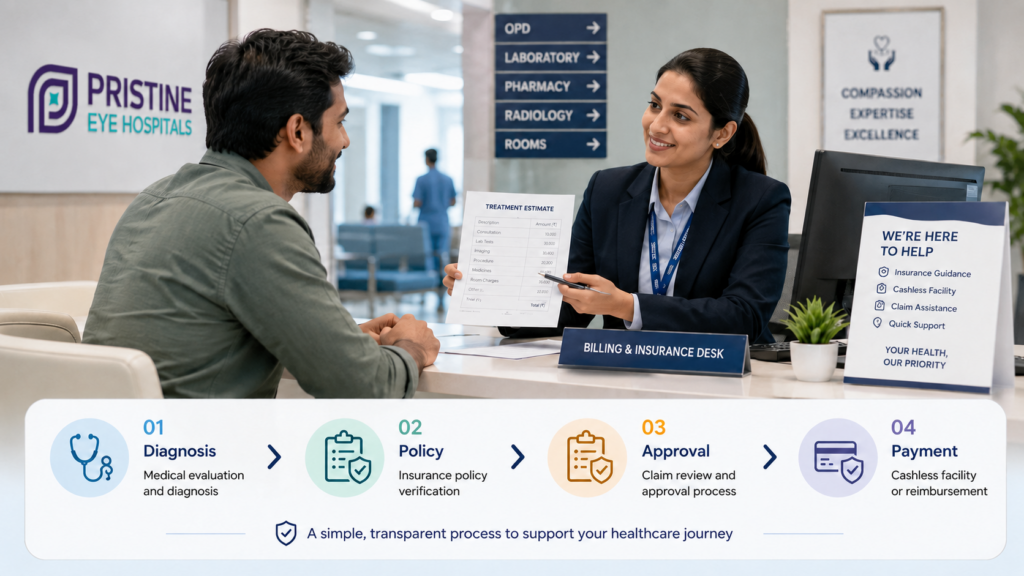
Image suggestion: A patient and hospital billing desk discussion with a simple overlay showing “Diagnosis, Policy, Approval, Payment.”
Why eye treatments create so much insurance confusion
Eye care is different from many other hospital treatments. Some eye procedures are clearly medically necessary. Others are considered elective. Some are done as day care procedures. Some need hospital admission. Some involve implants or premium technology that may increase your personal cost.
For patients, the confusion usually happens for three reasons:
- One eye procedure may be covered, while another may be excluded.
- A surgery may be covered, but only up to a package limit or sub-limit.
- Cashless approval may come through, but that does not always mean the full bill is covered.
This is why you should never assume that “eye surgery is covered” as a broad statement. The more useful question is: “Is my exact eye condition and my exact procedure covered under my policy, and how much will I still need to pay?”
Covered vs non-covered eye procedures
Many patients want a simple list. While no single list applies to every policy, there are common patterns that help.
| Procedures that are often covered | Procedures often not covered or partly covered |
|---|---|
| When medically necessary and when policy conditions are met: | These are commonly excluded or only covered in special situations: |
| 1. Cataract surgery 2. Glaucoma surgery 3. Retinal laser procedures 4. Vitrectomy and other retinal surgeries 5. Corneal transplant and other corneal procedures 6. Treatment for eye injuries or trauma 7. Some intravitreal injections or advanced retina treatments 8. Medically necessary squint surgery in selected cases | 1. Routine glasses 2. Contact lenses 3. Cosmetic or convenience-based vision correction 4. LASIK done only to reduce dependence on spectacles 5. Premium upgrades beyond standard coverage 6. Charges above package limits or sub-limits 7. Non-medical consumables or excluded billing items |
This is where patients must be especially careful with insurance coverage for cataract surgery and insurance for LASIK. Cataract surgery is commonly covered, but usually subject to waiting periods and sometimes sub-limits. Insurance for LASIK is much more restricted and often depends on whether the procedure is medically necessary rather than optional.
Insurance coverage for cataract surgery
Insurance coverage for cataract surgery is one of the biggest concerns for patients in India, especially older adults and their families. In many policies, cataract surgery is covered, but the details matter more than the headline.
Before you schedule surgery, check these points carefully:
- Has the waiting period for cataract been completed?
- Does your policy have a cataract-specific sub-limit?
- Is your chosen hospital part of the insurer’s network?
- Is your selected lens within the approved package?
- Does your policy have room-rent restrictions that may affect the bill?
- Are there any co-pay or deductible clauses?
Many patients are surprised when they hear that their cataract surgery is approved but not fully paid. This usually happens because the patient selected a premium lens, chose a higher room category, crossed the package rate, or had a sub-limit in the policy.
So when you ask about insurance coverage for cataract surgery, do not stop at “yes, it is covered.” Also ask, “How much is covered, under what conditions, and how much may I still need to pay?”
Insurance for LASIK
Insurance for LASIK needs a separate discussion because it is often misunderstood. Many younger patients assume that if they have health insurance, laser vision correction will be covered. In reality, that is not usually how standard policies work.
Most plans do not cover LASIK when it is done purely for convenience, lifestyle preference, or freedom from glasses. In some cases, insurance for LASIK may be available when the refractive problem is severe enough or when the surgery is medically necessary under specific policy conditions.
Before planning LASIK, ask these questions:
- Does my policy mention LASIK or refractive surgery at all?
- Is there a medical necessity requirement?
- Is there a minimum refractive power threshold?
- Does the insurer require pre-authorization?
- Will the hospital provide written confirmation before surgery?
Patients should never assume that insurance for LASIK will be available just because the procedure is done in a hospital. Always get written clarity in advance.
Cashless vs reimbursement claims
This is one of the most important things for patients to understand.
What is a cashless claim?
A cashless claim means the insurer directly pays the approved amount to the hospital, usually when treatment is taken at a network hospital.
What is a reimbursement claim?
A reimbursement claim means you pay the hospital first and then submit your documents to the insurer to claim the eligible amount later.
Why cashless is easier for patients
Cashless insurance in India for eye surgery is often smoother because:
- You do not have to arrange the full hospital amount upfront
- The hospital insurance desk usually helps with paperwork
- Approval and billing happen directly between hospital and insurer
- It reduces stress for elderly patients and their families
Why reimbursement still matters
Reimbursement may be necessary when:
- The hospital is not in the insurer’s network
- You had emergency treatment before approval could be arranged
- Cashless was denied but the claim may still be payable later
- You chose a hospital or package outside insurer arrangements
For many patients, cashless insurance in India for eye surgery is the preferred route. But you should still understand reimbursement, because even a planned surgery may shift to reimbursement if documents are incomplete or the chosen hospital is not empanelled.
Complete insurance claim process for eye treatment
Patients often think the claim process starts after surgery. Actually, it starts much earlier.
Cashless claim
- Visit your ophthalmologist and get the exact diagnosis and procedure advice.
- Ask the hospital insurance desk whether your hospital is in the insurer’s network.
- Share your insurance card, ID proof, and policy details.
- Confirm waiting periods, sub-limits, co-pay, and deductibles.
- Ensure the hospital submits pre-authorization to the insurer or TPA.
- Wait for initial approval, query, or clarification.
- Undergo surgery once medical and insurance clearance is complete.
- Before discharge, ask what amount is approved and what amount is payable by you.
- Collect discharge summary, final bill copy, prescriptions, and all important records.
Reimbursement claim
- Undergo treatment and pay the hospital bill.
- Collect the final bill, receipts, discharge summary, prescriptions, investigation reports, and procedure notes.
- Fill out the insurer’s claim form carefully.
- Attach all required documents, including bank details if needed.
- Submit the reimbursement claim within the insurer’s deadline.
- Track the claim and respond quickly if additional documents are requested.
- Keep scanned copies of every paper before submission.
Patients do best when they prepare before surgery, not after it.
Role of hospitals in insurance claims
Your hospital plays an important role, but it does not decide your policy benefits. That is important to understand.
A hospital insurance desk can usually help with:
- Checking whether your insurer is accepted for cashless treatment
- Sending pre-authorization requests
- Sharing estimates and medical records with the insurer
- Replying to insurer queries
- Helping explain the approved and non-approved parts of the bill
But the hospital cannot:
- Remove a waiting period from your policy
- Force approval for an excluded procedure
- Convert an elective procedure into a medically necessary one
- Override a cataract sub-limit or a LASIK exclusion
So always ask the hospital two separate questions:
- What is the total package cost?
- What amount is likely to be approved by insurance?
Those two numbers are often different.
Patient rights and responsibilities
Patients have rights. Patients also have responsibilities. A successful claim usually depends on both.
Rights as a patient
- Clear policy information
- Written explanation of coverage and exclusions
- Proper claim communication
- Reasons for rejection or deduction in writing
- Access to grievance redressal channels
- Access to the Insurance Ombudsman when needed
Responsibilities as a patient
- Read your policy and customer information sheet
- Declare your medical history honestly
- Never sign blank forms
- Fill proposal and claim forms carefully
- Keep copies of all medical and billing documents
- Inform the insurer correctly about the diagnosis and planned treatment
- Ask questions before admission, not only after discharge
Patients who understand both rights and responsibilities usually face fewer unpleasant surprises.
Importance of declaring medical history
This deserves special attention. A large number of claim disputes begin with incomplete or incorrect medical disclosure.
For eye treatment, the most important disclosures often include:
- Diabetes
- Hypertension
- Previous cataract surgery
- Glaucoma
- Retinal disease
- Previous LASIK or refractive surgery
- Eye trauma history
- Long-term steroid use
- Any known pre-existing eye disorder
Some patients think these details are not important because “this claim is only for the eye.” That is not true. In ophthalmology, diabetes may directly affect retinal treatment. Previous eye surgery may affect current care. Long-term steroid use may relate to glaucoma or cataract. If such facts were not properly declared earlier, the insurer may question the claim.
It is always safer to disclose fully from the beginning.
Common reasons for claim rejection
When patients hear “claim rejected,” they often think the insurer is simply refusing payment unfairly. Sometimes that may happen, but many rejections are linked to clear policy issues.
Common reasons include:
- Waiting period not completed
- Pre-existing disease not properly declared
- Procedure considered elective rather than medically necessary
- Missing documents in a reimbursement claim
- Hospital not in network for cashless treatment
- Charges beyond policy sub-limits
- Use of premium implant or premium lens not fully covered
- Excluded items in the bill
- Mismatch between diagnosis, documents, and final claim
- Late claim submission
This is why documentation matters so much. Even for a genuine eye condition, poor paperwork can weaken your claim.
Corporate vs personal health insurance
Many working patients depend fully on employer-provided insurance. That is understandable, but it has limitations.
Advantages of corporate insurance
- It is usually easier to access
- Premium is often partly or fully handled by the employer
- Cover may begin without as many barriers as an individual first-time plan
- It can be very useful for immediate protection
Limitations of corporate insurance
- It may end when you leave the job
- Benefits may change from year to year
- You may have less control over plan design
- Family coverage may be limited
- Long-term continuity may become a problem
Advantages of personal health insurance
- Better long-term continuity
- Greater control over policy selection
- Useful even if job changes
- Easier long-term planning for conditions such as cataract, glaucoma, or diabetic eye disease
For many families, the best approach is to use both when possible. Corporate cover helps today. Personal cover protects tomorrow.
Understanding co-pay, deductibles, and out-of-pocket expenses
These three ideas decide your final personal expense more than most patients realize.
Co-pay
A co-pay means you pay a fixed percentage or portion of the approved claim.
Deductible
A deductible means the initial part of the expense is borne by you before insurance starts paying.
Out-of-pocket expense
This means the real amount you still pay yourself, even when insurance is used.
Your out-of-pocket expense may include:
- Co-pay
- Deductible
- Charges above package limit
- Premium lens upgrade
- Non-covered consumables
- Excluded billing items
- Room upgrade related deductions
So even when you have cashless insurance in India for eye surgery, you may still receive a bill at discharge. Cashless does not always mean fully free.
Choosing the right health insurance policy for eye care
If eye care matters to you or your family, choose your policy with that in mind. Do not buy a plan only by looking at premium amount.
Check these points carefully before buying:
- Waiting period for cataract and other procedures
- Network hospitals near you
- Cataract sub-limits, if any
- Co-pay clauses
- Deductibles
- Day care procedure coverage
- Exclusions for refractive surgery
- Claim support and hospital network strength
- Renewability and continuity
- Whether elderly parents are well supported under the plan
A good policy for ophthalmic needs is not just one with a high sum insured. It is one that works well at the time of an actual eye claim.
Image suggestion: A checklist graphic titled “How to choose the right eye-surgery insurance policy.”
Health insurance myths vs facts
Patients often make decisions based on half-truths. Let us clear up a few common myths.
Myth 1: Every eye surgery is cosmetic
Fact: Many eye surgeries are medically necessary, including cataract, retinal, glaucoma, trauma, and corneal procedures.
Myth 2: Insurance coverage for cataract surgery means I will pay nothing
Fact: You may still pay for co-pay, sub-limits, premium lenses, or excluded charges.
Myth 3: Insurance for LASIK is always available
Fact: In most cases, it is not routinely covered unless your policy allows it under specific medical conditions.
Myth 4: Cashless approval means the claim is fully settled
Fact: Cashless approval usually covers only the approved eligible part of the bill.
Myth 5: Employer insurance is enough for life
Fact: Job changes can end or change your cover, which is why personal health insurance is important.
Legal rights, grievance redressal, and Ombudsman
If your eye claim is denied, delayed, or partly paid, do not stop at an oral explanation. Patients should ask for written reasons.
Follow this escalation path:
- First, speak to the hospital insurance desk and understand the exact issue.
- Then contact the insurer or TPA customer support.
- File a written grievance with the insurer if the matter remains unresolved.
- Keep all email records, claim copies, and denial letters.
- If needed, escalate through the insurer’s grievance system and official complaint platform.
- If the issue still remains unresolved, approach the Insurance Ombudsman as applicable.
This matters especially for patients facing major bills for cataract surgery, retina procedures, implants, or medically necessary advanced eye care.
Frequently Asked Questions
1. Is insurance for eye surgery available in India?
Yes, many medically necessary eye procedures are covered under health insurance, but coverage depends on your policy wording, waiting period, exclusions, and hospital network status.
2. Is insurance coverage for cataract surgery common?
Yes, insurance coverage for cataract surgery is common in many health plans, but patients must still check waiting periods, cataract limits, and package rules.
3. Is insurance for LASIK available?
Insurance for LASIK is usually limited. In most cases, standard policies do not cover LASIK when it is done purely for convenience. Some policies may allow it when medically necessary.
4. What is better for patients: cashless or reimbursement?
Cashless is usually easier because the hospital and insurer settle the approved amount directly. Reimbursement is useful when cashless is not available, but it requires stronger paperwork.
5. Can I still have out-of-pocket expenses after approval?
Yes. You may still have to pay co-pay, deductibles, premium lens charges, excluded items, or amounts above the insurer’s allowed rate.
6. What should I ask my insurer before cataract surgery?
Ask these six things:
1. Is the waiting period over?
2. Is there a cataract sub-limit?
3. Is the hospital in network?
4. Is my chosen lens fully covered?
5. How much is likely to be approved?
6. How much may I need to pay personally?
Glossary of insurance terms
- Cashless claim: The insurer directly pays the approved amount to the network hospital.
- Reimbursement claim: You pay first and later claim the eligible amount from the insurer.
- Network hospital: A hospital linked to your insurer for cashless treatment.
- TPA: A Third Party Administrator that helps manage claims and policy servicing.
- Co-pay: The part of the claim amount that you must pay.
- Deductible: The amount you must bear before insurance starts paying.
- Sub-limit: A treatment-specific cap within the overall sum insured.
- Waiting period: A time period during which certain diseases or procedures are not yet covered.
- Sum insured: The maximum amount your policy can pay, subject to terms and conditions.
- Out-of-pocket expense: The amount you still pay yourself after insurance settlement.
Important Insurance checklists
1. Eye surgery insurance checklist before admission
- Check your policy number and insurer contact details.
- Confirm whether the hospital is in the insurer’s network.
- Ask the ophthalmologist for the exact procedure name.
- Check waiting period status.
- Check cataract or procedure-specific sub-limits.
- Ask about co-pay and deductible.
- Ask whether your implant or lens choice is fully covered.
- Ensure pre-authorization is submitted.
- Keep your ID proof and insurance card ready.
- Estimate your likely out-of-pocket expense.
2. Reimbursement claim checklist after discharge
- Final claim form
- Discharge summary
- Doctor’s prescription
- Investigation reports
- Final hospital bill
- Payment receipt
- Pharmacy bills
- Implant or lens details where relevant
- Bank details for reimbursement
- Copies of all submitted documents
3. Questions to ask the hospital insurance desk
- How much of this package is likely to be approved?
- Is the chosen lens or implant fully covered?
- What items are commonly not covered?
- Is cashless approved or still under process?
- What is the likely personal payable amount?
- If approval is partial, what is the written reason?
When you should not delay treatment
There are times when vision matters more than insurance formalities. If you have sudden loss of vision, severe eye injury, retinal detachment symptoms, acute glaucoma symptoms, severe infection, or another emergency, do not delay treatment while waiting endlessly for paperwork. Save vision first. Then organize the documents properly.
Final advice for patients
As your ophthalmologist, my practical advice is simple. Do not think of insurance only as a finance issue. Think of it as part of your treatment planning. When patients understand their policy before surgery, treatment becomes smoother, decisions become calmer, and families feel less stressed.
If you are planning cataract surgery, LASIK, glaucoma surgery, retinal treatment, corneal treatment, or another eye procedure, ask early, document everything, and get written clarity. That one step can save you both money and anxiety.
If you have been advised an eye procedure, book a consultation with our ophthalmology team and speak to our insurance help desk before your treatment date. A clear plan before surgery is always better than confusion after discharge.
References
- IRDAI policyholder guidance on health insurance and claims
- IRDAI guidance on buying health insurance, portability, and patient responsibilities
- Council for Insurance Ombudsmen guidance for grievance redressal
- American Academy of Ophthalmology patient education on cataract surgery
- American Academy of Ophthalmology patient education on LASIK and refractive surgery