
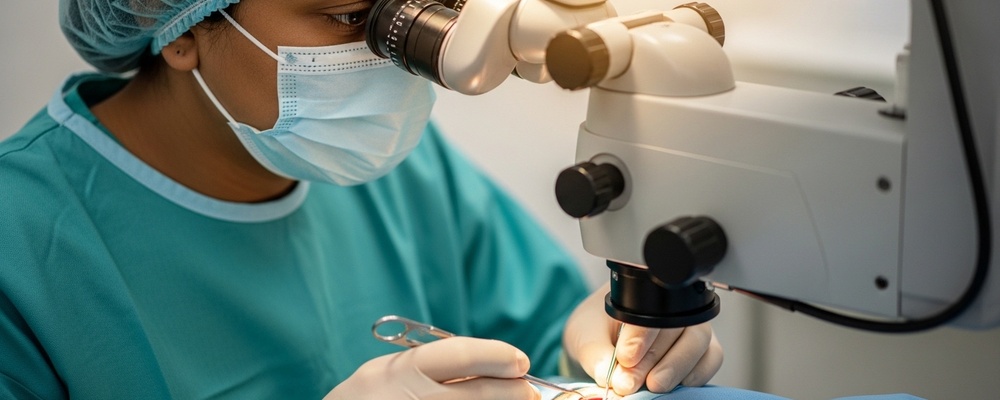
Epiretinal Membrane (ERM) Peeling / Internal Limiting Membrane (ILM) Peeling in Hyderabad: Cost, Procedure & Recovery
Epiretinal Membrane (ERM) Peeling, often combined with Internal Limiting Membrane (ILM) Peeling, is a delicate eye surgery designed to restore clear vision by removing a thin, scar-like tissue that forms on the retina. This precise procedure helps flatten the retina, which can become wrinkled or distorted, significantly improving your sight and reducing visual disturbances. It’s a vital intervention aimed at preserving and enhancing your precious vision.
QUICK FACTS
- Procedure Duration: 30-90 minutes
- Anesthesia Type: Local anesthesia with sedation
- Recovery Time: Several weeks for vision to stabilize
- Hospital Stay: Daycare / No overnight admission required
UNDERSTANDING THE BASICS
What is Epiretinal Membrane (ERM) Peeling / Internal Limiting Membrane (ILM) Peeling?
Your eye contains a light-sensitive layer at the back called the retina, much like the film in a camera. The central part of the retina, called the macula, is responsible for your sharp, detailed central vision, allowing you to read, recognize faces, and see colors clearly. Sometimes, a very thin, transparent layer of scar tissue, known as an Epiretinal Membrane (ERM), can form on the surface of the macula. Think of it like a piece of crinkled cellophane or cling film that has stuck to the surface of your camera’s film. This “crinkle” pulls and distorts the macula, causing blurry or wavy vision.
Epiretinal Membrane (ERM) Peeling is a specialized Incisional Vitreoretinal Surgery where your surgeon carefully removes this delicate scar tissue from the macula. In many cases, an additional step called Internal Limiting Membrane (ILM) Peeling is performed. The ILM is the innermost, ultra-thin layer of the retina itself. Peeling this layer helps prevent the ERM from growing back and further smooths the retinal surface. The goal of this Vitreoretinal Procedure is to release the tension on the macula, allowing it to flatten out and restore clearer, undistorted vision.
CONDITIONS AND SYMPTOMS
Why is Epiretinal Membrane (ERM) Peeling / Internal Limiting Membrane (ILM) Peeling performed?
This surgery is performed to correct visual problems caused by the formation of an epiretinal membrane.
Eye Conditions Treated
- Epiretinal Membrane (Macular Pucker): The primary condition, where scar tissue forms on the macula, distorting vision.
- Vitreomacular Traction (VMT): When the vitreous gel pulls on the macula, sometimes in conjunction with an ERM.
- Certain types of Macular Edema: Swelling of the macula that can be exacerbated by or associated with an ERM.
Symptoms You Might Be Experiencing
- Blurred or distorted central vision: Straight lines may appear wavy or bent.
- Difficulty reading fine print: Words might seem jumbled or unclear.
- Objects appearing smaller or larger: A noticeable change in the perceived size of things.
- Double vision in the affected eye: Seeing two images with one eye.
- A gray or cloudy area in your central vision: A patch of vision that seems obscured.
SURGICAL JOURNEY STEP-BY-STEP
How is the Epiretinal Membrane (ERM) Peeling / Internal Limiting Membrane (ILM) Peeling Procedure Performed?
1. How to Prepare Before the Procedure
Before your surgery, your medical team will guide you through several important steps to ensure the best outcome:
- Medical Clearance: You’ll undergo a thorough medical evaluation, including blood tests and an ECG, to ensure you are fit for surgery.
- Eye Examination: Detailed diagnostic checks, such as Optical Coherence Tomography (OCT) scans and visual acuity tests, will be performed to map your retina and assess your vision.
- Medication Review: Discuss all your current medications with your doctor. You may be advised to temporarily stop blood thinners or certain eye drops.
- Fasting Instructions: You will typically be asked to fast (no food or drink) for several hours before the procedure.
- Arrange Transport: Since your vision will be blurry after surgery, arrange for someone to drive you home.
2. What Happens During the Procedure?
The Epiretinal Membrane Peeling is a meticulous Incisional Vitreoretinal Surgery performed in a sterile operating room.
- Anesthesia: You will receive local anesthesia, often combined with a mild sedative, to ensure you are comfortable and feel no pain during the surgery. Your eye will be completely numb.
- Preparation: Your eye area will be cleaned, and sterile drapes will be placed around your face, exposing only the eye to be operated on. An eyelid holder will gently keep your eye open.
- Vitrectomy: The surgeon makes tiny incisions (less than 1mm) in the white part of your eye (sclera). Through these tiny openings, specialized micro-instruments are inserted. The vitreous gel, a clear jelly-like substance that fills the center of your eye, is carefully removed.
- Membrane Peeling: Using extremely fine forceps and under high magnification, the surgeon delicately grasps and peels away the epiretinal membrane from the surface of your macula. If ILM peeling is also required, a special dye might be used to make the ILM more visible before it is gently removed.
- Fluid/Gas/Oil Fill: After the membrane is removed, the eye is usually filled with a saline solution, a gas bubble, or silicone oil to help the retina stay in place and heal properly.
- Closure: The tiny incisions are usually self-sealing and may not require stitches.
3. What to Expect Immediately After the Procedure
- Recovery Lounge: After the surgery, you will rest in a recovery area while the effects of the sedation wear off.
- Eye Protection: Your eye will likely be covered with a protective patch and shield to prevent accidental rubbing and protect it from light and dust.
- Initial Vision: Your vision will be blurry due to the anesthesia, eye drops, and any gas or oil placed in your eye. This is normal.
- Mild Discomfort: You might experience some mild discomfort, grittiness, or a foreign body sensation, which can be managed with prescribed pain relievers.
- Discharge: Once your medical team determines you are stable, you will be discharged with detailed instructions for post-operative care, including eye drops and activity restrictions.
POST-OPERATIVE CARE AND TIMELINE
Recovery and Post-Operative Care
Following your Epiretinal Membrane Peeling, diligent post-operative care is crucial for optimal healing and visual recovery.
Do’s:
- Use Eye Drops: Administer all prescribed eye drops exactly as instructed to prevent infection and reduce inflammation.
- Wear Protection: Keep your protective eye shield on, especially while sleeping, for the recommended period.
- Rest: Allow your eyes and body ample rest. Avoid straining your eyes.
- Follow Positioning Instructions: If a gas bubble was placed in your eye, you might need to maintain a specific head position (e.g., face down) for several days. Follow these instructions strictly.
- Attend Follow-ups: Keep all scheduled follow-up appointments with your ophthalmologist to monitor your healing progress.
Don’ts:
- Rub or Press Your Eye: Avoid touching, rubbing, or applying any pressure to your operated eye.
- Lift Heavy Objects/Strenuous Activity: Refrain from heavy lifting, bending over, or engaging in strenuous physical activities that could increase eye pressure.
- Swim or Use Hot Tubs: Avoid swimming or exposing your eye to dirty water to prevent infection.
- Wear Eye Makeup: Do not apply eye makeup until cleared by your doctor.
- Fly (if gas bubble present): If a gas bubble was used, you cannot fly or travel to high altitudes until it dissipates, as changes in air pressure can cause complications.
Recovery Timeline:
- Day 1: Your vision will be very blurry, and you may experience mild discomfort. The eye patch will be in place. Your first follow-up appointment is usually on this day.
- Week 1: Vision will gradually start to improve, though it will still be blurry. You’ll continue with eye drops. Most discomfort should subside. You can resume light activities but avoid anything strenuous.
- Month 1: Significant visual improvement should be noticeable, though your final vision may still be developing. You’ll continue with follow-up visits, and your doctor will advise on resuming more activities. Full visual recovery can take several months as the retina completely settles and heals.
COST AND INSURANCE COVERAGE IN HYDERABAD
Cost of Epiretinal Membrane (ERM) Peeling / Internal Limiting Membrane (ILM) Peeling in Hyderabad & Insurance Options
- Estimated Local Investment: ₹90000 – ₹175000
- Cost Determinants: The final cost for Epiretinal Membrane (ERM) Peeling / Internal Limiting Membrane (ILM) Peeling can vary based on several factors:
- Surgeon’s Experience and Reputation: Highly experienced vitreoretinal surgeons may charge higher consultation and surgical fees.
- Hospital Facility: The choice between a basic eye clinic and a premium, state-of-the-art hospital with advanced technology can influence the overall cost.
- Complexity of the Case: More complex cases, such as those with significant retinal distortion or requiring additional procedures (e.g., combined with cataract surgery), may incur higher costs.
- Anesthesia Type: While local anesthesia is standard, specific sedation requirements can affect the cost.
- Post-operative Care and Medications: The cost of prescribed eye drops, follow-up consultations, and any necessary additional treatments are part of the overall expense.
- Insurance Protocol: Epiretinal Membrane (ERM) Peeling / Internal Limiting Membrane (ILM) Peeling is considered a therapeutic ‘Medical Necessity’ as it addresses a condition that impairs vision and can lead to permanent vision loss if untreated. Therefore, it is generally covered by most major health insurance providers and Third-Party Administrator (TPA) networks in India. It is crucial to check with your specific insurance provider regarding your policy’s terms, coverage limits, and the pre-authorization process well in advance of your scheduled surgery. Corporate policies may also offer coverage, but verification is always recommended.
FREQUENTLY ASKED QUESTIONS
Frequently Asked Questions About Epiretinal Membrane (ERM) Peeling / Internal Limiting Membrane (ILM) Peeling
Q: Is Epiretinal Membrane (ERM) Peeling a painful procedure?
A: No, the procedure is performed under local anesthesia with sedation, ensuring you remain comfortable and feel no pain during the surgery.
Q: How long does it take for my vision to improve after ERM/ILM peeling?
A: Initial vision improvement can be noticed within a few weeks, but your vision will continue to stabilize and improve gradually over several months as the retina heals completely.
Q: What are the risks associated with this surgery?
A: Like any surgery, there are potential risks, though rare, including infection, bleeding, retinal detachment, or increased eye pressure. Your surgeon will discuss these thoroughly.
Q: Can the epiretinal membrane grow back after peeling?
A: While rare, there is a small chance of recurrence. Performing Internal Limiting Membrane (ILM) peeling significantly reduces the likelihood of the membrane growing back.
DISCLAIMER
Disclaimer: This content is curated using artificial intelligence and may contain inaccuracies. It is provided for informational and educational purposes only and should not be considered professional medical advice. Please consult your ophthalmologist for personalized clinical care. The prices listed in this article are indicative only and may vary based on the patient’s specific condition, procedural techniques, surgical complexity, and materials used. We strongly advise discussing actual costs directly with your healthcare provider.