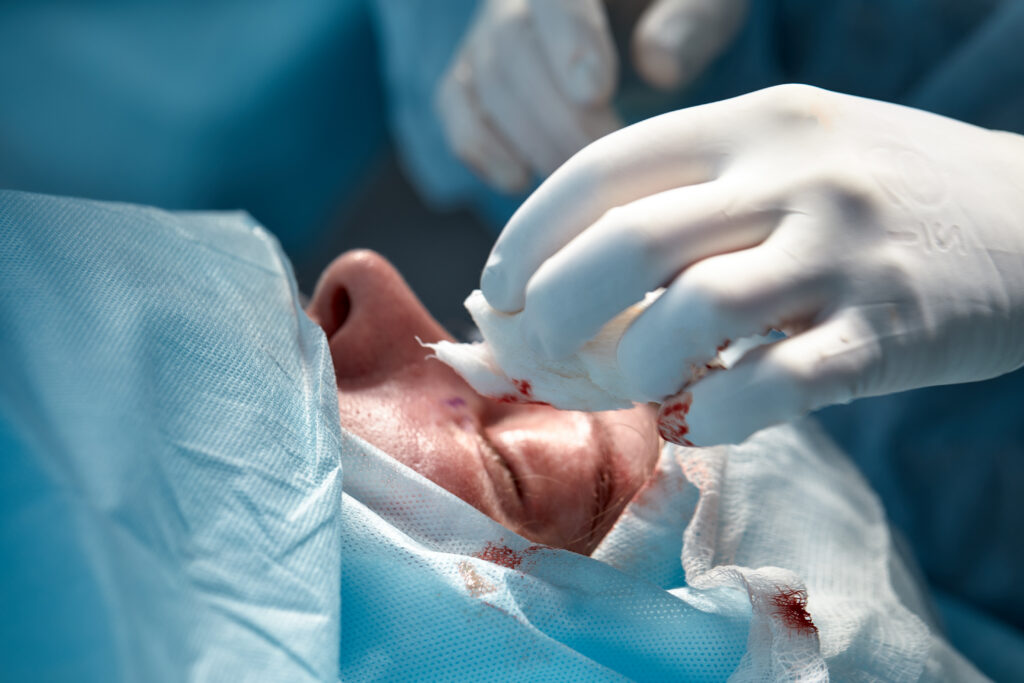
If your “genetic eye bags” are mainly a hollow groove under the eye, under-eye filler may help. If they are true bulges caused by lower-lid fat pushing forward, lower blepharoplasty usually fits better because it treats the actual structure, not just camouflages it. Fat grafting is a third option for selected patients with volume loss, but it is not the same as filler and it does not replace surgery when there is obvious bagginess. The right choice depends less on trend and more on whether your problem is a hollow, a bulge, or both. (Cleveland Clinic)
Lower Blepharoplasty vs Under-Eye Fillers in India: Which One Actually Fits Genetic Eye Bags?
If you spend any time on Indian skincare, aesthetic medicine, or plastic surgery forums, you will notice the same argument repeating again and again. Someone posts a photo of their under-eyes. One person says, “Just get tear trough filler.” Another says, “No, you need fat grafting.” A third says, “This needs lower bleph.” The reason for the confusion is simple: these three treatments are not treating the same problem.
That is the most important thing to understand before spending money, taking time off work, or putting anything near the lower eyelid. Under-eye filler adds volume. Fat grafting also adds volume, but using your own fat. Lower blepharoplasty is surgery that can remove or reposition fat and address excess lower-lid skin or laxity. So the question is not which option is “best” in general. The real question is: what exactly is causing your under-eye concern? (Cleveland Clinic)
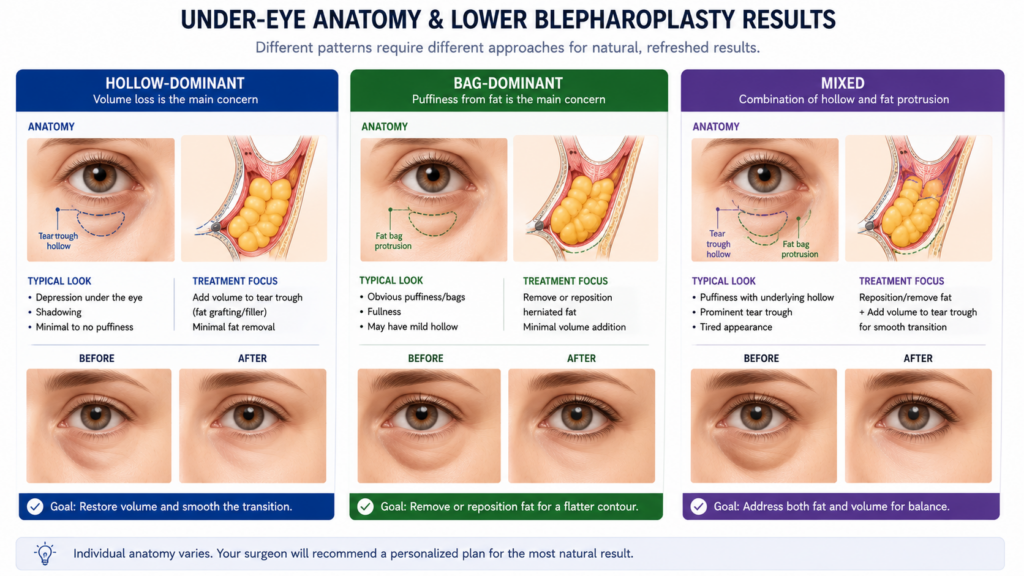
For many young Indian patients, the phrase “genetic eye bags” is accurate in one sense and misleading in another. Yes, family traits do matter. The appearance of the eyelids can run in families, and the tear trough region is also influenced by anatomy and genetics. But what patients call a “bag” may actually be one of three different things: a hollow, a bulge, or a combination of both. That distinction is what decides whether filler makes sense or whether surgery is the more honest solution. (Guy’s and St Thomas’ NHS Trust)
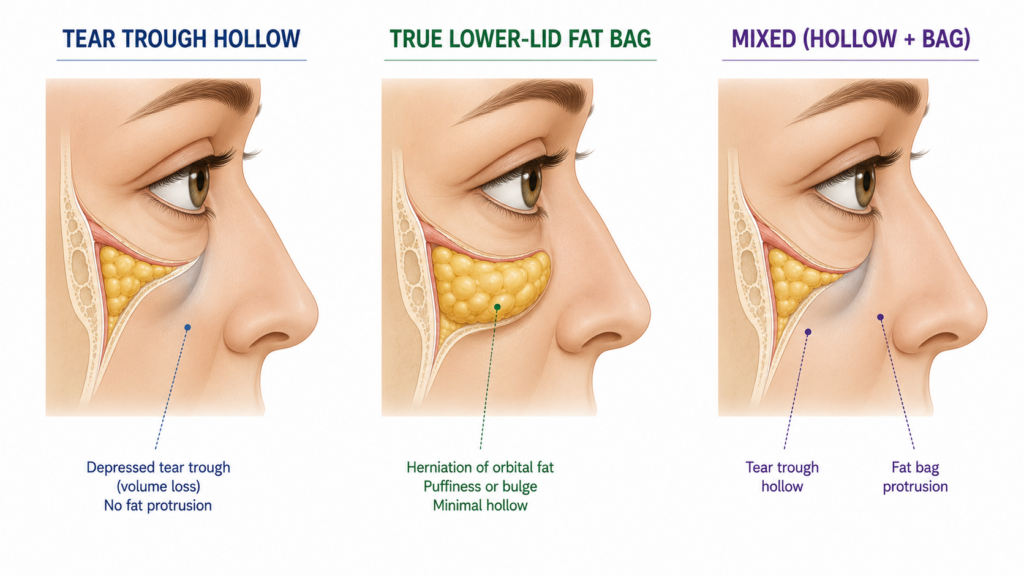
What people often call “eye bags” are not all the same
A true lower-lid bag usually happens when the tissues around the eye weaken and fat that normally supports the eye becomes more visible in the lower lid. Mayo Clinic describes under-eye bags as mild swelling or puffiness that becomes more common with age as tissues weaken and fat moves into the lower eyelids; fluid can also collect there. Blepharoplasty is one option because it can remove or reposition excess fat and tissue. (Mayo Clinic)
A tear trough is different. It is the hollow or groove starting near the inner corner of the eye and running outward. When this groove is deep, the person looks tired even if they are sleeping well. This hollow can be related to genetics, age-related volume loss, and the way the lid-cheek junction is built. A filler or fat transfer can help here because the core problem is lack of volume, not excess bulging fat. (American Academy of Ophthalmology)
Many patients, especially younger adults, actually have a mixed picture: a small inherited bag sitting just above a hollow. This is where online advice becomes messy. A little filler may soften the contrast between the bulge and the hollow, so the eye area looks smoother. But if the bag itself is structurally prominent, filler cannot remove it. It can only try to disguise it. That is why some people love their result and others feel they look even puffier. (Cleveland Clinic)
What under-eye fillers actually do
Under-eye fillers are usually hyaluronic acid gels placed in carefully selected patients to restore volume under the eye. Cleveland Clinic notes that this is a less invasive and less time-consuming option than surgery, and the procedure itself is relatively quick. Patients usually see fullness immediately, with the final effect settling over about two weeks. In some patients, results last around one to two years, though this varies. (Cleveland Clinic)
This is why fillers remain popular in India. They are fast, office-based, and they appeal to people who want little downtime. For the right anatomy, they can be very effective. If the under-eye is mostly sunken, if the skin quality is decent, and if there is not much true bagginess, a conservative filler treatment can make the lid-cheek transition look softer and less tired. (Cleveland Clinic)
But fillers have limits, and the lower eyelid is not a forgiving area. Moorfields Eye Hospital highlights common problems such as bluish discoloration from superficial placement, called the Tyndall effect, and persistent puffiness or malar oedema related to lymphatic issues. Cleveland Clinic also warns that not everyone is a good candidate and that some people can look puffier after treatment. (moorfields.nhs.uk)
This is the point many patients miss: filler is best thought of as a camouflage tool for a hollow, not a true debulking treatment for a bag. If your main issue is fat protruding forward, adding more volume underneath can sometimes blur the contour a little, but it can also make the whole lower lid-cheek area look heavier. In other words, it may soften the problem without solving it. That is often disappointing in people with obvious “genetic bags.” This is an inference based on how filler adds volume and how blepharoplasty treats protruding fat. (Cleveland Clinic)
Safety also matters. Rare but serious vascular complications, including vision loss, have been reported with periocular fillers. Cleveland Clinic advises choosing a licensed dermatologist, plastic surgeon, or oculoplastic surgeon rather than a med-spa type setting, and Moorfields describes vision loss as a rare but devastating risk if filler enters a vessel that supplies the eye. (Cleveland Clinic)
What lower blepharoplasty actually does
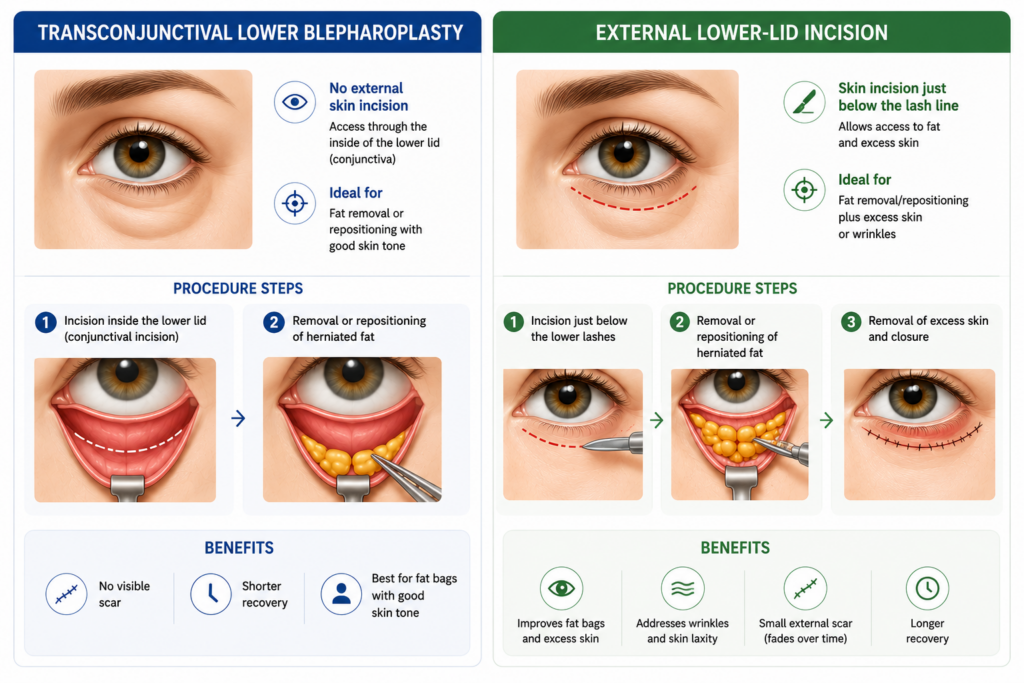
Lower blepharoplasty is not simply “skin cutting.” It is a procedure designed to improve lower-lid bagginess by addressing skin, muscle, and fat based on your anatomy. Cleveland Clinic describes lower blepharoplasty as surgery that reduces bagginess from the lower eyelids, and Mayo Clinic notes that blepharoplasty can be tailored to a patient’s unique anatomy and may involve removing excess fat through an incision inside the lower lid or trimming skin and tissue through an external incision. (Cleveland Clinic)
This is why lower blepharoplasty often fits true genetic eye bags better than filler. If the problem is prominent lower-lid fat pads, surgery can directly remove or reposition that fat. If there is loose skin as well, surgery can address that too. Filler cannot do either of those things. It does not tighten skin. It does not pull back bulging fat. It does not change lower-lid support. (Cleveland Clinic)
In some patients, especially younger people with puffiness but not much excess skin, surgeons may use a transconjunctival approach, which hides the incision inside the eyelid. In others with skin excess, an external incision just under the lash line may be used. That choice depends on the skin, fat, lid tone, and overall facial structure. (Cleveland Clinic)
The trade-off is that surgery is still surgery. Recovery is longer than filler. Swelling and bruising are common. Cleveland Clinic notes that people often need several days off and usually feel more comfortable being seen in public after about 10 to 14 days, although full healing takes longer. NHS sources also list temporary bruising, swelling, watery or irritated eyes, and rare complications such as ectropion, bleeding into the eye socket, and visual problems. (Cleveland Clinic)
That said, lower blepharoplasty has one big advantage for the right patient: it treats the structure causing the bag. Lower eyelid surgery also tends to be long-lasting. Cleveland Clinic states that lower eyelid blepharoplasty rarely needs to be repeated more than once. So while recovery is more involved, the result can be more definitive when compared with repeated filler sessions trying to hide the same bulge year after year. (Cleveland Clinic)
Where fat grafting fits in this discussion
Fat grafting is often thrown into these conversations as if it were just a “natural filler.” That is partly true, but only partly. Cleveland Clinic explains that under-eye fat transfer uses fat from your own body to fill sunken, hollowed areas beneath the eyes. It can feel softer, there is no allergy risk to a lab-made filler, and results may be long-lasting or even effectively permanent in some patients. (Cleveland Clinic)
But fat grafting is more involved than standard filler because fat must first be harvested, usually by liposuction. Recovery is longer, swelling can last months while the graft settles, and side effects can include bruising, infection, lumps, cysts, swelling, and scarring. It is also still a volume-adding treatment. So while fat grafting may be a good option for selected patients with hollowing, it is not the ideal answer for a patient whose main complaint is a strong inherited bulge under the eye. (Cleveland Clinic)
In practical terms, fat grafting sits between filler and surgery in complexity, but not necessarily in purpose. It behaves more like a volume restoration treatment than a bag-removal treatment. So if your eye area looks sunken, it may be relevant. If your eye area looks puffy and protruding, it usually does not replace a proper lower-lid surgical assessment. (Cleveland Clinic)
So which one usually fits genetic eye bags better?
For a true inherited lower-lid bag, lower blepharoplasty usually fits better.
That is the clearest answer I can give as a doctor. If the lower lid is bulging because the fat pads are prominent, surgery addresses the actual reason you look puffy. Filler may still have a role in a carefully selected mixed case, but it is not the most logical first-line treatment for a clearly protruding bag. (Cleveland Clinic)
For a true tear trough hollow without much bagginess, under-eye filler may fit better.
That patient usually says, “I look tired,” rather than, “I look puffy.” Their problem is a depression, not a bulge. In that situation, adding volume can work very nicely when done conservatively by an experienced doctor. (Cleveland Clinic)
For the mixed patient, the answer is more nuanced.
Some patients have a small bag plus a deep hollow. These patients are the ones most likely to get conflicting advice online. A tiny amount of filler may help if the bag is mild and the hollow is dominant. But once the bag becomes structurally obvious, especially in certain lighting and side angles, lower blepharoplasty with fat repositioning often gives a cleaner and more natural correction than trying to “chase” the contour with more filler. That is a clinical inference supported by the different mechanisms of the procedures. (Cleveland Clinic)
What this means for patients in India
In India, one major practical issue is that many patients first reach a skin clinic because filler sounds easier than surgery. That is understandable. But lower-lid anatomy is delicate, and the decision should not be made like a routine salon treatment. Cleveland Clinic specifically recommends choosing a licensed dermatologist, plastic surgeon, or oculoplastic surgeon for fillers in this region rather than a med-spa setting, and the same principle applies even more strongly when surgery is being considered. (Cleveland Clinic)
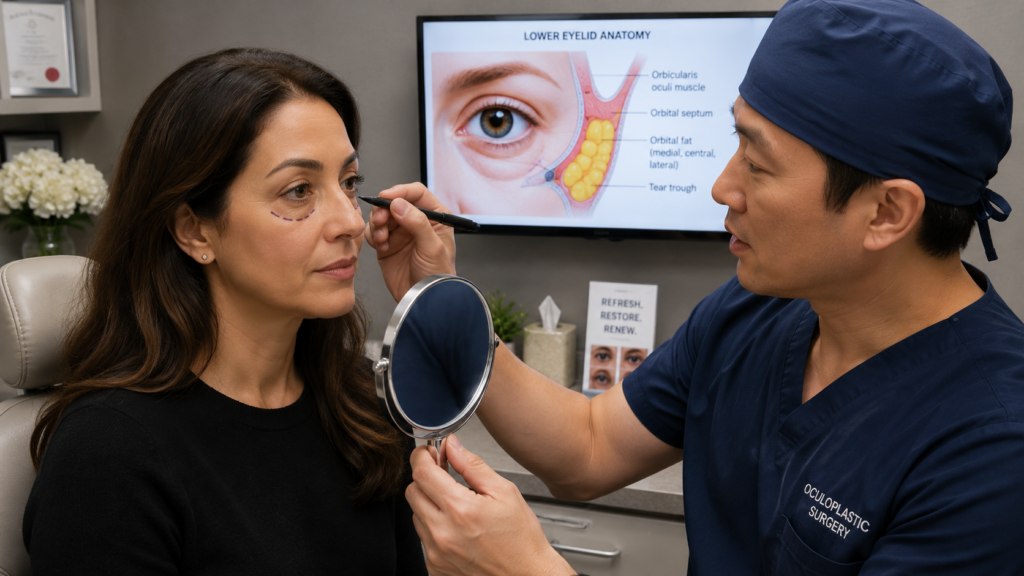
For Indian readers, I would strongly suggest a consultation with an oculoplastic ophthalmologist or a very experienced plastic surgeon who regularly treats the lower eyelid. Ask them to explain, using a mirror or photos, whether they see mainly hollowing, fat prolapse, skin laxity, or a mixed deformity. If the explanation is vague and the answer is immediately “just put filler,” be careful. Good treatment begins with naming the anatomy correctly. (Mayo Clinic)
A few consultation questions can be very helpful. Ask whether your problem is mainly a tear trough or a true bag. Ask whether a smile makes the puffiness worse. Ask whether there is skin excess. Ask what happens if filler is placed and later needs to be dissolved. And if surgery is recommended, ask whether the incision would likely be inside the lid or below the lash line and why. Those questions usually reveal whether the plan is thoughtful or generic. (Mayo Clinic)
A simple way to think about the choice
If you need volume, think filler or fat grafting.
If you need debulking or fat repositioning, think lower blepharoplasty.
If you need both, surgery may still be the foundation, with volume treatment added only when necessary.
That framework is not a slogan. It is the reason the same under-eye treatment can look beautiful on one patient and disappointing on another. (Cleveland Clinic)
When should you see a doctor?
Please seek a proper eye-area consultation if your under-eye appearance bothers you consistently, if you are considering repeated filler top-ups, if you already had filler and now have chronic puffiness or lumpiness, or if a previous procedure left you asymmetrical. After any filler treatment, urgent symptoms such as severe pain, vision changes, or sudden swelling need immediate medical attention. Cleveland Clinic and Moorfields both emphasize the importance of urgent review when vision symptoms occur. (Cleveland Clinic)
Final word
If your under-eye issue is truly a genetic hollow, filler may be enough. If it is truly a genetic bag, lower blepharoplasty usually makes more anatomical sense. And if it is both, the right answer comes from careful lower-lid assessment, not from whichever procedure is trending this month.
The best next step is not to choose a treatment from a comment thread. It is to book an evaluation with an oculoplastic ophthalmologist who can tell you, honestly, whether your under-eye problem needs volume, surgery, or a combination planned in the right order.
References
- Mayo Clinic, Blepharoplasty. (Mayo Clinic)
- Mayo Clinic, Bags under eyes: Diagnosis and treatment. (Mayo Clinic)
- Cleveland Clinic, Are Tear Trough Fillers Effective for Undereye Bags? (Cleveland Clinic)
- Cleveland Clinic, Under-Eye Fat Transfer. (Cleveland Clinic)
- Moorfields Eye Hospital, The 5 key risks of under-eye filler injections… and why surgery might be a better option. (moorfields.nhs.uk)