
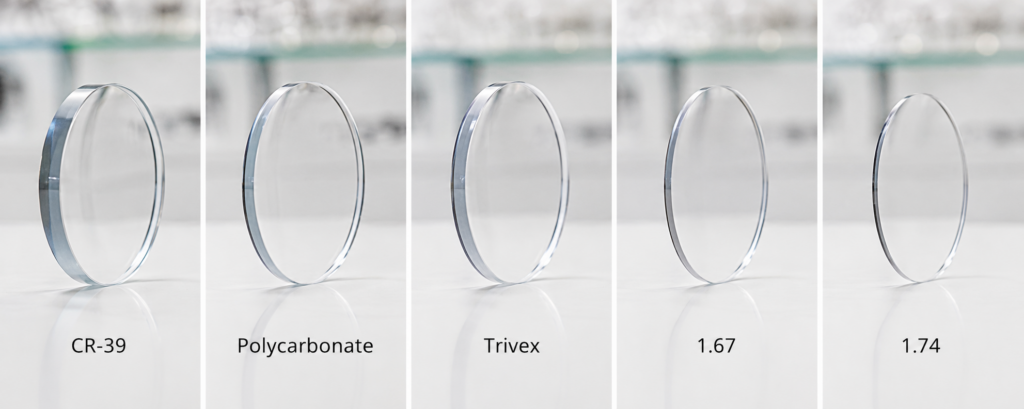
CR-39, polycarbonate, Trivex, and high-index lenses all correct vision well, but they are not equal in clarity, safety, thickness, or price. CR-39 is usually the clearest and cheapest, but thicker and less impact-resistant. Polycarbonate is thinner and very tough, so it suits children and active lifestyles. Trivex is a premium “best balance” option with strong impact resistance and better clarity than polycarbonate. High-index lenses are best for stronger prescriptions because they make glasses thinner and lighter, though they usually cost more and may show more color fringing.
Complete Guide to Eyeglass Lens Materials (CR-39, Polycarbonate, Trivex, High-Index)
When patients shop for glasses, they often focus on the frame first. That is natural. But in day-to-day use, the lens material often matters even more. The material influences how thick your lenses look, how heavy your glasses feel, how well they stand up to drops or sports, how much glare you notice, and how much you pay. In other words, two pairs of glasses with the same prescription can feel completely different simply because the lens material is different.
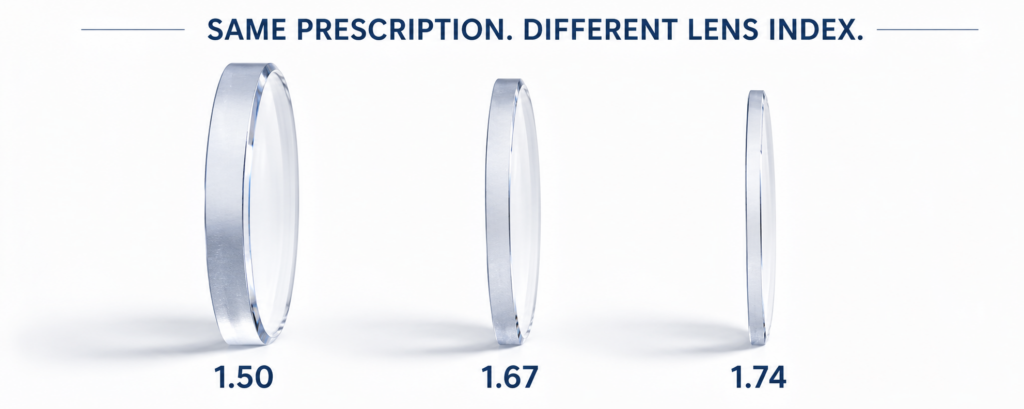
The four lens materials most people hear about are CR-39, polycarbonate, Trivex, and high-index plastic. High-index is really a family of thinner materials, usually starting around 1.60 and going up to 1.67 or 1.74. The higher the index, the more efficiently the lens bends light, which usually allows a thinner lens for the same prescription. That sounds simple, but the “thinnest” option is not automatically the “best” option for every patient.
As I explain to patients in clinic, there is no perfect lens material. Every option is a trade-off between four main things: optical clarity, impact resistance, thickness, and price. PPG’s Trivex material page says this very clearly: most lens materials require you to give up something to gain something else. That is why the right answer depends on your prescription, your lifestyle, your frame choice, and your budget.
What do “index” and “Abbe value” actually mean?
Before comparing materials, two terms are worth understanding. Refractive index tells us how efficiently a material bends light. A higher refractive index usually means a thinner lens. Abbe value tells us how much the material disperses light into colors. A higher Abbe value usually means less chromatic aberration, which patients may notice as color fringing or blur toward the lens edges. In plain language: higher index usually helps thinness, and higher Abbe usually helps optical purity.
That does not mean every person will notice Abbe differences strongly. HOYA’s technical comparison of polycarbonate and Trivex notes that lower Abbe values are often less troublesome in lower prescriptions, and that the area where chromatic aberration becomes significant is not always where patients normally look. Still, some people are very sensitive to edge blur or color fringing, especially in stronger prescriptions.
Quick comparison table
| Lens material | Typical refractive index | Approx. Abbe value | Impact resistance | Relative thickness | Relative price |
| CR-39 | 1.49 | 58 | Lower than polycarbonate/Trivex | Thickest of the common plastics | Lowest |
| Polycarbonate | 1.59 | 30 | Very high | Thinner than CR-39 and usually thinner than Trivex | Low to mid |
| Trivex | 1.53 | 43 | Very high | Thinner than CR-39, usually thicker than poly/high-index | Mid |
| High-index 1.67 | 1.67 | about 31 | Moderate | Very thin | High |
| High-index 1.74 | 1.74 | about 31 | Moderate | Thinnest | Highest |
For thickness, HOYA’s sample comparison at a -6.00 prescription showed an edge thickness of 11.1 mm for 1.50 plastic, 7.7 mm for 1.53 Phoenix/Trivex-type material, 5.7 mm for 1.67, and 5.4 mm for 1.74. Actual results vary with prescription, frame size, and measurements, so treat these as direction, not a guarantee. Abbe and index figures above come from manufacturer technical references.
CR-39 lens material: the classic budget choice
CR-39 has been the standard plastic lens material for decades. It remains popular for a good reason: it offers very good optical quality at a low cost. PPG describes CR-39 as a 1.5 index material that provides outstanding optical quality, low chromatic aberration compared with polycarbonate, and good durability. IOT lists its Abbe value at 58, which is excellent for a plastic lens.
For patients with low prescriptions, that is often enough to make CR-39 a smart choice. If your prescription is mild, your frame is full-rim, and your main goals are clarity and affordability, CR-39 is still hard to beat. It also has very good baseline abrasion resistance compared with other uncoated plastic materials and tints well, which is useful for sunglasses.
The drawbacks are just as important. CR-39 has a low refractive index, so lenses get thicker and heavier more quickly as the prescription rises. It is also less impact-resistant than polycarbonate and Trivex, and it is not ideal for rimless or semi-rimless frames because it can crack under drill stress. IOT also notes that CR-39 does not inherently provide the same level of built-in UV protection as modern materials like polycarbonate and Trivex, so coatings may matter more.
In practical terms, CR-39 is often best for simple everyday glasses in low prescriptions, especially when cost matters. It is not usually my first choice for children, sports eyewear, rimless frames, or stronger prescriptions.
Polycarbonate: the safety-first material
Polycarbonate became popular because it is strong, light, and naturally impact-resistant. AAO and AOA both steer active wearers toward polycarbonate or Trivex for protective uses, and the AAO notes that Trivex meets the same safety standards as polycarbonate. Polycarbonate also has built-in UV protection.
This is why polycarbonate is such a common recommendation for children, sports glasses, and safety eyewear. It is much tougher than CR-39 and less likely to crack or shatter with everyday mishaps. In the United States, spectacle lenses generally must comply with FDA impact-resistance requirements, but polycarbonate and Trivex still stand out as the materials most favored when extra real-world toughness is needed.
Polycarbonate also helps with thickness. Its refractive index is around 1.584 to 1.586, which is higher than CR-39 and Trivex, so it can make lenses thinner than both. That can be useful for moderate prescriptions and slimmer frames.
The main compromise is clarity. Polycarbonate’s Abbe value is about 30, which is much lower than CR-39 and lower than Trivex. IOT notes that this can lead to more chromatic aberration, halos, or edge blur in some wearers. Not everyone notices this, but patients who are picky about crisp vision sometimes do. Polycarbonate is also softer than CR-39, so scratch-resistant coatings are especially important.
So when patients ask me, “polycarbonate vs CR39 — which is better?” my answer is simple: polycarbonate is usually better for safety, durability, and thinner everyday wear; CR-39 is usually better for pure optical clarity and price in low prescriptions.
Trivex lenses: the best balance for many active adults
Trivex sits in a very interesting middle ground. It was developed to combine several strengths at once: high impact resistance, low weight, good optical quality, and good durability. PPG describes Trivex as a material that balances clear vision, lightweight comfort, strength, and protection. AAO also notes that Trivex meets the same safety standards as polycarbonate, while sometimes causing less distortion.
Its refractive index is lower than polycarbonate, around 1.53, so it is not quite as thin in stronger prescriptions. But its Abbe value is much better, around 43, which is a meaningful jump over polycarbonate’s 30. That is why many opticians see Trivex as the premium “clarity plus safety” option. It is also one of the lightest lens materials available, which can make glasses feel better on the face even when they are not the absolute thinnest.
Another major advantage is frame compatibility. PPG says Trivex is excellent for rimless or drill-mount frames because of its strength, durability, and stress-free characteristics. That is an important detail that many shoppers miss. A very thin lens is not always the most stable lens in a delicate frame. Sometimes a slightly thicker but tougher lens performs better in real life.
When patients ask, “which lens material is best?” Trivex is often the answer for someone with a low to moderate prescription who wants one pair of glasses that feels light, resists breakage, gives better clarity than polycarbonate, and works well in rimless or active-use frames. The downside is price: it typically costs more than CR-39 and polycarbonate.
High-index lenses: best for stronger prescriptions
High-index is less a single material and more a category of thinner plastics. The versions most shoppers hear about are 1.67 and 1.74. These materials are designed for patients whose prescriptions are strong enough that standard plastic or polycarbonate lenses would look bulky or feel heavy. HOYA describes 1.67 as a premium high-index material that is thin and lightweight, and 1.74 as its thinnest and most elegant option.
This is where high-index lenses shine. If you are quite nearsighted or farsighted, a high-index lens can make a big cosmetic and comfort difference. Eyebuydirect recommends 1.67 for roughly ±7.00 to ±9.00 sphere and 1.74 for ±9.25 and above, while also noting that the exact choice depends on prescription strength. That is not a medical rule, but it matches what many optical practices do in the real world.
The trade-off is optical purity and cost. HOYA’s lens material guide lists Abbe values around 31 for higher-index materials, much lower than CR-39 and lower than Trivex. That means some patients notice more color fringing off-center. High-index lenses also usually cost more, and anti-reflective coating is particularly helpful because higher-index materials reflect more light and can look glary without a good coating.
High-index lenses are therefore usually the best lens material for glasses when the prescription is strong and thinness is the top priority. But for a mild prescription, paying extra for 1.67 or 1.74 often gives very little practical benefit.
CR-39 vs polycarbonate vs Trivex: the honest patient answer
If your prescription is low and you want the clearest, cheapest everyday pair, CR-39 is still a very reasonable choice. If you have children, play sports, work in active environments, or just want maximum peace of mind, polycarbonate makes a lot of sense. If you want that same toughness but care more about crisp optics and lightweight comfort, Trivex is often the upgrade that feels worth it.
Put differently, CR-39 wins the clarity-and-value contest, polycarbonate wins the toughness-and-price contest, and Trivex wins the balance contest. High-index lenses sit in a different lane altogether: they win the thinness contest for stronger prescriptions.
What about price?
Price is where many online articles become misleading, because “lens price” depends on whether you are buying clear single-vision lenses, progressives, tinted lenses, Transitions, or a full frame-and-lens package. A more honest approach is to treat price as a tier rather than a promise.
Still, real examples are helpful. In sampled online pricing, Eyebuydirect lists standard 1.5 lenses starting at $0 with frames and its 1.59 polycarbonate lenses at $18.95. ReplaceALens lists clear single-vision replacement lenses at about $69 for CR-39, $69 for polycarbonate, $89 for Trivex, $129 for 1.67 high-index, and $260 for 1.74 high-index. Online Opticians UK lists 1.67 and 1.74 high-index add-ons at £49 and £99. The lesson is not the exact number. The lesson is the pattern: CR-39 is usually cheapest, polycarbonate stays affordable, Trivex costs more, 1.67 is premium, and 1.74 is usually the most expensive.
So which lens material is best?
For a low prescription and tight budget, CR-39 is often the best value. For children, sports, and safety use, polycarbonate or Trivex is usually the better choice. For an active adult who wants better clarity than polycarbonate without giving up durability, Trivex is often my favorite answer. For stronger prescriptions where thickness is the main issue, high-index 1.67 or 1.74 is usually the right direction.
There is also one more practical point: frame choice matters. HOYA’s own comparison chart says actual thickness varies based on prescription, personal measurements, and frame selection. A smaller, rounder full-rim frame can sometimes make a bigger difference than a material upgrade alone. So the best lens is not chosen in isolation. It is chosen together with the frame.
Questions to ask before ordering your glasses
Before buying, ask your optician or eye doctor these simple questions: Is my prescription strong enough to benefit from high-index? Am I likely to notice edge blur with polycarbonate? Will this frame work better with Trivex or polycarbonate if it is rimless? Do I need built-in UV protection and impact resistance because of work, sports, or children? Would an anti-reflective coating make more sense than paying for a thinner material? Those questions usually lead to a much better final pair of glasses.
When to see an eye doctor
If your vision has changed, you are getting headaches with your current glasses, you struggle with night driving, or you feel your lenses are never comfortable no matter what frame you choose, do not treat it as only a shopping problem. Sometimes the issue is not just lens material. It may be an outdated prescription, dry eye, binocular vision strain, or another eye health issue. A proper eye examination is the right next step.
Call to Action
If you are unsure which lens material is right for your prescription and lifestyle, book a comprehensive eye examination with our ophthalmology team. We can help you compare CR-39, polycarbonate, Trivex, and high-index lenses in a way that fits your eyes, your frame, and your daily life.

References
- American Academy of Ophthalmology, “Eyeglasses: How to Choose Glasses for Vision Correction.”
- U.S. FDA, “Impact-Resistant Lenses: Questions and Answers,” and spectacle lens guidance.
- PPG, “TRIVEX Lens Material.”
- PPG, “CR-39 Monomer.”
- HOYA lens material guides and technical references.