
Cataract surgery is usually a short, safe, same-day procedure that replaces the eye’s cloudy natural lens with a clear artificial lens. Before surgery, your eye doctor checks your vision, measures your eye, and helps you choose the right lens implant. On the day, your eye is numbed, the cataract is removed through a tiny opening, and a new lens is placed inside. Recovery is usually quick, but careful eye-drop use, eye protection, and realistic lens-choice expectations make a big difference.
Cataract Surgery Guide: Your Complete Step-by-Step Patient Journey
If you have reached the stage where cataract surgery has been advised, you are not alone. Many patients feel stuck between two emotions at this point: relief that there is a treatment, and anxiety about what the surgery will actually be like. That anxiety is understandable. Most people do not fear the cataract itself as much as the unknowns around the operation, the lens choice, the recovery, and whether their vision will really improve.
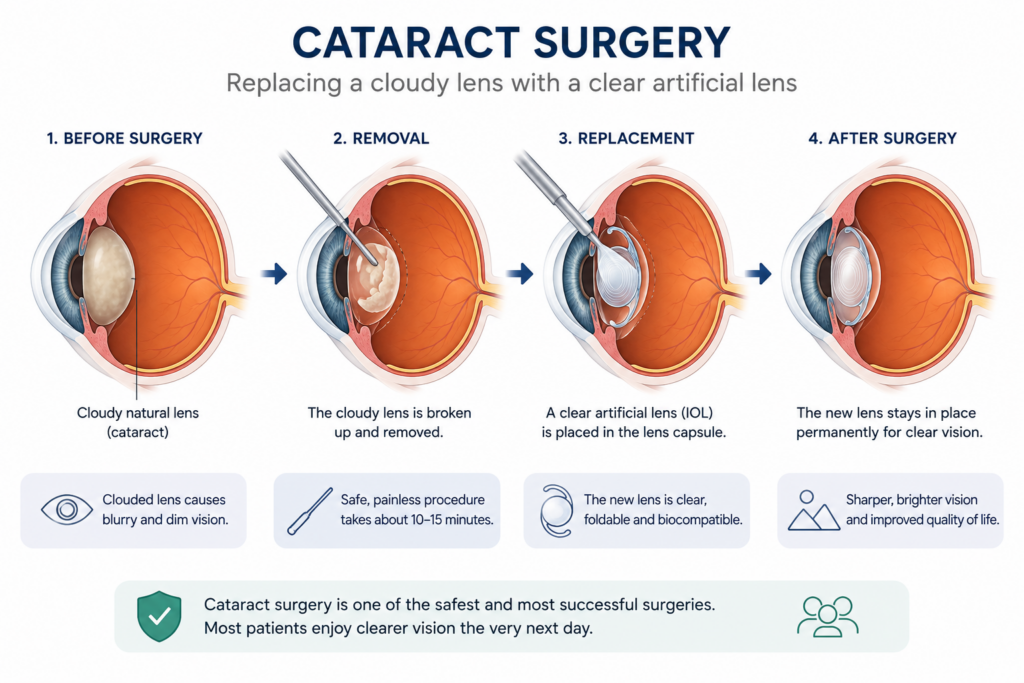
The good news is that modern cataract surgery is one of the most commonly performed eye operations in the world and is generally very safe. It is usually done as an outpatient or day-care procedure, which means most patients go home the same day. The goal is simple: remove the cloudy natural lens and replace it with a clear artificial lens called an intraocular lens, or IOL.
This guide walks you through the full patient journey: before surgery, during surgery, and after surgery. My aim is not to oversell the experience, but to make it predictable. When patients know what to expect, they usually feel calmer, make better decisions, and recover with more confidence.
What cataract surgery actually treats
A cataract happens when your eye’s natural lens becomes cloudy. Instead of passing light clearly, the lens begins to scatter it. That is why vision may become blurred, dull, hazy, or more sensitive to bright lights and glare. Many people first notice trouble with night driving, reading, or recognizing faces in dim lighting.
Eye drops, medicines, exercises, and glasses cannot remove a cataract once it has become visually significant. Surgery is the only effective treatment because the cloudy lens must be removed. In adults, surgery is usually advised when the cataract starts interfering with daily life rather than at a fixed stage. In other words, the “right time” for surgery is when your vision no longer matches your needs.
That matters because cataract surgery is not just about taking out a cataract. It is also a chance to improve your overall quality of vision. With proper planning, we can often address distance vision goals and, in some patients, reduce dependence on glasses.
Step 1: Your pre-surgery consultation
Before cataract surgery, you will usually have a detailed eye assessment. This is where a lot of the real work happens. Patients often think the operation day is the most important part, but the planning visit is just as important because it helps the surgeon choose the correct lens power and identify any eye conditions that may affect the final result.
At this visit, your doctor may check your vision, examine the cataract with a slit lamp, dilate the pupil to examine the back of the eye, and measure the shape and length of the eye. These measurements are known as biometry. Biometry includes values such as corneal curvature and axial length, and those numbers are used to calculate the IOL power that will be implanted during surgery.
This is also the time to discuss other eye problems. A cataract can coexist with glaucoma, diabetic eye disease, macular degeneration, corneal disease, or dry eye. Surgery may still help, but those conditions can limit how sharp the final vision becomes. One of the most important parts of good counselling is making sure the patient understands what surgery can improve and what it cannot.
If you wear contact lenses, you may be told to stop them for a few days before the measurements or before surgery. That is because contact lenses can affect the surface measurements of the eye and lead to an inaccurate IOL calculation.
Step 2: Choosing your IOL lens
For many patients, the IOL discussion feels more stressful than the surgery itself. That is because lens choice affects how you will see after the cataract is gone. There is no single “best” lens for everyone. The right IOL depends on your eye health, your lifestyle, your work, your night-driving needs, and how comfortable you are with wearing glasses after surgery.
The most common lens is a monofocal IOL. A monofocal lens gives the best focus at one main distance. Most patients choose distance correction, which means they often still need glasses for reading or computer work. This is the most standard and predictable option for many people.
If you have significant astigmatism, a toric IOL may be considered. Toric lenses are designed to correct astigmatism as well as the cataract, which can reduce the need for glasses afterward.
Some patients ask about multifocal or presbyopia-correcting lenses, including extended depth-of-focus, trifocal lens options. These lenses are designed to provide useful vision at more than one distance and can reduce dependence on glasses. However, they are not perfect. In some patients they can cause glare, halos, or other light-related visual symptoms, and they are generally not ideal when there is other significant eye disease such as glaucoma or macular degeneration.
This is where honest expectation-setting matters. Many cases of disappointment after cataract surgery happen not because the operation failed, but because the lens choice did not match the patient’s daily life or visual priorities. If you read a lot, drive at night, use screens for work, or have high expectations of spectacle independence, say that clearly during your consultation. Your surgeon should help match the lens to the person, not the other way around.

Step 3: Getting ready for surgery day
Once surgery is scheduled, most patients want to know what they need to do the day before and the morning of surgery. In many routine cases, cataract surgery is done under topical or local anaesthesia, so patients are awake but the eye is numb. NHS guidance notes that when surgery is done under local anaesthetic, patients can usually eat and drink as normal, though you should always follow the exact instructions from your own hospital or surgeon, especially if sedation is planned.
Wear comfortable clothes. Do not plan to drive yourself home. Arrange for a family member or friend to accompany you or collect you after the procedure. If both eyes need surgery, they are usually treated on separate days rather than together.
You may also be advised about your regular medicines, especially blood thinners, diabetes medicines, or other eye drops. Follow your surgeon’s instructions carefully rather than making changes on your own. The exact plan can vary depending on your medical history and the type of anaesthesia being used.
Step 4: What happens at the hospital or surgery center
On arrival, the team will confirm your details, check which eye is being treated, and start preparing the eye. You will usually receive drops to widen the pupil. The area around the eye is cleaned, and a sterile drape is placed so that only the treated eye is exposed.
Patients often ask me, “Will I be asleep?” Usually, no. Cataract surgery is commonly done with topical or local anaesthesia, which means you are awake but should not feel pain. The anaesthetic may be given as drops, an injection, or both, depending on the case. During the operation, many patients notice bright lights, movement, or shadows, but they usually do not see the surgery in detail.
That point alone reassures many people. You are not expected to “watch” your surgery. You are simply asked to lie still and follow simple instructions.
Step 5: What happens during the cataract surgery procedure
The operation itself is usually quite short. NHS guidance says it commonly takes about 20 to 45 minutes, though the full hospital visit is longer because of preparation and recovery time around the procedure.
In the most common technique, the surgeon makes a tiny opening at the front of the eye, opens the front of the lens capsule, and uses ultrasound to break the cloudy lens into small pieces. Those pieces are removed with suction. Then the new artificial lens is placed inside the remaining lens capsule, where it stays permanently. Often no stitches are needed because the incision is so small.
For the patient, this usually feels much simpler than expected. You may feel a little pressure or water around the eye, but not sharp pain. The operating microscope light can feel bright. Some patients feel emotionally overwhelmed afterward because they had imagined something much more dramatic. In reality, modern cataract surgery is typically calm, controlled, and highly standardized.
Step 6: Immediately after surgery
After the operation, your eye may be covered with a shield or dressing. You will rest for a short while and then, in most cases, go home the same day. You should not drive yourself home. Vision may be blurry for the first few hours, partly because of the dilating drops and partly because the eye has just been operated on.
Mild irritation, watering, a foreign-body sensation, or light sensitivity can happen in the first few days. Some redness is also common. These early symptoms do not automatically mean something is wrong. What matters is whether things gradually improve rather than worsen.
Step 7: Cataract surgery recovery — what the timeline usually looks like
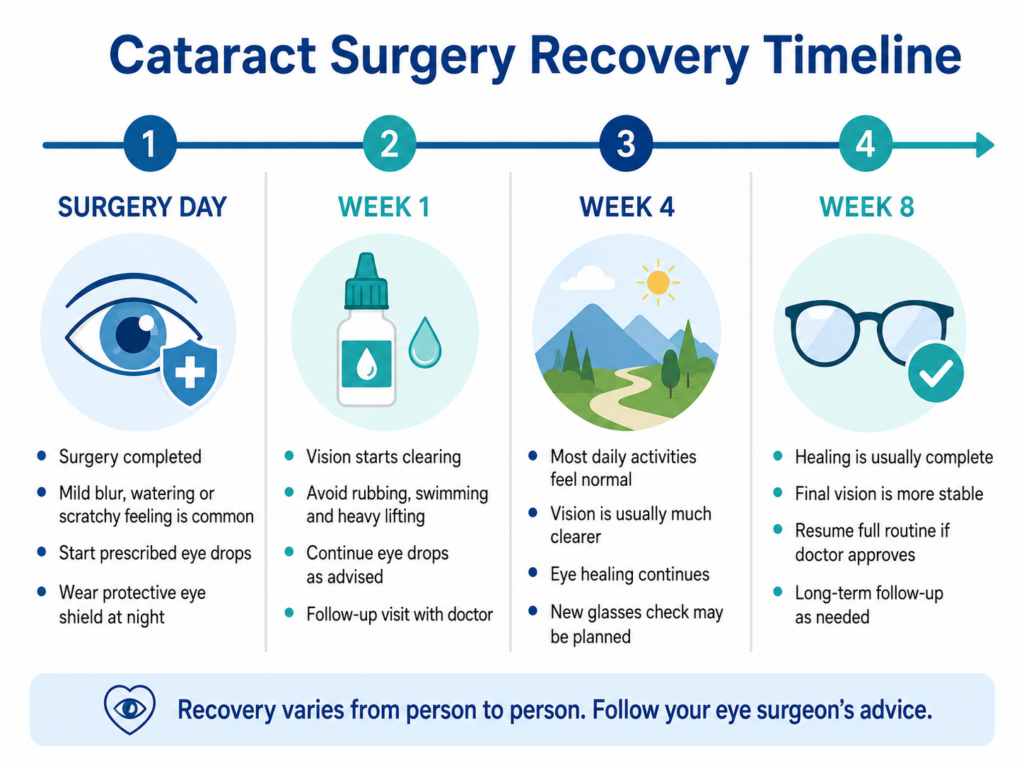
Most people recover quickly after cataract surgery, but recovery is not always instant. Some patients see clearly very soon, while others notice steady improvement over several days. NHS guidance notes that vision may take several days to improve and that eye drops are commonly used for about 4 weeks. Mayo Clinic notes that complete healing often happens within about 8 weeks.
In practical terms, cataract surgery recovery time in India is usually similar to the recovery timeline described in international guidance, because the healing pattern of the eye is the same whether surgery is performed in India or elsewhere. Most patients in India also have cataract surgery as a day-care procedure, begin postoperative drops, return to light daily activities fairly soon, and continue healing over the following weeks. That is a reasonable, evidence-based expectation to set.
A simple way to think about recovery is this. On day 1, the eye may feel scratchy, watery, or mildly blurry. During the first week, vision usually settles, and most patients begin to feel more normal. Over the next few weeks, the eye continues to heal, drops are tapered or completed as advised, and the final visual result becomes clearer. A new glasses prescription, if needed, is usually considered after healing is more stable.
Step 8: Normal side effects versus warning signs
This is one of the most important parts of patient education. Some side effects after cataract surgery are common and temporary. These can include blurry vision in the first days, mild discomfort, scratchiness, light sensitivity, redness, and seeing glare or halos while the eye and brain adapt.
But there are also warning signs that need urgent attention. You should contact your eye doctor right away if you develop vision loss, pain that does not improve with pain medicine, increasing redness, significant eyelid swelling, sudden new flashes, many new floaters, or a dark curtain or shadow in your vision. These can be signs of complications such as retinal problems or infection and should not be ignored.
Patients should also know that vision can sometimes become cloudy again months or years after successful cataract surgery. This is often due to posterior capsule opacification, or PCO, which is not the cataract “coming back” but clouding of the thin membrane behind the implant. It is a recognized late issue after surgery and is usually treatable.
Step 9: Cataract surgery precautions that really matter
The most important precautions after surgery are usually the simple ones. Use your eye drops exactly as instructed. Do not rub the eye. Use the protective shield at night if advised. Avoid driving until your vision is good enough and your doctor says it is safe.
It is also sensible to avoid heavy lifting, contact sports, swimming, eye makeup, and getting water directly into the eye during the early healing phase. NHS guidance advises avoiding heavy lifting and swimming, and some hospital guidance notes that makeup and swimming are often delayed until the drop course is finished, around 4 weeks in many cases.
If bright light bothers you, sunglasses can help. If the eye feels slightly dry or irritated, do not self-medicate randomly with old bottles of drops. Use only the treatment plan given by your surgeon unless you are told otherwise.
How to reduce disappointment after cataract surgery
A successful cataract surgery is not only about removing the cloudy lens. It is also about matching the result to the patient’s expectations. That starts with three practical questions.
First, what do you most want to do without glasses: drive, read, use a phone, or work on a computer? Second, how much night driving do you do? Third, are you comfortable with some glasses use if it means more predictable quality of vision? Those questions often matter more than choosing the fanciest lens.
Many patients do extremely well with a monofocal lens and reading glasses. Others are happier with toric or presbyopia-correcting options. The key is informed choice. When the expected result is clearly explained before surgery, patients usually feel reassured and satisfied afterward.
When to see your ophthalmologist again
You should keep all scheduled follow-up visits after cataract surgery, even if you feel fine. The eye may look calm to you while your surgeon is still monitoring healing, pressure, inflammation, and lens position. Follow-up is also the best time to ask whether your symptoms are normal, when you can return to specific activities, and whether you still need glasses.
And if something feels clearly worse rather than slowly better, do not wait for the next routine appointment. Worsening pain, worsening redness, or worsening vision deserves prompt review. In eye care, timely review is often the difference between a minor issue and a major one.
Final word: what most patients can realistically expect
Most patients feel that cataract surgery was easier than they expected. The procedure is usually short, the eye is numbed, and recovery is commonly faster than people imagine. The part that needs the most thought is often not the surgery itself, but the planning: understanding your eye health, choosing the right IOL, and following recovery instructions carefully.
If you approach cataract surgery as a step-by-step journey rather than a single event, it becomes much less intimidating. Ask questions. Be honest about your visual goals. Take your drops properly. Protect the eye while it heals. And remember that the aim is not perfection on day one, but steady, safe improvement in the weeks that follow.
If your vision is being limited by cataract and you are ready to explore treatment, book a comprehensive cataract evaluation with our ophthalmologist. A careful pre-surgery assessment and a clear lens discussion can make the entire journey smoother and more reassuring.
References
American Academy of Ophthalmology. Cataract Surgery: Risks, Recovery, Costs.
American Academy of Ophthalmology. Intraocular Lenses (IOL) for Cataract Surgery and Factors to Consider in Choosing an IOL for Cataract Surgery.
NHS. Cataract surgery.
Mayo Clinic. Cataract surgery.
NCBI Bookshelf / NIH. Intraocular Lenses for Cataract Surgery and Optical Biometry.