
Monthly contact lenses are often more economical than daily lenses for regular users in India, especially if you wear lenses most days of the month. While monthly lenses cost more upfront, their per-day cost becomes much lower when used correctly with proper lens care solutions. Daily lenses are more hygienic and convenient but significantly more expensive over time. Yearly lenses may seem cheaper but carry higher risks if not maintained perfectly. The best choice depends on how often you wear lenses, your budget, and your eye health.
Are Monthly Contact Lenses Economical in India? A Practical Cost Breakdown
As an ophthalmologist, I frequently meet young patients and working professionals who ask a very practical question: “Doctor, which contact lenses are actually economical in the long run?”
This question has become even more common because Indian Reddit users and online forums are actively debating daily versus monthly versus yearly lenses. Many people are confused because prices look similar at first glance, but the real cost depends on how lenses are used over time.
In this article, I will break this down clearly and honestly, keeping Indian prices, usage habits, and eye safety in mind. My goal is not to sell you a specific lens, but to help you choose what makes sense for your eyes and your wallet.
Why This Question Matters in India
India has a rapidly growing population of contact lens users. Students, IT professionals, content creators, and fitness enthusiasts often prefer lenses over spectacles for comfort and appearance. At the same time, most people are cost-conscious.
Unlike some Western countries where insurance may cover part of lens expenses, in India, contact lenses are usually paid for entirely out of pocket. This makes cost comparisons very important.
But here is the key point many people miss: the cheapest-looking lens is not always the most economical or the safest.
Understanding the Three Main Types of Contact Lenses
Before we compare costs, let us clearly understand what we mean by daily, monthly, and yearly lenses.
Daily Disposable Lenses
Daily lenses are worn once and thrown away at the end of the day. You use a fresh pair every morning.
They do not require any cleaning solution or storage case. This makes them very hygienic and convenient.
Daily lenses are ideal for people who:
- Wear lenses occasionally
- Travel frequently
- Have sensitive eyes or allergies
However, convenience comes at a price, which we will discuss shortly.
Monthly Disposable Lenses
Monthly lenses are designed to be worn daily and replaced after 30 days.
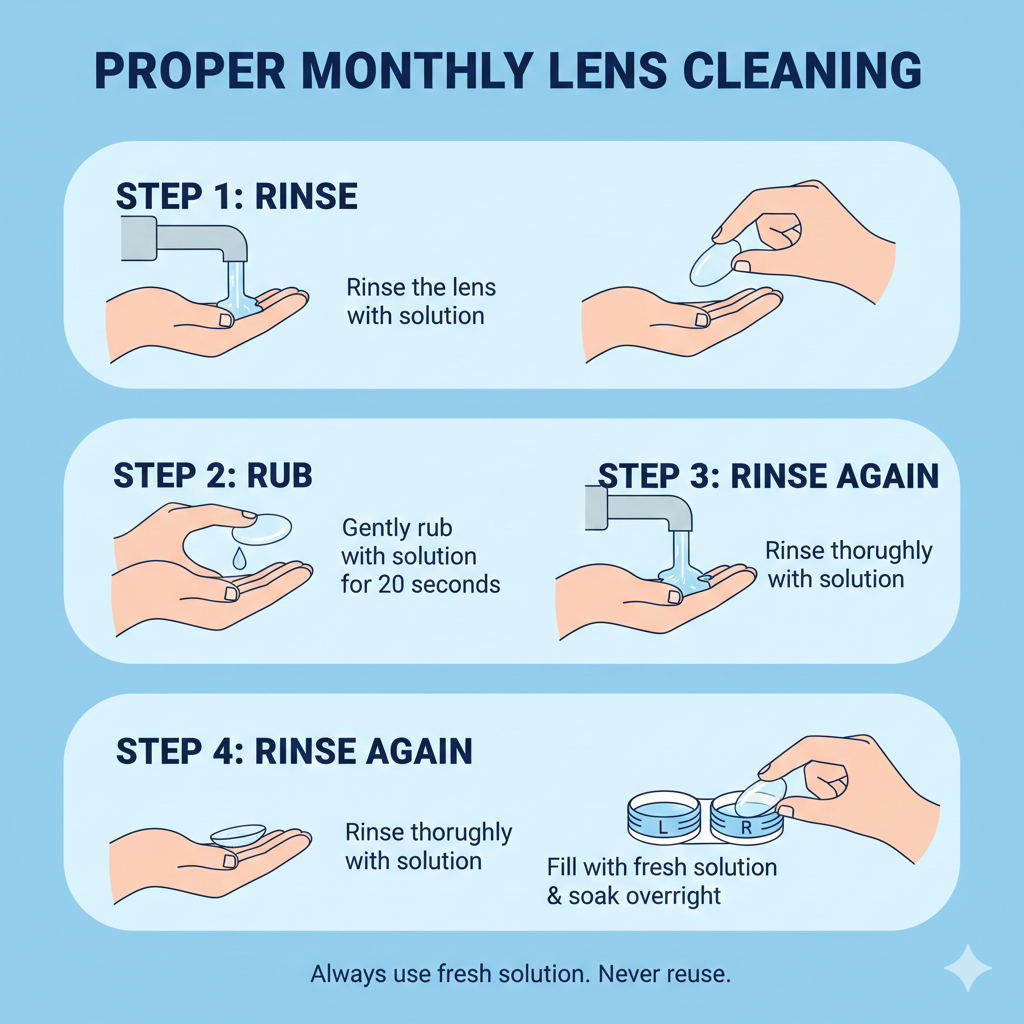
You remove them every night, clean them with lens solution, and store them in a lens case.
Monthly lenses are commonly chosen by:
- Students and office-goers
- People who wear lenses most days of the month
- Users looking for a balance between cost and comfort
Yearly (Conventional) Lenses
Yearly lenses are designed to last 6 to 12 months with proper care.
They are thicker, require strict cleaning routines, and are less forgiving if hygiene slips.
These lenses are now less commonly recommended due to higher infection risks, especially in Indian conditions where heat, dust, and humidity are factors.
The Real Cost Comparison in India (2025 Perspective)
Let us now look at realistic Indian price ranges, keeping popular brands and optical store pricing in mind. Prices may vary slightly by city and brand, but these ranges reflect what most patients pay.
Cost of Daily Disposable Lenses
A box of 30 daily lenses (for one eye) typically costs between ₹900 and ₹1,500.
If you wear lenses in both eyes daily, you will need:
- 2 boxes per month
- Approximately 24 boxes per year
This brings the annual cost to roughly:
₹22,000 to ₹36,000 per year
There is no additional cost for solution, but the recurring expense is high.
Cost of Monthly Disposable Lenses
Monthly lenses usually come in packs of 3 or 6 lenses.
A 3-month pack for both eyes generally costs between ₹800 and ₹1,200.
Over a year, lens cost alone comes to approximately:
₹3,200 to ₹5,000 per year
You must also include lens solution costs. A good-quality multipurpose solution costs around ₹250 to ₹400 per bottle, lasting about 1–2 months.
Annual solution cost:
₹1,500 to ₹2,500
So the total annual cost of monthly lenses is roughly:
₹4,700 to ₹7,500 per year
This is a significant difference compared to daily lenses.
Cost of Yearly Lenses
Yearly lenses typically cost between ₹1,200 and ₹3,000 per pair.
Add solution costs similar to monthly lenses, around ₹2,000 per year.
So the total annual expense may be:
₹3,200 to ₹5,000 per year
On paper, this looks cheapest. But cost alone is not the full story.
Cost Per Day: A Simple Way to Compare
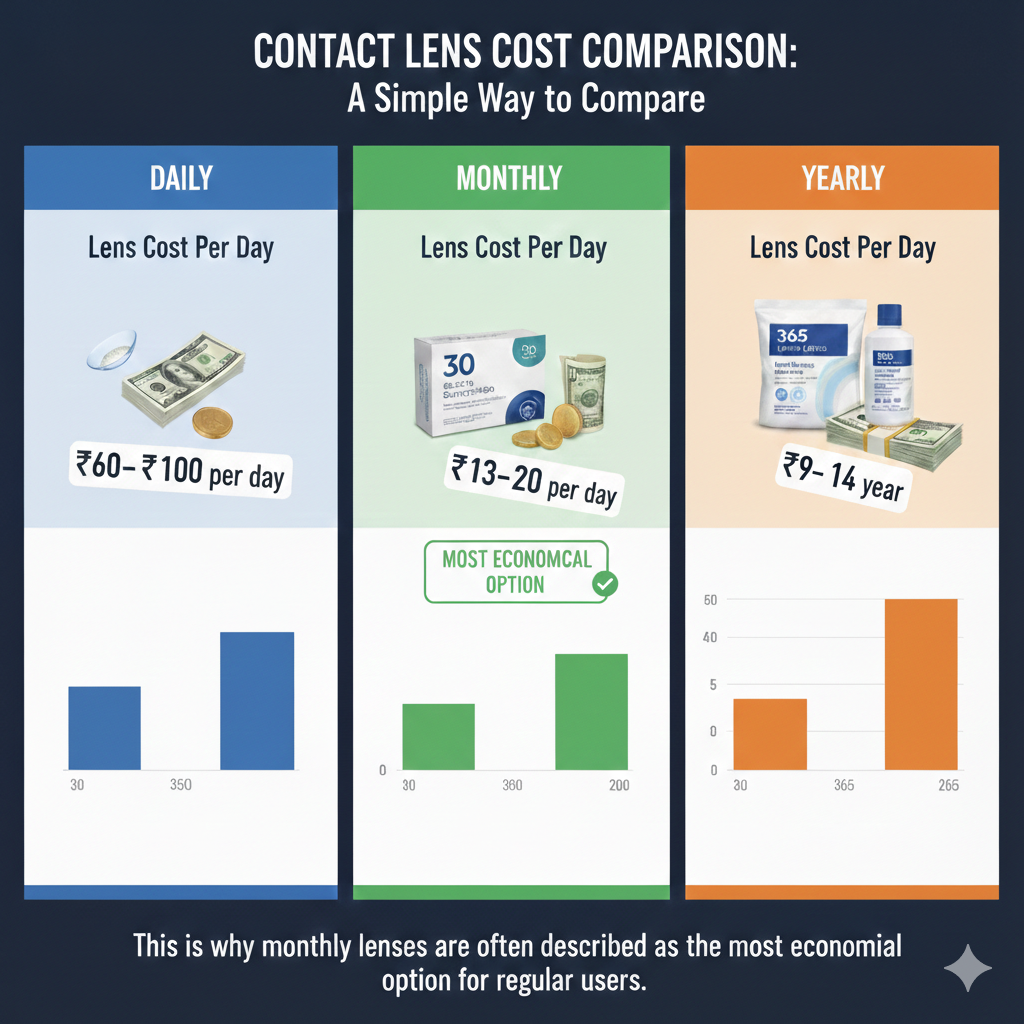
Let us simplify this further by calculating approximate cost per day.
- Daily lenses: ₹60–₹100 per day
- Monthly lenses: ₹13–₹20 per day
- Yearly lenses: ₹9–₹14 per day
This is why monthly lenses are often described as the most economical option for regular users.
Why Monthly Lenses Often Make the Most Sense in India
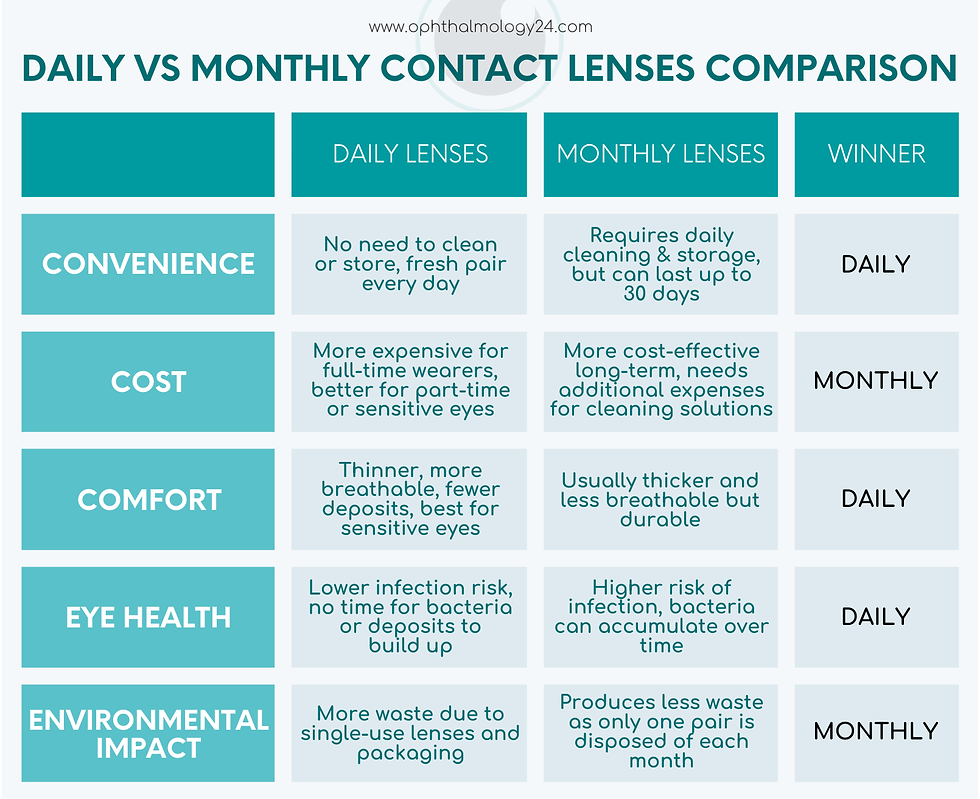
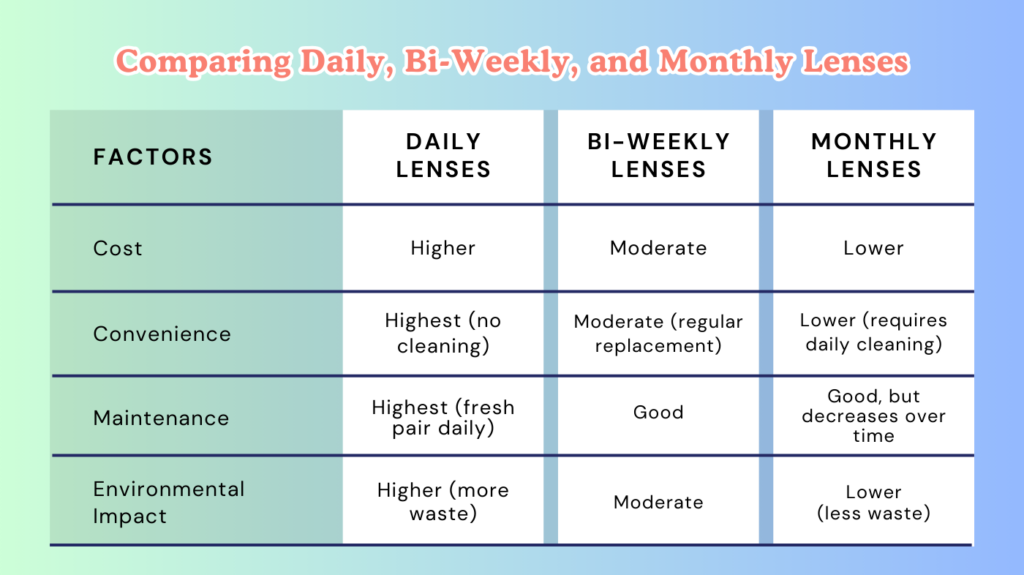
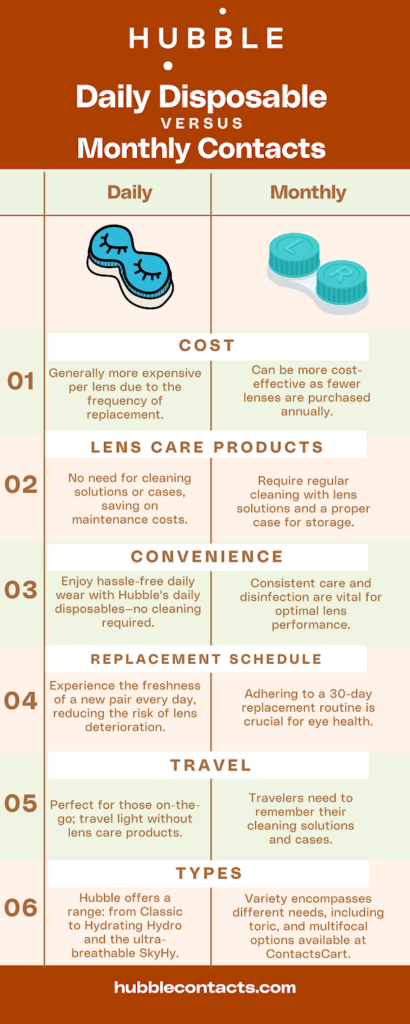
From a medical and practical perspective, monthly lenses strike a very reasonable balance.
They are:
- Much cheaper than daily lenses over a year
- Safer and more breathable than most yearly lenses
- Widely available in India in multiple power ranges
For someone wearing lenses 20–25 days a month, monthly lenses usually offer the best value for money without compromising eye health.
Hidden Costs People Often Ignore
Many Reddit discussions focus only on lens price. But there are hidden costs that matter.
Eye Infections and Treatment Costs
Improper lens use can lead to infections like conjunctivitis or corneal ulcers. Treating these can cost:
- ₹1,500–₹5,000 for mild infections
- Much more for serious complications
Daily lenses reduce this risk, but monthly lenses are safe if hygiene is followed strictly.
Replacement Due to Damage or Loss
Daily lenses are thrown away anyway, so damage does not matter.
Monthly and yearly lenses can tear or get contaminated, requiring early replacement. Monthly lenses are less painful to replace than yearly ones in such cases.
What Indian Reddit Users Are Getting Right – and Wrong
Many Reddit users correctly point out that daily lenses are expensive in the long run. That is true.
However, some underestimate the discipline required for monthly and yearly lenses. Skipping cleaning even occasionally can lead to redness, dryness, or infection.
Another common myth is that yearly lenses are always the best value. Medically speaking, I do not recommend yearly lenses for most people today unless there is a strong reason and excellent hygiene habits.

Which Lens Type Should You Choose?
Instead of asking only “Which lens is cheapest?”, I advise patients to ask:
“How often will I wear lenses, and how careful can I be?”
If you wear lenses:
- Occasionally (once or twice a week): Daily lenses may be worth the extra cost
- Regularly (most days): Monthly lenses are usually the most economical and sensible choice
- Very rarely but for long hours: Monthly lenses still make more sense than yearly ones
A Word on Eye Comfort and Dryness
Monthly lenses today are made from advanced materials that allow more oxygen to reach the eye. This reduces dryness and fatigue, especially for people using screens for long hours.
However, no lens is “maintenance-free.” Using a good-quality solution and giving your eyes lens-free days each week makes a big difference.
When You Should Avoid Monthly Lenses
Monthly lenses may not be ideal if:
- You are unable to clean lenses daily
- You frequently sleep with lenses on
- You have recurring eye infections
- You live or work in very dusty environments
In such cases, daily lenses or spectacles may be safer, even if they cost more.
When to See an Eye Doctor
You should consult an ophthalmologist if you experience:
- Redness that does not settle
- Pain or burning sensation
- Blurred vision
- Excessive watering or discharge
Never ignore these symptoms or continue wearing lenses hoping they will improve on their own.
Final Takeaway: Are Monthly Lenses Economical in India?
Yes, for most regular contact lens users in India, monthly lenses are the most economical option when cost, safety, and comfort are considered together.
They offer a sensible middle ground between expensive daily disposables and higher-risk yearly lenses.
That said, the best lens is always the one that fits your eyes, lifestyle, and habits — not just your budget.
Call to Action
If you are confused about which contact lens type suits you best, book a comprehensive eye examination at our eye hospital. A proper lens fitting and professional advice can save you money and protect your vision in the long run.
References
- https://www.aao.org/eye-health/glasses-contacts/contact-lens-types
- https://www.mayoclinic.org/healthy-lifestyle/adult-health/in-depth/contact-lenses/art-20046297
- https://www.ncbi.nlm.nih.gov/pmc/articles/PMC5452162/
- https://www.nhs.uk/conditions/contact-lenses/