When to See a Specialist for Dry Eyes: Red Flags & Appointment Checklist
Most dry eye can be managed at home at first, but you should see an eye specialist if symptoms last more than a few weeks, keep returning, or start affecting your vision, comfort, or contact lens wear. Seek urgent care for red, painful eyes (especially with contact lenses), light sensitivity, sudden vision changes, significant discharge, or after an injury/chemical exposure. Before your appointment, track triggers, screen time, medicines, and which drops you’ve tried—this helps your doctor find the real cause and choose the right long-term plan.
Dry eyes sound simple—until they aren’t.
Many people start with basic remedies: over-the-counter artificial tears, warm compresses, blinking more during screen time, and drinking more water. And for mild dryness, that can be enough.

But dry eye disease isn’t just “not enough tears.” Modern research describes it as a problem of tear film “balance” (homeostasis). When that balance is disturbed, the eye surface can become irritated and inflamed, and symptoms can start affecting daily life—reading, driving, working on screens, wearing contact lenses, even sleeping comfortably. (tfosdewsreport.org)
As an ophthalmologist, one of the most common questions I hear is:
“How do I know when home treatment isn’t enough?”
Let’s make that decision easier—without panic, and without missing anything important.
First: What “Dry Eye” Really Means (in plain language)
Your tears aren’t just water. They’re a carefully mixed “three-layer” system:
The oily layer slows evaporation (often affected by blocked eyelid oil glands).
The watery layer provides moisture and nutrients.
The mucous layer helps tears spread evenly over the eye surface.
Dry eye happens when this system becomes unstable—because you’re not producing enough tears, the tears evaporate too quickly, or the tear quality is poor. In many people, it’s a mix. (tfosdewsreport.org)
That’s why someone can say, “My eyes water all the time” and still have dry eye. Excess watering can be a reflex response to irritation, not a sign of healthy lubrication. (National Eye Institute)
When Home Remedies Are Reasonable (and when they’re not)
If your symptoms are mild and recent, a short trial of home care is sensible. For many patients, consistent care over a couple of weeks improves comfort.
Home care usually includes:
Regular lubricating drops (not the “get-the-red-out” type), and using preservative-free drops if you need them frequently. (Mayo Clinic)
Warm compresses and gentle lid hygiene if you have flaky lids or suspected oil gland blockage. (Mayo Clinic)
Reducing airflow to the eyes (fan/AC in the face), and taking screen breaks.
If symptoms settle and stay settled, great.
But if you’re repeatedly “rescuing” your eyes with drops just to get through the day, that’s a clue that you may need a targeted diagnosis and a longer-term plan.
Signs It’s Time to See a Specialist (Non-urgent, but important)

Consider booking an eye evaluation (optometrist or ophthalmologist) if any of the following are true:
Your symptoms have lasted more than a few weeks
If dryness, burning, grittiness, redness, or fluctuating vision has been going on for weeks, it’s time to check what’s driving it and whether your eye surface is being damaged. (Mayo Clinic)
The NHS guidance is similar: if dry eyes persist after trying home treatments for a few weeks, get checked. (nhs.uk)
Your vision is affected—even if it comes and goes
Dry eye can cause “fluctuating vision” that improves after blinking. People often describe it as:
“My vision goes blurry after staring at the screen,” or
“Night driving feels harder than it used to.”
Foreign-Body SensationThis matters because it can signal tear film instability and surface irritation that needs more than basic drops. (National Eye Institute)
You’re using drops many times a day and still struggling
If you need lubrication constantly, we should ask:
Is this evaporation-dominant dry eye (oil gland issue)?
Is there inflammation that needs prescription treatment?
Is there an underlying condition like blepharitis, allergy, or autoimmune disease?
Contact lenses are becoming uncomfortable
Needing to remove lenses early, burning with lenses, or “lens intolerance” is a common reason to escalate care. Contact lens wear can also raise the stakes if redness and pain appear (more on that in the red flags section). (nhs.uk)
You have risk factors that change the game
It’s especially worth seeing a specialist if you have dry eye symptoms plus:
Autoimmune disease symptoms (dry mouth, joint pains) or a known diagnosis
History of refractive surgery (like LASIK)
Eyelid problems (lids not closing fully, eyelids turning out/in) (nhs.uk)
Long-term use of medicines that can worsen dryness (some antihistamines, antidepressants, acne medicines, etc.—don’t stop anything on your own; just mention it)
Red Flags: When Dry Eye Might Not Be “Just Dry Eye”
Now the crucial part.
Some symptoms overlap between dry eye and more serious eye problems. If any of these occur, don’t wait for a routine appointment.
Seek urgent care if you have a red, painful eye
Pain + redness is not typical “simple dryness,” especially if it’s sudden or severe. The NHS lists a painful red eye as urgent. (nhs.uk)
Red eye + contact lenses = urgent until proven otherwise
If you wear contact lenses and develop a red eye—particularly with pain, light sensitivity, discharge, or reduced vision—stop wearing the lenses and seek urgent eye assessment.
Why we take it seriously: contact lens–related corneal infection (microbial keratitis) can worsen quickly and may threaten vision. (nhs.uk)
Sudden vision changes
Any sudden loss of vision, flashing lights, wavy lines, or a dramatic change in clarity needs immediate evaluation. The NHS treats changes in sight as an emergency trigger. (nhs.uk)
Light sensitivity (photophobia), severe headache, nausea, or vomiting with red eye
These combinations can signal conditions far more serious than dryness. Both NHS and Mayo Clinic list red eye with light sensitivity or severe headache/nausea as reasons to seek immediate care. (nhs.uk)
Thick discharge or sticky eyelids
Dry eye can cause stringy mucus, but heavy discharge and eyelids stuck shut can suggest infection or significant inflammation that needs targeted treatment. (National Eye Institute)
Injury, chemical splash, or something stuck in the eye
This is an emergency situation, not a “wait and see.” (nhs.uk)
You can’t keep the eye open, or there’s marked swelling around the eye
These symptoms deserve immediate care because they’re not typical of routine dry eye. (Mayo Clinic)
Who Should You See: Optician/Optometrist vs Ophthalmologist vs Dry Eye Specialist?
Different health systems use different terms, but a practical guide is:
An optometrist/optician visit can be a good first step for persistent dryness, especially if you need a baseline eye exam, advice on drops, and screening for common causes. The NHS notes that an optician or GP may refer to an ophthalmologist for further tests if needed. (nhs.uk)
An ophthalmologist (medical eye doctor) is important when:
Symptoms are persistent despite home care
There’s significant inflammation, surface damage, or complicated eyelid disease
You may need prescription therapies or in-office procedures
You have autoimmune disease concerns, post-surgery dryness, or corneal involvement
A cornea/dry eye specialist is useful when:
Dry eye is severe, recurrent, or affecting the cornea
Symptoms are out of proportion to basic findings (possible nerve-related pain)
Standard treatments haven’t worked and advanced options are being considered
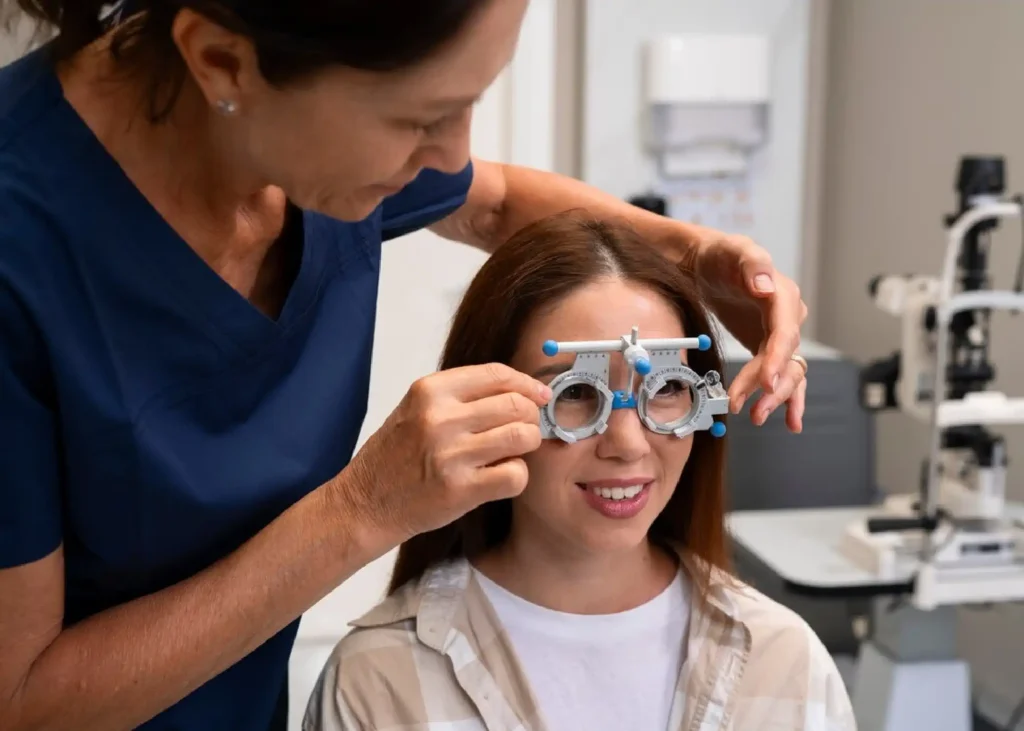
What to Expect at a Dry Eye Evaluation
People worry the appointment will be long or uncomfortable. In reality, it’s usually straightforward.
A proper dry eye assessment typically includes:
A detailed history (this is more important than most people realize)
We want patterns:
Is it worse on screens? In air-conditioning? In the morning or evening?
Do you wake up with gritty eyes?
Which drops help, and for how long?
A slit-lamp exam (microscope exam in clinic)
This lets us look at:
Eyelid margins and oil glands
Tear film quality
Signs of inflammation
Corneal and conjunctival surface health
Tear production and tear stability tests
Common tests include:
Schirmer test (measures tear production using a small paper strip) (Mayo Clinic)
Surface staining with special dyes to detect dry spots or damage (aaojournal.org)
Sometimes additional tests such as tear osmolarity or inflammatory markers (used in some clinics) (aaojournal.org)

Treatments You Might Discuss (so you’re not surprised)
Many patients think the “next step” after artificial tears is simply “stronger artificial tears.” Sometimes yes—but often we need a different approach depending on the cause.
Options your specialist may discuss include:
Prescription anti-inflammatory drops (commonly used when inflammation is a driver—your doctor will decide what fits your case). (aaojournal.org)
Treatments to improve tear retention, like punctal plugs (tiny plugs placed in tear drainage openings) or procedures to reduce tear drainage. (Mayo Clinic)
Eyelid-focused treatments when oil glands are blocked: consistent warm compresses, clinic-based therapies, or other gland-opening strategies. (Mayo Clinic)
For severe cases, options such as scleral lenses (moisture-trapping lenses) or autologous serum drops (drops made from your own blood) may be considered. (Mayo Clinic)
Newer approaches like varenicline nasal spray to stimulate tear production exist in some regions and may be discussed depending on availability and suitability. (Mayo Clinic)
The key point: effective dry eye treatment is personalized. Two people with the same “dry feeling” can have very different underlying problems.
The Appointment Checklist: How to Prepare (and get the most value)
Appointments can feel brief. Preparation helps us help you faster. Mayo Clinic specifically recommends coming prepared with symptoms, medicines, and questions. (Mayo Clinic)
Here’s a patient-friendly checklist I give my own patients.
1) Track your symptoms for 7 days (quick notes are enough)
Write down:
What time of day it’s worst
What makes it worse (screens, AC, driving, smoke, long reading)
What makes it better (drops, breaks, sleep, humidifier)
Whether you get burning, gritty feeling, watering, redness, light sensitivity, or blurred vision (National Eye Institute)
If you don’t want to write, you can simply keep notes in your phone.
2) List every eye product you use
Include:
Artificial tears (brand/name if possible) and how many times daily
Any “redness relief” drops (important—these can worsen irritation if overused) (Mayo Clinic)
Ointments or gels at night
Allergy drops
Contact lens rewetting drops
Tip: take a photo of the bottles/boxes. It’s faster than trying to remember names.
3) List your general medicines and supplements
Some medicines can worsen dryness. Don’t stop them on your own—but do bring a list. Mayo Clinic recommends bringing a complete list of medicines, vitamins, and supplements. (Mayo Clinic)
4) Contact lens details (if you wear them)
Bring (or note):
Lens type (daily/monthly, soft/rigid)
How many hours you wear them
Whether you ever sleep in them
Your cleaning solution name
When you last changed the lenses
And if you have a red, painful eye with contact lenses—don’t wait for a routine visit. Seek urgent care. (nhs.uk)
5) Your environment and routines
These are often the missing puzzle pieces:
Daily screen time (work + phone)
Work environment (AC, dust, chemicals, wind exposure)
Sleep quality (snoring or possible sleep apnea can be relevant for some patients)
New cosmetics/skin treatments around the eyelids
Recent illness or allergies
6) Be ready for a few key questions
Mayo Clinic notes doctors commonly ask when symptoms started, whether they’re continuous, and what you’ve tried. (Mayo Clinic)
If you can answer these clearly, we move faster:
When did this start?
Is it one eye or both?
Is it worse in the morning or evening?
What have you tried and what happened?
7) Questions you should ask your doctor
You don’t need a long list. Even 4–5 questions is enough:
What type of dry eye do I likely have (low tears vs fast evaporation vs mixed)?
Is there any damage on the eye surface?
What’s my step-by-step plan for the next 4–8 weeks?
Which drops should I use, how often, and for how long? (Mayo Clinic)
When should I follow up, and what should prompt me to come sooner?
When to Seek Help “Today” vs Booking a Routine Visit
A simple way to decide:
Book a routine appointment soon if:
Symptoms persist beyond a few weeks despite home care (nhs.uk)
You’re relying on drops frequently
Vision fluctuates regularly (National Eye Institute)
Contact lenses are becoming intolerable
Seek urgent care today if:
Painful red eye (nhs.uk)
Red eye with contact lenses (nhs.uk)
Light sensitivity, sudden vision changes, severe headache/nausea, injury, chemical exposure, or something stuck in the eye (nhs.uk)
If you’re unsure, treat it as urgent—eyes don’t give us many “second chances” when infections or acute inflammation are involved.
Call to Action
If your dry eye symptoms are lingering, disrupting work or screen use, or you’re worried because of redness, pain, or vision changes, schedule a comprehensive dry eye evaluation with an ophthalmologist. A targeted diagnosis can prevent months (or years) of trial-and-error and help protect the eye surface long-term.
If you wear contact lenses and develop a red, painful eye, stop lens wear and seek urgent eye care the same day.
References
1) NHS – Dry eyes: https://www.nhs.uk/symptoms/dry-eyes/
2) Mayo Clinic – Dry eyes (Symptoms & causes): https://www.mayoclinic.org/diseases-conditions/dry-eyes/symptoms-causes/syc-20371863
3) Mayo Clinic – Dry eyes (Diagnosis & treatment): https://www.mayoclinic.org/diseases-conditions/dry-eyes/diagnosis-treatment/drc-20371869
4) National Eye Institute (NIH) – Dry Eye: https://www.nei.nih.gov/eye-health-information/eye-conditions-and-diseases/dry-eye
5) TFOS DEWS II Definition & Classification (report page): https://www.tfosdewsreport.org/report-definition_and_classification/48_36/en/
SEO Meta Title: When to See a Specialist for Dry Eyes
SEO Meta Description: Dry eye red flags, urgent warning signs, and a simple checklist to prepare for your eye specialist appointment.
Suggested Keywords: dry eye red flags, when to see eye doctor, dry eye specialist, dry eye appointment checklist, painful red eye, contact lens red eye, dry eye treatment options, chronic dry eyes