An oculoplastic surgeon is the eye specialist who treats problems around the eye, not just “cosmetic eyelid surgery.” In India, oculoplasty is a subspecialty of ophthalmology that commonly covers droopy eyelids, eyelids turning in or out, blocked tear ducts, watering eyes, thyroid eye disease, eye-socket infections or fractures, eyelid tumors, trauma repair, and selected cosmetic procedures such as blepharoplasty. In simple terms: if the problem involves the eyelids, tear drainage, or the orbit around the eye, this is usually the right specialist.
What Does an Oculoplastic Surgeon Actually Treat?
A Simple Guide to Eyelids, Tear Ducts, and Eye-Orbit Problems
When people hear the term “eyelid surgery,” they often think only of beauty treatments. That is understandable. But in real eye care, eyelid surgery is often about much more than appearance. It may be done to improve vision, protect the eye surface, stop chronic watering, repair injury, remove tumors, or correct changes caused by thyroid disease. In India, the specialist who usually handles these problems is the oculoplastic surgeon, also called an ophthalmic plastic surgeon or oculofacial surgeon. This field is a subspecialty of ophthalmology, which means it sits within eye care, not outside it. Major Indian eye institutes describe its scope as the eyelids, the tear drainage system, the orbit or eye socket, and nearby tissues around the eye.
That point matters because the area around the eye is delicate. A surgeon working here needs to think not only about the skin and face, but also about vision, corneal safety, blinking, tear flow, eye movements, and the eye socket itself. That is why many patients in India are referred to an oculoplastic service when the issue is a droopy lid, a blocked tear duct, thyroid-related eye bulging, an orbital fracture after trauma, or a suspicious eyelid lump.
First, what is an oculoplastic surgeon?
In simple words, an oculoplastic surgeon is an ophthalmologist with additional training in surgery around the eye. Indian eye hospitals such as Aravind and LV Prasad Eye Institute describe oculoplasty as a specialized branch of ophthalmology dealing with eyelid disorders, lacrimal or tear-drainage problems, orbital disease, reconstructive work, and cosmetic eyelid surgery. Training pathways in India also reflect this: fellowship programs in orbit and oculoplasty are designed for ophthalmologists, which tells you this is very much an eye subspecialty. (Aravind Eye Care System)
So, if your main problem is the eyelid, the tear duct, the eye socket, or the tissues just around the eye, this is usually the specialist to see. If the problem is inside the eyeball itself, such as cataract, retina, glaucoma, or cornea disease, another ophthalmology subspecialist may lead your care. Sometimes they work together. That team approach is especially common in India for thyroid eye disease, facial trauma, sinus-related tear-duct disease, and tumors. (Aravind Eye Care System)
The simplest way to understand the field: three main zones
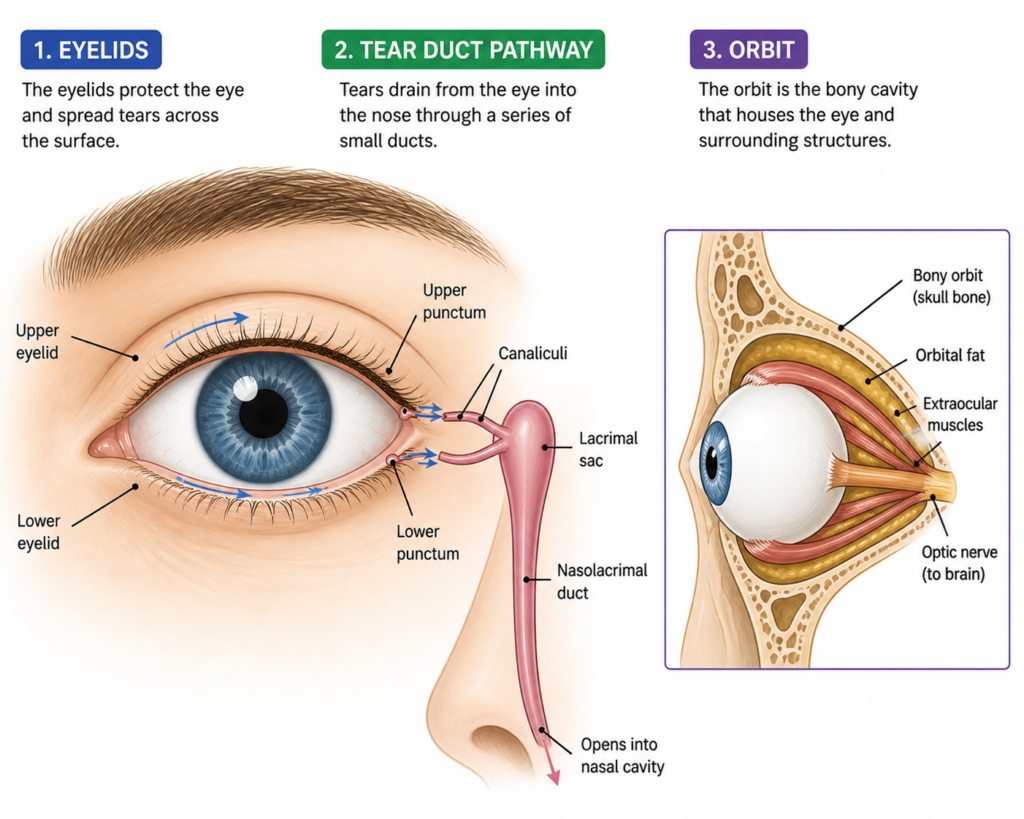
A helpful way to remember oculoplasty is to divide it into three zones.
The first is the eyelids. This includes droopy eyelids, extra eyelid skin, lids turning inward or outward, eyelid lumps, spasms, scars, trauma, and tumor-related reconstruction. The second is the tear drainage system. This includes watering eyes, blocked tear ducts, recurrent infections near the inner corner of the eye, and canalicular injuries after cuts. The third is the orbit, meaning the eye socket and tissues around the eyeball. This includes thyroid eye disease, orbital fractures, some infections, inflammation, tumors, and prosthetic rehabilitation after eye removal. (Aravind Eye Care System)
Eyelid problems an oculoplastic surgeon treats
1) Ptosis: the droopy upper eyelid
Ptosis means the upper eyelid droops lower than normal. Patients often say, “My eye looks small,” “I have to raise my eyebrows to see,” or “I feel tired when reading.” Moorfields notes that a low upper lid can interfere with the upper part of the visual field and may also cause eyestrain, eyebrow ache, and fatigue. Ptosis may be present from birth, or it may develop later due to aging, contact lens wear, trauma, previous eye surgery, or less commonly nerve or muscle disorders. (moorfields.nhs.uk)
This is one of the clearest examples of eyelid surgery helping with both function and appearance. If the eyelid is blocking vision, surgery is not just cosmetic. Treatment usually involves tightening or advancing the muscle that lifts the lid, and in weaker muscles a sling-type procedure may be used so the forehead can help lift the eyelid. (asoprs.org)
2) Extra upper lid skin and “eyelid surgery” that helps vision
Many people use the term “eyelid surgery” to mean blepharoplasty. But blepharoplasty is not always done for looks alone. The AAO notes that eyelid surgery may be done to remove extra eyelid skin, treat droopy upper eyelids, and repair lids that turn inward or outward. In some patients, excess upper lid skin can weigh down the lid or block the visual field, making the procedure functional as well as aesthetic. (American Academy of Ophthalmology)
In practice, patients often notice better comfort and a less heavy feeling around the eyes after a functional upper lid procedure. Others seek cosmetic correction for puffy lids or age-related changes. The important point is that the same broad category of surgery can serve different goals, and your examination decides which one applies to you. (lvpei.org)
3) Entropion and ectropion: when the lid turns the wrong way
Sometimes the eyelid is not too high or too low, but simply in the wrong position. Entropion means the eyelid turns inward, so the lashes rub against the eye. Ectropion means the eyelid turns outward, so the eye surface becomes exposed and tears do not drain well. These problems can cause watering, irritation, redness, soreness, and damage to the front of the eye if neglected. The NHS notes that ectropion can range from mild to requiring specialist treatment, depending on symptoms and cause. (American Academy of Ophthalmology)
This is another reason patients are sent to an oculoplastic surgeon even when they simply say, “My eyes keep watering.” The watering may not be from too many tears. It may be from a lid position problem that prevents tears from draining normally. Repairing the lid position can protect the cornea and improve comfort. (American Academy of Ophthalmology)
4) Eyelid lumps, tumors, and reconstruction
Not every eyelid lump is dangerous. Many are benign. But some eyelid lesions can be skin cancers or uncommon tumors that need biopsy and careful removal. Oculoplastic units in India routinely manage benign and malignant eyelid tumors and also reconstruct the eyelid afterward so the eye can still close and function properly. That last part is important. The job is not only to remove the lesion, but to rebuild the eyelid in a way that protects the eye and preserves appearance as much as possible. (Aravind Eye Care System)
5) Eyelid trauma, cuts, and canalicular injuries
A cut near the eyelid margin may look small from outside but can involve the tear drainage channel. LVPEI notes that injuries to the canaliculus within the eyelids often require special repair using silicone tubes to keep the passage open while healing occurs. In other words, a seemingly simple eyelid injury can affect lifelong tearing if not repaired properly. (lvpei.org)
Tear duct problems an oculoplastic surgeon treats
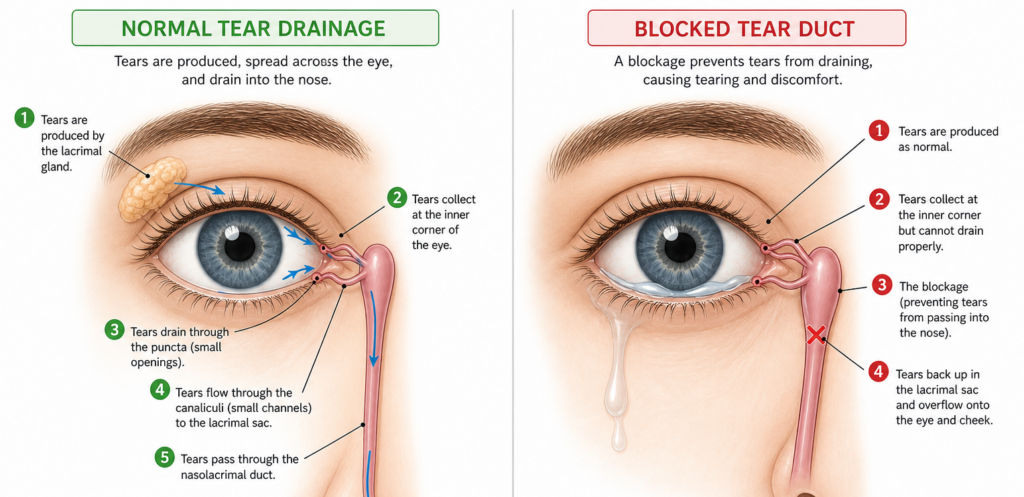
Why do blocked tear ducts cause watery eyes?
Tears are supposed to spread across the eye and then drain into tiny openings near the inner eyelids, passing into the nose. Mayo Clinic explains that when this drainage system is partly or completely blocked, tears cannot drain normally, so the eye becomes watery and irritated. Adults may develop blockage because of infection, inflammation, injury, age-related change, prior surgery, certain medicines, or rarely a tumor. (Mayo Clinic)
So when a patient says, “My eye waters all day,” the problem may be a tear drainage issue rather than dry eye alone. In India, this area is often called dacryology within oculoplasty services. Indian specialty centers describe detailed evaluation of the tear duct from both the eye side and the nasal side, especially in persistent or complicated cases. (lvpei.org)
What symptoms suggest a tear-duct problem?
Typical symptoms include constant watering, recurrent sticky discharge, crusting, redness, repeated infection, and swelling near the inner corner of the eye. Mayo Clinic also notes that persistent tearing should be assessed because, in uncommon cases, a tumor pressing on the drainage pathway can be the cause. (Mayo Clinic)
How is it treated?
Treatment depends on the cause. Mild cases may be managed differently from complete, long-standing obstruction. For adults with a true nasolacrimal duct block, one of the most common surgeries is dacryocystorhinostomy, or DCR. Mayo Clinic describes DCR as a procedure that creates a new drainage passage into the nose, and this may be done externally or through the nose. Indian centers such as Aravind and LVPEI also list probing, external DCR, endonasal DCR, intubation tubes, and selected advanced lacrimal procedures as part of routine oculoplastic care. (Mayo Clinic)
Patients are often relieved to learn that “watering eyes” is not something they must just tolerate forever. When the right cause is identified, treatment can be very effective. (Mayo Clinic)
Eye-orbit problems an oculoplastic surgeon treats
1) Thyroid eye disease
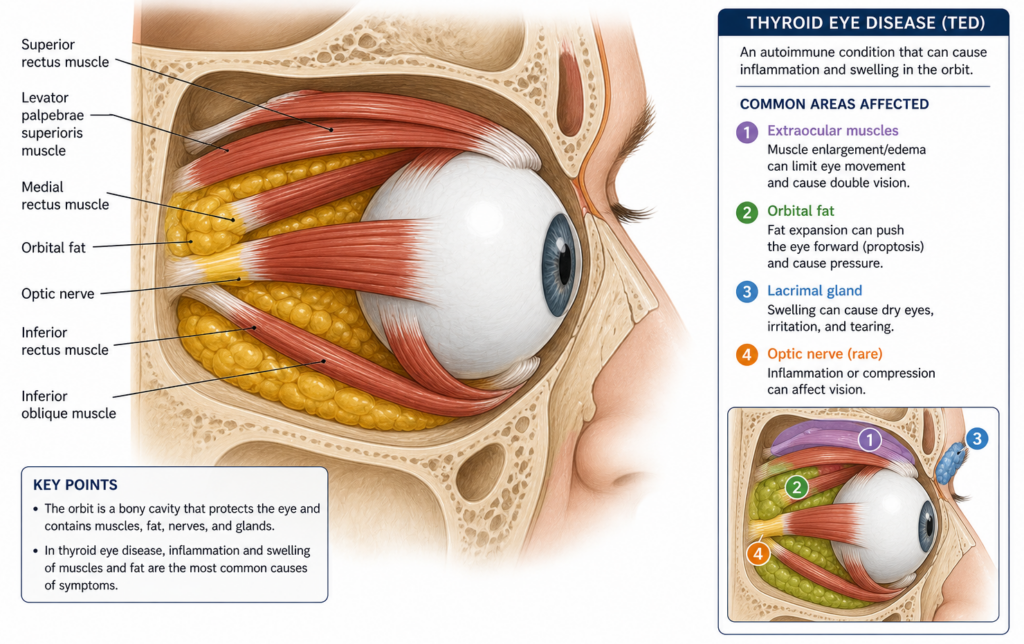
This is one of the most misunderstood orbit problems. Thyroid eye disease, also called TED or Graves’ eye disease, is an immune-mediated inflammation of the orbit. It can cause bulging eyes, lid retraction, incomplete eyelid closure, dryness, tearing, redness, pain behind the eye, double vision, and in severe cases optic nerve damage. StatPearls notes that it is the most common cause of adult proptosis, and that eyelid retraction is among its most common signs. (NCBI)
This condition is a very good example of why an oculoplastic surgeon is not “just a cosmetic eyelid surgeon.” In thyroid eye disease, the problem is deeper in the orbit. Treatment may involve lubricants and corneal protection for mild disease, medical therapy during active inflammation, and then staged surgery for selected patients. ASOPRS notes that function and appearance can often be improved by reconstructive eyelid or orbital surgery, while StatPearls describes roles for orbital decompression, strabismus surgery, and eyelid surgery depending on the stage and severity. Indian orbit clinics also routinely co-manage these patients with physicians and endocrinologists. (asoprs.org)
2) Orbital fractures after injury
A blow to the face can fracture the bones around the eye. These fractures may cause double vision, poor eye movement, sunken appearance of the eye, numbness, swelling, or sometimes vision problems. Aravind specifically lists orbital trauma and orbital floor fracture repair as part of oculoplastic practice. StatPearls notes that some orbital fractures can be managed conservatively while others need surgery to restore function and appearance. (Aravind Eye Care System)
This is why people injured in road accidents, sports injuries, or assaults may eventually be referred to orbit-oculoplasty services after emergency stabilization. In India, these cases are often managed in coordination with maxillofacial surgeons, ENT specialists, or neurosurgeons when facial bones or sinuses are also involved. (Aravind Eye Care System)
3) Orbital infections and inflammation
Some eye-socket infections are emergencies. Orbital cellulitis can present with painful eye movements, bulging of the eye, reduced eye movement, eyelid swelling, and decreased vision. These are dangerous warning signs because the infection is behind the orbital septum, not just in the skin in front of the eyelid. Timely treatment matters because vision and even general health can be at risk. (NCBI)
Oculoplastic and orbit surgeons may become involved in diagnosis, imaging decisions, drainage procedures, or management of complications, especially when sinus disease or abscess formation is present. (PMC)
4) Orbital tumors and prosthetic rehabilitation
The orbit can also develop benign or malignant masses. Indian tertiary eye centers describe routine management of orbital tumors, biopsies, tumor removal, and histopathology support. If an eye has to be removed because of severe trauma or tumor, oculoplastic services also handle socket reconstruction and custom ocular prostheses to restore appearance. (Aravind Eye Care System)
Is oculoplasty only cosmetic?
No. That is probably the biggest misconception.
Cosmetic procedures are certainly part of the field. Indian and international oculoplastic services include blepharoplasty, facial aesthetic procedures, and selected use of botulinum toxin. But the field is equally, and often more importantly, about function and safety: keeping the eye protected, restoring tear drainage, improving vision blocked by the eyelid, repairing trauma, and treating orbit disease. (lvpei.org)
A useful way to think about it is this: if the surgery helps the eye see better, blink better, close better, drain tears better, move better, or stay safer, it is not “just cosmetic,” even if appearance also improves. (American Academy of Ophthalmology)
When should you see an oculoplastic surgeon?
You should consider seeing one if you have a droopy lid affecting vision, repeated watering from one eye, a lid that turns in or out, a persistent swelling near the inner corner of the eye, a suspicious eyelid lump, eye bulging, double vision, or a deformity after trauma. These are classic oculoplastic complaints. (Aravind Eye Care System)
You should seek urgent care if you have sudden painful eyelid swelling with fever, pain when moving the eye, reduced vision, new double vision after injury, or rapid bulging of the eye. Those can point to orbital cellulitis, fracture-related complications, or severe thyroid-related compression of the optic nerve. (NCBI)
The bottom line for patients in India
If someone tells you that an oculoplastic surgeon “only does cosmetic eyelids,” that is not accurate. In India, as at major eye centers worldwide, oculoplasty is a broad ophthalmic subspecialty that covers eyelid disorders, tear-duct disease, orbit problems, trauma, reconstruction, prosthetics, and selected cosmetic surgery. So the answer to “What does eyelid surgery help with?” is: sometimes it helps you look fresher, but very often it helps you see better, protects your eye, reduces watering, repairs injury, or treats disease around the eye. (Aravind Eye Care System)
If you have symptoms in this area, the right first step is not to guess whether it is cosmetic or medical. It is to get examined by an ophthalmologist or oculoplastic surgeon who can tell the difference and guide you properly. (Aravind Eye Care System)
Visit our eye hospital for a comprehensive oculoplasty evaluation if you have droopy lids, chronic watering, eyelid swelling, eye bulging, or an eyelid lump that is not settling. Early assessment often makes treatment simpler and safer. (Mayo Clinic)
References
- Aravind Eye Care System, “Orbit, Oculoplasty, Prosthetics & Oncology.” (Aravind Eye Care System)
- LV Prasad Eye Institute, “Ophthalmic Plastic and Facial Aesthetic Surgery Services.” (lvpei.org)
- Moorfields Eye Hospital, “Ptosis (droopy eyelid).” (moorfields.nhs.uk)
- Mayo Clinic, “Blocked tear duct: Symptoms & causes” and “Diagnosis & treatment.” (Mayo Clinic)
- NCBI Bookshelf, “Thyroid Eye Disease” and “Orbital Floor Fracture.” (NCBI)