
Choosing the right eyeglass lenses is not just about your frame or fashion. Your prescription strength plays a major role in deciding lens thickness, weight, clarity, and comfort. Higher prescriptions often benefit from high-index lenses and specific coatings to reduce thickness, glare, and eye strain. Lower prescriptions have more flexibility and may not need advanced options. Understanding how lens index, coatings, and materials relate to your prescription helps you get glasses that look better, feel lighter, and provide clearer vision for everyday life.
How to Choose Eyeglass Lenses Based on Your Prescription Strength
As an eye doctor, one of the most common concerns I hear from patients is not about the glasses frame, but about the lenses themselves. Many people walk into an optical store with a prescription in hand and feel overwhelmed by terms like “high-index,” “anti-reflective coating,” or “blue light filter.”
These questions are especially common on optometry forums, and understandably so. The right lens choice depends heavily on your prescription strength. What works well for a mild prescription may be uncomfortable or impractical for a stronger one.
In this article, I will guide you step by step through how prescription strength affects lens choice, what lens index really means, which coatings are useful at different prescription levels, and how to make practical decisions that balance comfort, clarity, and cost.
Why Prescription Strength Matters More Than You Think
Your eyeglass prescription tells us how much optical correction your eyes need. This correction is measured in diopters and written as plus (+) or minus (–) numbers.
A small number, such as –1.00 or +1.25, means a mild prescription. A larger number, such as –6.00 or +5.00, indicates a stronger prescription.
Prescription strength affects:
Lens thickness
Lens weight
Edge thickness or center thickness
Visual clarity
Distortion at the edges
Cosmetic appearance
Ignoring prescription strength when choosing lenses can lead to glasses that feel heavy, look bulky, or cause visual discomfort.
Understanding Lens Index in Simple Terms
What Is Lens Index?
Lens index, also called refractive index, describes how efficiently a lens bends light. The higher the index, the more the lens can bend light using less material.
In simple words, higher index lenses are thinner for the same prescription.
Common lens index options include:
1.50 (standard plastic)
1.56 or 1.59 (polycarbonate)
1.60
1.67
1.74
Each step up in index makes the lens thinner and lighter.
Choosing Lens Index Based on Prescription Strength
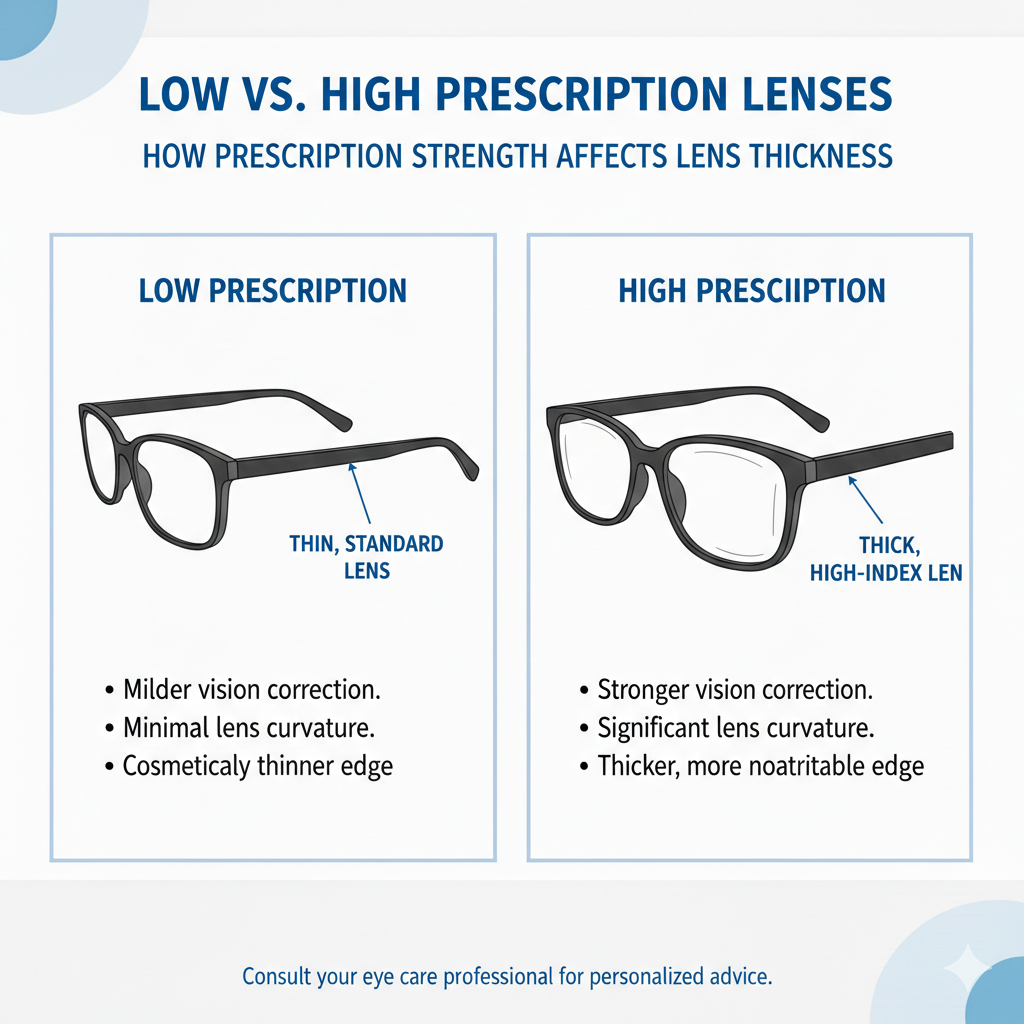
Low Prescriptions (Up to ±2.00)
If your prescription is mild, lens thickness is usually not a concern.
Standard 1.50 plastic lenses often work very well. They provide good clarity, are affordable, and do not look bulky in most frames.
At this level, choosing higher index lenses usually offers little visual or cosmetic benefit.
Moderate Prescriptions (±2.25 to ±4.00)
At moderate strengths, lens thickness becomes more noticeable, especially in smaller or thinner frames.
A 1.56, 1.59 (polycarbonate), or 1.60 index lens is often a good balance between comfort and cost.
These lenses:
Reduce edge thickness
Feel lighter on the nose
Look better cosmetically
For many adults in this range, 1.60 index lenses are a popular and practical choice.
High Prescriptions (±4.25 to ±6.00)
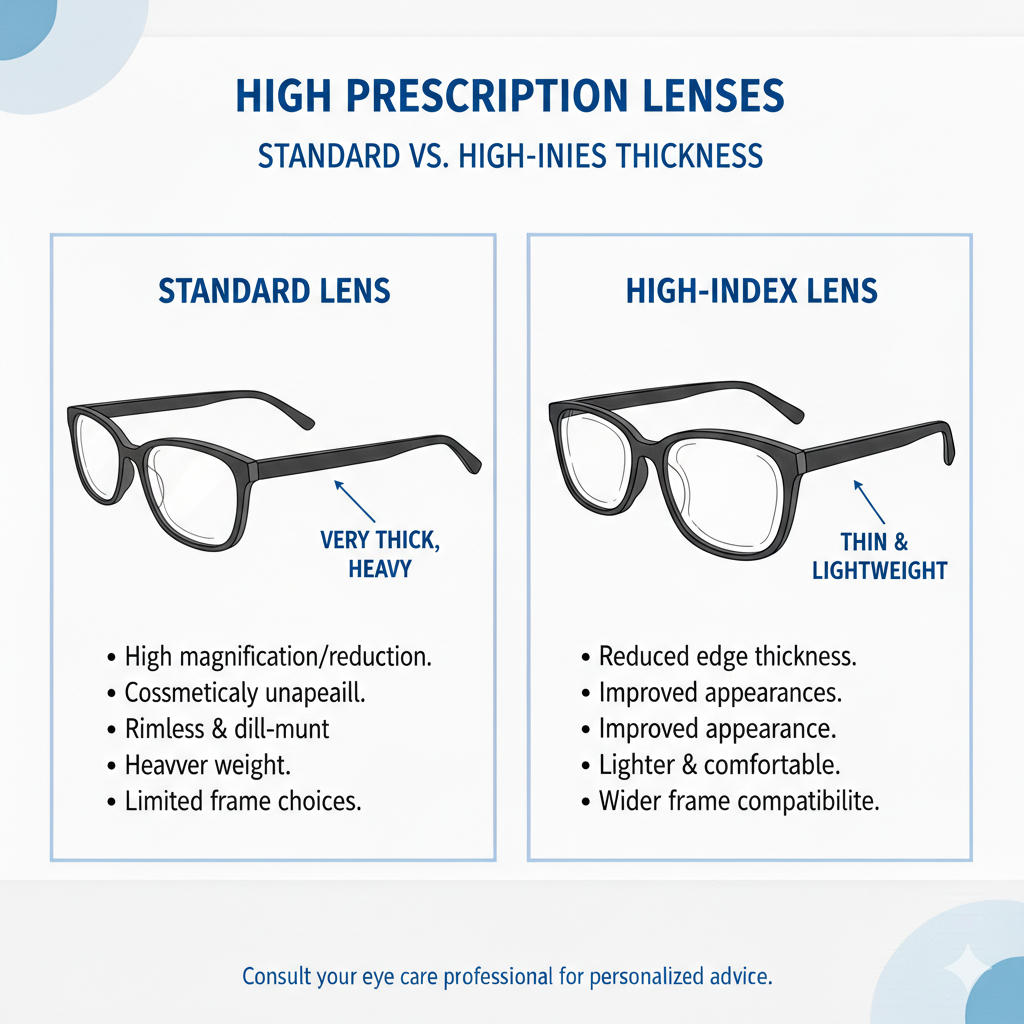
For stronger prescriptions, lens index becomes very important.
Using standard plastic lenses at this level can result in:
Thick edges for minus lenses
Bulging centers for plus lenses
Heavy glasses
Increased distortion
High-index lenses such as 1.67 are strongly recommended. They significantly reduce thickness and improve comfort, especially for all-day wear.
Very High Prescriptions (Above ±6.00)
For very strong prescriptions, lens choice can make or break the wearing experience.
At this level, 1.74 index lenses offer the thinnest and lightest option available for glasses.
These lenses:
Minimize the “coke bottle” effect
Reduce pressure on the nose and ears
Improve cosmetic appearance
Allow more frame choices
While they are more expensive, most patients with very high prescriptions find them worth the investment.
Lens Material and Prescription Strength
Plastic (CR-39)
Best for low prescriptions
Good optical clarity
Affordable
Thicker at higher powers
Polycarbonate
Often recommended for children
Impact-resistant
Naturally blocks UV rays
Slightly less optical clarity than plastic
Works well for mild to moderate prescriptions.
High-Index Materials
Designed for stronger prescriptions
Thinner and lighter
May reflect more light without coating
Best choice for moderate to high prescriptions.
Why Lens Coatings Matter More as Prescriptions Increase
As prescription strength increases, lens surfaces become more curved and reflective. This makes coatings much more important for comfort and vision quality.
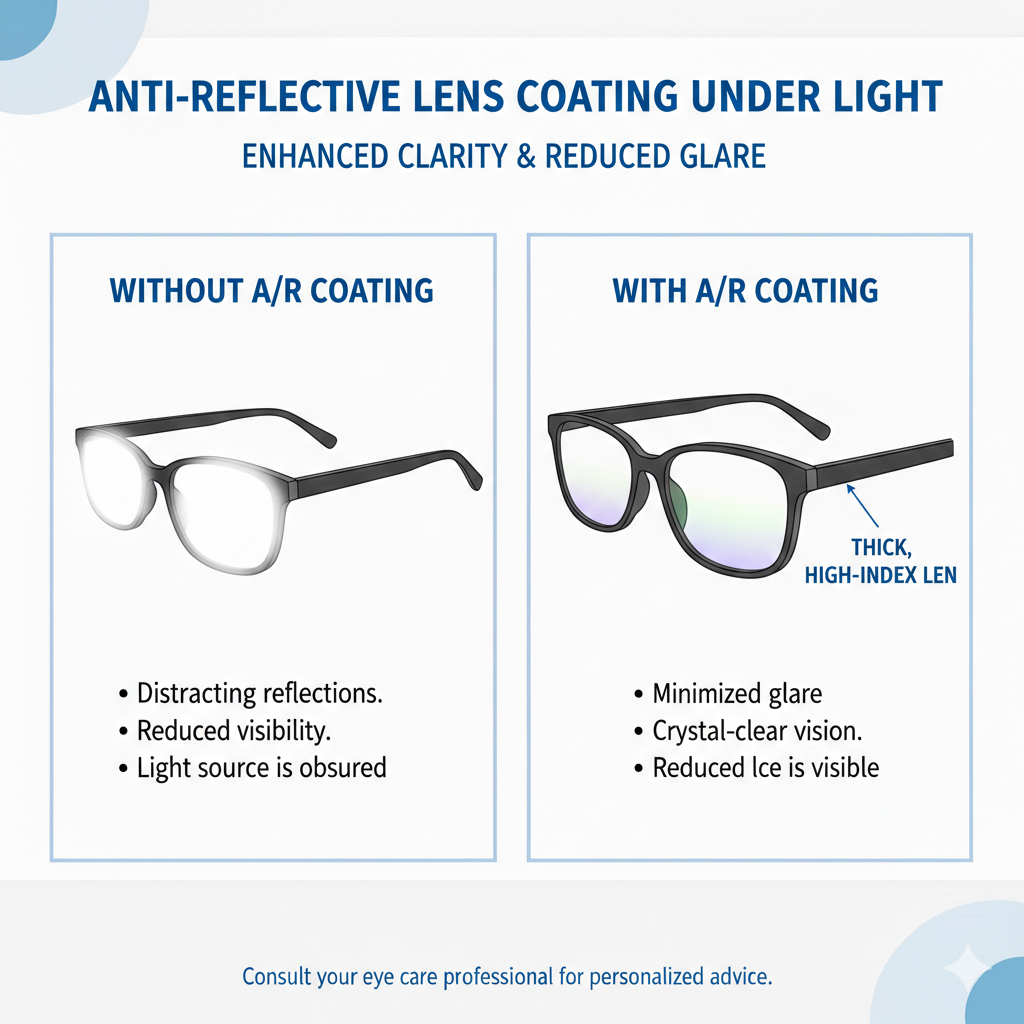
Anti-Reflective (AR) Coating and Prescription Level
What It Does
Reduces glare
Improves night vision
Makes lenses look clearer
Enhances screen use comfort
For low prescriptions, AR coating is helpful but optional.
For moderate to high prescriptions, AR coating is strongly recommended. High-index lenses reflect more light, and without AR coating, glare can be distracting.
Scratch-Resistant Coating
All modern lenses include some scratch resistance, but this is especially important for:
High-index lenses
Polycarbonate lenses
Stronger prescriptions often require thinner materials, which benefit from added surface protection.
UV Protection and Prescription Strength
UV protection is essential for everyone, regardless of prescription strength.
Many high-index and polycarbonate lenses block UV rays automatically. Standard plastic lenses may require an added UV coating.
Long-term UV exposure increases the risk of cataracts and retinal damage, so this feature should never be skipped.
Blue Light Filtering: Does Prescription Strength Matter?
Blue light filtering lenses are often discussed on forums, especially by people who work long hours on screens.
Prescription strength itself does not determine the need for blue light filters. Instead, it depends on lifestyle.
However, patients with higher prescriptions may experience more visual fatigue, and blue light filtering combined with AR coating can improve comfort during prolonged screen use.
Frame Choice and Prescription Strength
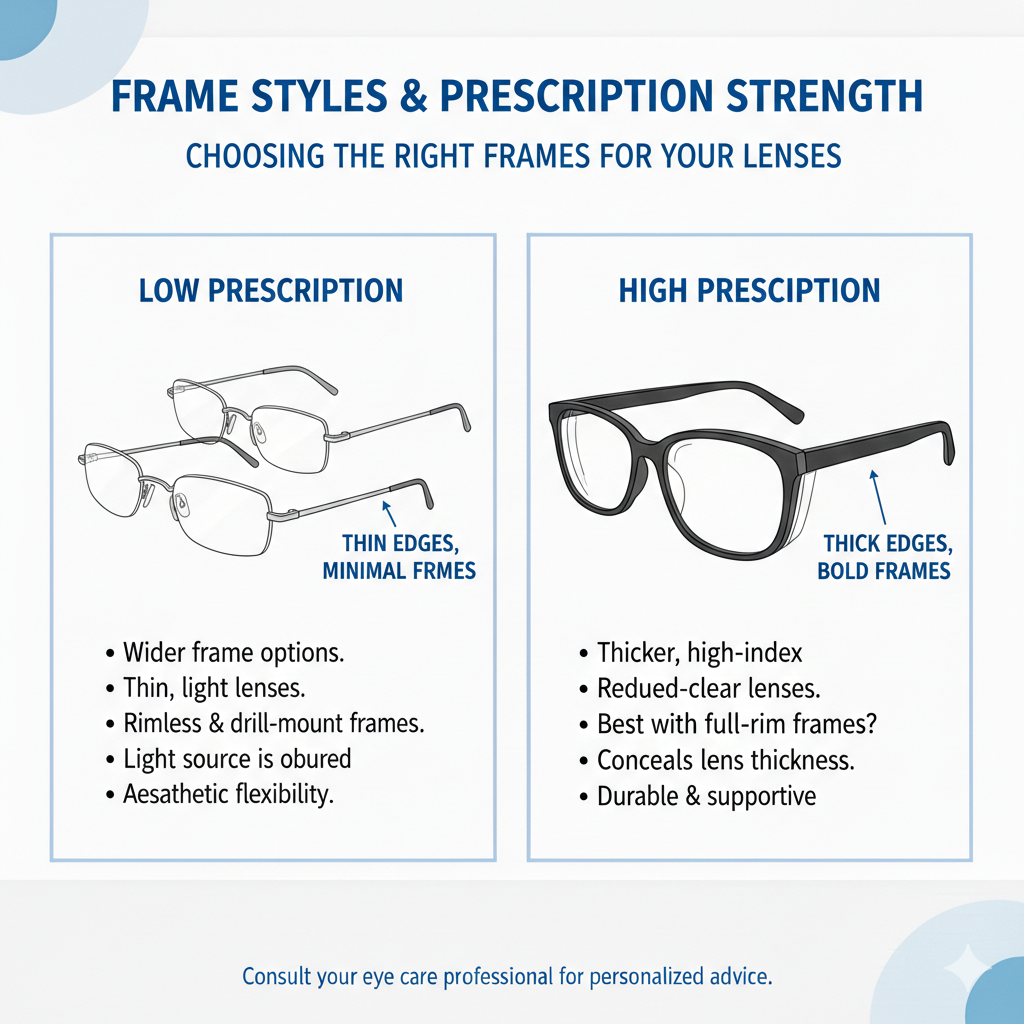
Lens choice does not exist in isolation. Frame selection plays a major role.
Higher prescriptions benefit from:
Smaller frames
Thicker rims
Rounded shapes
These designs help hide lens thickness and reduce distortion.
Common Myths About High-Index Lenses
Many patients believe that higher index lenses always provide better vision. This is not entirely true.
High-index lenses make glasses thinner and lighter, but optical quality depends on proper design, fitting, and coatings.
For low prescriptions, higher index does not improve vision and may add unnecessary cost.
When to Talk to Your Eye Doctor or Optician
You should seek professional guidance if:
Your prescription is above ±3.00
Your glasses feel heavy or uncomfortable
You experience glare or eye strain
Your lenses look very thick
You are changing frame styles
An experienced eye care professional can balance prescription strength, lens index, coatings, and frame choice for the best outcome.
Call to Action
If you are unsure which lenses are right for your prescription, do not rely solely on online advice. A comprehensive eye exam and personalized lens consultation can make a significant difference in comfort and clarity.
Visit our eye hospital or book an appointment with our ophthalmology team to receive expert guidance tailored to your eyes and lifestyle.
References
American Academy of Ophthalmology – Eyeglasses and Lens Options
https://www.aao.org
Mayo Clinic – Glasses and Vision Correction
https://www.mayoclinic.org
National Eye Institute – Vision Correction
https://www.nei.nih.gov
PubMed – Optical Properties of High-Index Lenses
https://pubmed.ncbi.nlm.nih.gov