
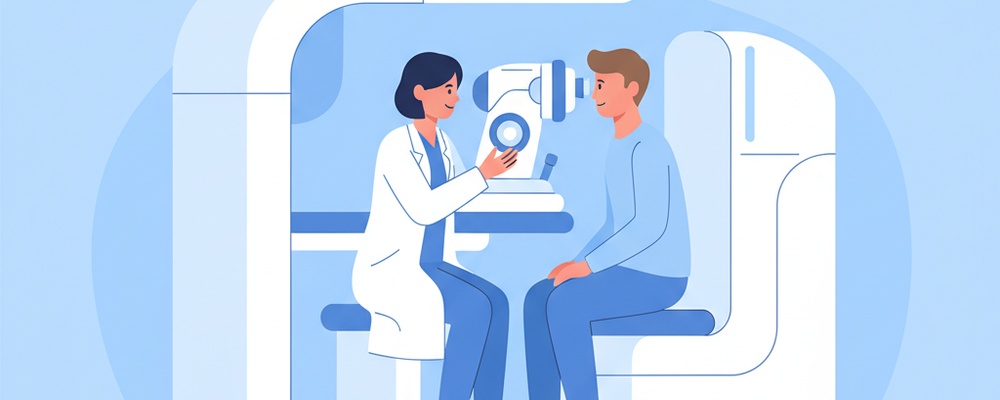
Meibography is a crucial diagnostic test that provides a detailed, high-resolution map of your meibomian glands. These tiny glands in your eyelids are essential for a healthy tear film, and this imaging helps us understand the root cause of many dry eye symptoms. It’s a quick, non-invasive way for your ophthalmologist to assess the health of your glands.
What is a Meibography?
Meibography is an advanced imaging technology that uses harmless infrared light to visualize the structure of the meibomian glands within the upper and lower eyelids. Unlike a standard eye exam, this test captures a direct picture of the glands, revealing their shape, length, and any areas of damage or loss (atrophy). This visual evidence is critical for accurately diagnosing Meibomian Gland Dysfunction (MGD), a leading cause of evaporative dry eye disease.
Why is this test performed?
Your cornea and dry eye specialist at Pristine Eye Hospitals may recommend a meibography to:
Diagnose the Cause of Dry Eye: To determine if your symptoms like burning, grittiness, or watering are caused by Meibomian Gland Dysfunction (MGD).
Assess Gland Health: To evaluate the extent of gland atrophy or “dropout,” which is when glands have become permanently damaged and are no longer present.
Create a Targeted Treatment Plan: The results help your doctor choose the most effective treatment, such as LipiFlow, IPL therapy, or specific eye drops, tailored to your condition.
Monitor Treatment Progress: To track changes in your gland structure over time and see how well your prescribed treatment is working.
How to Prepare for Your Meibography
Preparation for a meibography is minimal, as it is a quick and simple in-office procedure. There are just a few things to keep in mind to ensure the clearest possible images are captured.
Please avoid wearing any eye makeup, including mascara, eyeliner, or eyeshadow, on the day of your appointment.
If you wear contact lenses, you may be asked to remove them just before the test.
No special diet, fasting, or medication changes are required before the procedure.
The Procedure: What to Expect Step-by-Step
The meibography process is straightforward, painless, and takes only a few minutes.
1. You will be seated comfortably in front of the specialized imaging machine, placing your chin on a chin rest to keep your head steady.
2. Your ophthalmologist or a trained technician will gently evert (flip) your lower eyelid to expose the glands for imaging. The same process may be repeated for the upper eyelid.
3. The device’s infrared camera will capture high-definition images of the glands in just a few seconds. You will not feel anything during this process.
4. The images are instantly available on a screen for your doctor to review with you.
Understanding Your Results
Your meibography results provide a clear visual report on the health of your meibomian glands. In a healthy eye, the images will show long, uniform, parallel glands, resembling the keys on a piano. If you have MGD, the images may reveal glands that are shortened, distorted, dilated, or completely missing (gland dropout).
Your doctor at Pristine Eye Hospitals will explain these images to you, pointing out any abnormalities. This detailed view allows for a precise diagnosis and helps quantify the severity of your condition. Based on this information, we can create a personalized and highly effective treatment plan to manage your dry eye symptoms and preserve your remaining gland function.
Frequently Asked Questions
Is Meibography painful?
No, the test is completely painless and non-invasive. The instrument does not touch your eye, and the infrared light used for imaging is not visible and cannot be felt.
How long does the test take?
The actual imaging process takes only a few seconds for each eyelid. The entire appointment for the test is typically completed in under five minutes.
Why is this test important for dry eye?
It moves beyond just treating symptoms by identifying a primary underlying cause of dry eye—MGD. By visualizing the gland structure, we can directly diagnose the problem and tailor treatments to improve gland function and relieve your discomfort.