
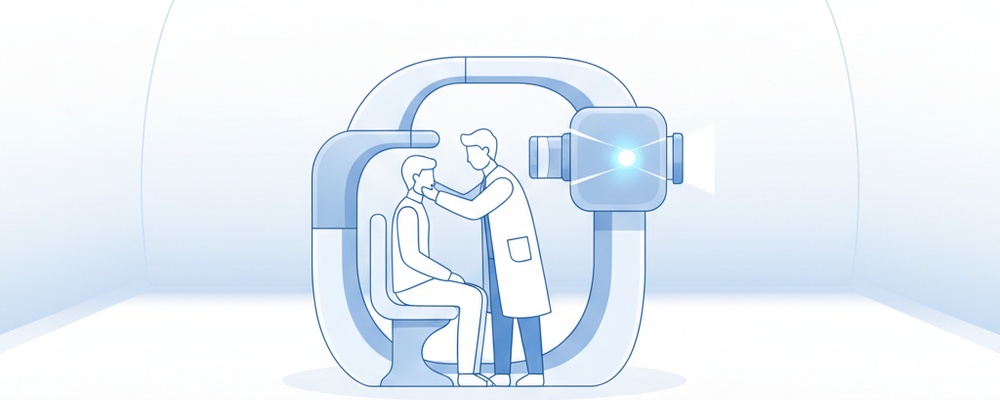
The Lenstar LS 900 provides a highly detailed map of your eye, essential for planning a successful cataract surgery. This advanced, non-contact diagnostic test uses optical biometry to take incredibly precise measurements. These measurements are crucial for selecting the perfect Intraocular Lens (IOL) to restore your vision.
What is a Lenstar LS 900 / Optical Biometry?
The Lenstar LS 900 is a state-of-the-art optical biometer that uses a harmless, low-coherence light beam to perform nine different measurements in a single, rapid scan. It captures a complete anatomical profile of your eye, including its axial length (the length from front to back), corneal curvature (keratometry), anterior chamber depth, and lens thickness. Unlike older methods, this technology provides unmatched accuracy without any part of the instrument touching your eye, ensuring both comfort and precision.
Why is this test performed?
This test is a critical step in the pre-operative evaluation for cataract surgery. Its primary purposes include:
To precisely calculate the correct power of the Intraocular Lens (IOL) that will replace your eye’s natural, cloudy lens.
To ensure the best possible vision outcome after surgery, helping to reduce your dependence on glasses for distance vision.
To provide the comprehensive data required for implanting advanced premium IOLs, such as toric lenses for astigmatism or multifocal lenses for a range of vision.
To obtain highly accurate and repeatable measurements, which are vital for surgical planning and predictable results.
How to Prepare for Your Lenstar LS 900 / Optical Biometry
Preparation for this test is simple and requires very little on your part. To ensure the most accurate readings, we recommend the following:
Remove Contact Lenses: If you wear soft contact lenses, please remove them at least 24 hours before your appointment. If you wear hard (RGP) lenses, they should be removed for a longer period, as advised by your doctor.
Inform our Staff: Let the technician know about any previous eye surgeries, injuries, or known conditions you may have.
No fasting or special drops are required for this test.
The Procedure: What to Expect Step-by-Step
The Lenstar biometry test is quick, efficient, and completely comfortable. Here is what you can expect:
1. You will be seated in a comfortable chair in front of the Lenstar LS 900 device.
2. Our technician will ask you to place your chin on a chinrest and your forehead against a positioning bar. This helps keep your head perfectly still during the measurement process.
3. You will be asked to look straight ahead at a small, steady light inside the machine.
4. The scan itself is over in seconds. The entire process for both eyes is typically completed in just a few minutes.
Understanding Your Results
The Lenstar LS 900 provides your ophthalmologist with a detailed report containing multiple precise measurements of your eye’s unique structure. These numbers are not a diagnosis of disease but are essential data points. Your surgeon will input these measurements, especially the axial length and corneal curvature, into advanced mathematical formulas (like SRK/T, Holladay, or Barrett Universal II).
This calculation determines the exact power of the Intraocular Lens (IOL) required to give you the clearest possible vision after your cataract is removed. The exceptional accuracy of the Lenstar LS 900 directly translates to a more predictable and successful surgical outcome, tailored specifically to your eye’s anatomy and your visual needs.
Frequently Asked Questions
Is the Lenstar LS 900 test painful?
No, the test is completely painless and non-contact. A beam of light is used for measurements, and nothing will touch your eye.
How long does the test take?
The entire process is very quick, usually taking just a few minutes to measure both eyes. You will spend more time getting positioned than on the actual scan itself.
Why is this test better than older methods?
Optical biometry like the Lenstar LS 900 is far more accurate and repeatable than older ultrasound methods. This superior precision leads to better IOL power calculations and more predictable vision outcomes after surgery.