
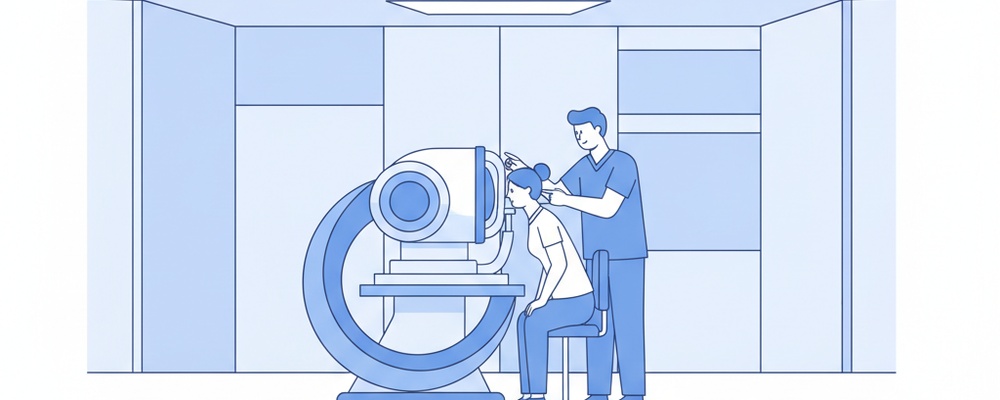
Corneal Topography is a sophisticated, non-invasive diagnostic test that creates a detailed 3D map of your cornea’s surface curvature. This painless procedure is a critical step in the workup for refractive surgeries like Contoura Vision LASIK, ensuring the highest levels of safety and precision for your vision correction journey. At Pristine Eye Hospitals, we use this advanced technology to achieve the best possible outcomes for our patients.
What is a Corneal Topography / Tomography?
Think of corneal topography as creating a unique “fingerprint” for the front surface of your eye. The technology uses a series of illuminated rings projected onto your cornea, which are then reflected back into the device. A computer analyzes these reflections to generate a highly detailed, colour-coded map. This map precisely illustrates the shape, curvature, and power of your cornea, while tomography provides an even more comprehensive view by mapping the front and back surfaces as well as its thickness.
Why is this test performed?
This detailed corneal map is essential for several reasons, primarily to ensure your eyes are healthy and suitable for specific procedures. Key indications include:
Refractive Surgery Screening: It is a mandatory test to determine candidacy for surgeries like LASIK, SMILE, and Contoura Vision by assessing corneal shape and thickness.
Detecting Irregularities: It helps identify and monitor conditions like keratoconus (a progressive thinning and bulging of the cornea) and irregular astigmatism.
Contact Lens Fitting: It aids in the precise fitting of specialized contact lenses, especially rigid gas permeable (RGP) and scleral lenses.
Pre-Surgical Planning: It is used before cataract surgery to accurately calculate the power of the intraocular lens (IOL) to be implanted.
How to Prepare for Your Corneal Topography / Tomography
Preparation for this test is simple but very important for accurate results. Your ophthalmologist will provide specific instructions, which generally include discontinuing the use of contact lenses as they can temporarily alter the cornea’s natural shape.
Soft Contact Lenses: Stop wearing them for at least 3-7 days before your appointment.
Hard (RGP) Contact Lenses: Stop wearing them for at least 2-3 weeks before your appointment.
On the day of your test, avoid wearing eye makeup.
The Procedure: What to Expect Step-by-Step
The entire process is quick, non-contact, and completely painless.
1. You will be seated comfortably in front of the topography machine.
2. You will be asked to place your chin on a chin rest and your forehead against a bar to keep your head still.
3. You will look straight ahead at a fixed light or target inside the instrument. You may be asked to blink and then keep your eye wide open for a few seconds.
4. The machine will capture the images in a matter of seconds without touching your eye. The process is then repeated for the other eye.
Understanding Your Results
The output of a corneal topography scan is a detailed colour map. This map uses a colour spectrum to represent the different curvatures of your cornea. Generally, warm colours (like reds and oranges) indicate steeper areas, while cool colours (like blues and greens) indicate flatter areas. A smooth, regular, and symmetrical pattern is typically seen in a healthy cornea.
Our expert ophthalmologists at Pristine Eye Hospitals will carefully analyze this map to check for any signs of irregularity, assess the severity of astigmatism, and confirm that your cornea has sufficient thickness and a stable shape for any planned procedure. This analysis is fundamental to creating a personalized and safe treatment plan tailored specifically to your eyes.
Frequently Asked Questions
Is Corneal Topography painful?
No, the test is completely non-contact and painless. You will not feel anything during the scan as nothing touches your eye.
How long does the test take?
The imaging process itself takes only a few seconds for each eye. The entire appointment for the test is typically completed within 5-10 minutes.
Why must I stop wearing contact lenses before the test?
Contact lenses rest on the cornea and can temporarily reshape its surface. To get a true and accurate measurement of your cornea’s natural curvature, it is crucial to allow it to return to its normal shape.