
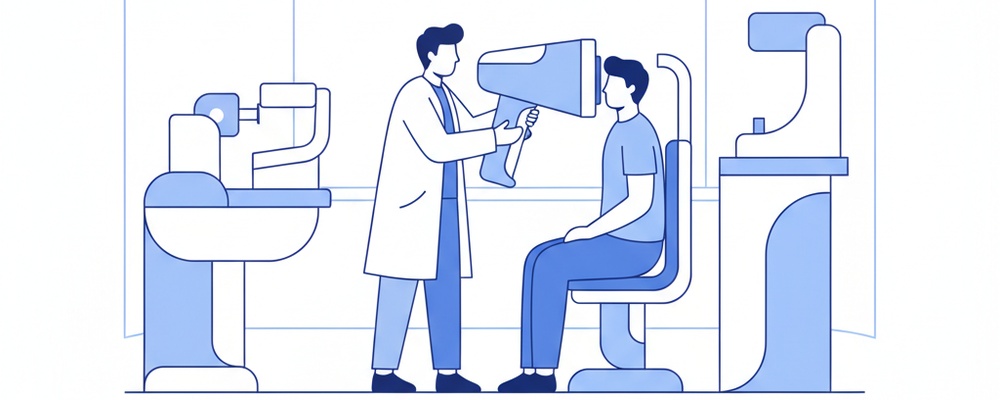
Just as you have a dominant hand, you also have a dominant eye that your brain prefers for visual input. A dominant eye test is a quick and simple assessment to determine which of your eyes is the leading one. This information is a crucial part of planning for personalised vision correction.
What is a Dominant Eye Testing?
Ocular dominance, or eye dominance, refers to the tendency to prefer visual input from one eye over the other. The dominant eye is the one that provides slightly more information to the brain’s visual cortex and more accurately relays positional information. A dominant eye test is not a measure of vision clarity but a simple, non-invasive assessment to identify this natural preference. At Pristine Eye Hospitals, our specialists use this test to understand your unique visual system.
Why is this test performed?
This test is essential for tailoring certain vision correction strategies. Key reasons include:
Monovision Planning: It is critical for planning monovision correction, whether through LASIK, contact lenses, or cataract surgery with IOLs. The dominant eye is typically corrected for distance vision, and the non-dominant eye for near vision.
Contact Lens Fitting: For patients considering monovision or multifocal contact lenses, knowing the dominant eye ensures a more comfortable and effective fit.
Surgical Precision: It helps surgeons make informed decisions during refractive and cataract surgeries to achieve the best possible visual outcomes for the patient.
Vision Therapy: The results can be valuable in certain vision therapy programs designed to improve binocular vision (how the eyes work together).
How to Prepare for Your Dominant Eye Testing
No special preparation is required for this test, as it is a simple observational assessment. However, to ensure a smooth and comprehensive evaluation at our Hyderabad centres:
Bring your current eyeglasses or contact lenses with you to the appointment.
Be prepared to discuss your visual habits and any concerns you may have with our eye care professional.
The Procedure: What to Expect Step-by-Step
The dominant eye test is quick, painless, and is often part of a standard comprehensive eye exam. A common method is the “Miles test”:
1. You will be asked to fully extend both arms in front of you.
2. You will then create a small triangular opening by overlapping your thumbs and index fingers.
3. With both eyes open, you will be instructed to look through this opening and centre a distant object (like a chart or a clock on the wall).
4. Our specialist will then ask you to close one eye at a time. The eye that keeps the object centred within the opening is your dominant eye.
Understanding Your Results
The result of your test will be straightforward: you are either right-eye dominant or left-eye dominant. A small percentage of people have no strong preference, which is known as mixed ocular dominance. This result is not an indicator of a “good” or “bad” eye; it is simply a normal neurological trait, similar to being right-handed or left-handed.
Understanding this trait is key to successful monovision correction. By setting your dominant eye for clear distance vision, we allow your brain to adapt more naturally and comfortably to having the non-dominant eye corrected for near tasks. This personalised approach maximises visual comfort and reduces the adaptation period for new multifocal or monovision solutions.
Frequently Asked Questions
Is having a dominant eye a problem?
No, not at all. It is a completely normal and common neurological feature that helps your brain process visual information efficiently and perceive depth.
Can my dominant eye change over time?
For most people, ocular dominance is stable throughout life. However, a significant eye injury or certain neurological conditions could potentially cause a shift in dominance.
How long does a dominant eye test take?
The test is extremely fast. It typically takes less than a minute to perform and is seamlessly integrated into your overall vision and refraction examination.