
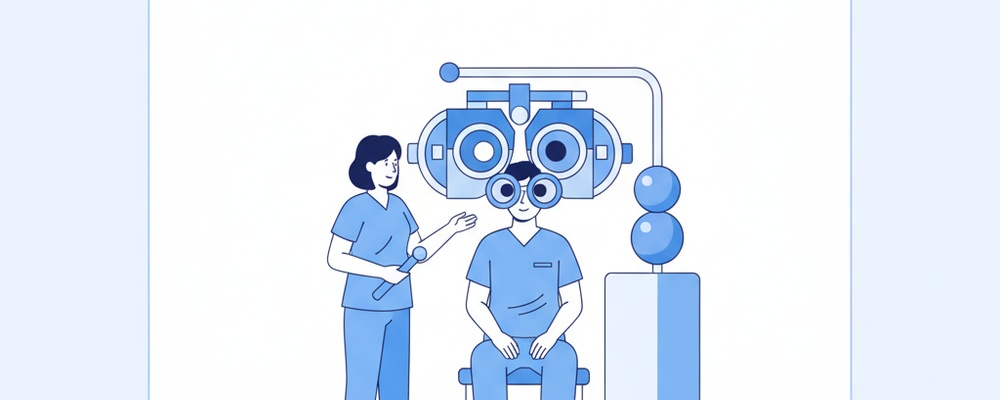
An Autorefraction is a quick, painless, and highly common test performed during a routine eye examination at Pristine Eye Hospitals. It provides our ophthalmologists with a fast and accurate baseline measurement of your eye’s prescription. This automated test serves as a crucial starting point for determining the precise vision correction you need.
What is a Autorefraction?
Autorefraction is a diagnostic test that uses a computer-controlled machine, known as an autorefractor, to objectively measure a person’s refractive error. The device works by shining a beam of light into the eye and measuring how it reflects off the retina (the light-sensitive layer at the back of the eye). Based on this reflection, the machine calculates an objective measurement for nearsightedness (myopia), farsightedness (hyperopia), and astigmatism without requiring any feedback from the patient.
Why is this test performed?
This test is an essential part of a comprehensive eye checkup for several reasons:
To obtain a quick and accurate starting point for determining your eyeglass or contact lens prescription.
To efficiently screen for refractive errors in children or patients who may have difficulty communicating.
To provide an objective measurement that helps the ophthalmologist refine the prescription during the subjective refraction test (the “which is better, 1 or 2?” part).
To monitor changes in your vision during regular annual eye examinations.
How to Prepare for Your Autorefraction
One of the key benefits of an autorefraction test is that it requires virtually no special preparation. It is a quick, non-invasive procedure that is performed as part of your initial eye workup.
If you wear contact lenses, you may be asked to remove them before the test.
Inform your technician or doctor about any current eye conditions or medications you are taking.
There is no need for dilating eye drops for this specific test.
The Procedure: What to Expect Step-by-Step
The autorefraction process is simple, comfortable, and takes less than a minute.
1. You will be seated and asked to place your chin on a chin rest and your forehead against a bar on the machine. This helps keep your head steady for an accurate reading.
2. You will be instructed to look into the instrument at an image, which is often a picture of a hot air balloon or a small house at the end of a road.
3. The image will move in and out of focus as the machine takes its measurements. It is important to relax and blink normally.
4. The machine will automatically take a reading for one eye and then repeat the process for the other. The entire test is completely painless.
Understanding Your Results
The autorefractor will produce a printout with a series of numbers that represent an objective measurement of your eye’s refractive error. This printout gives your ophthalmologist valuable data about the potential presence and degree of myopia, hyperopia, and astigmatism.
It is important to understand that these results are not your final prescription. Your eye doctor will use this information as a starting point for a subjective refraction. This is where they will ask for your feedback to fine-tune the lens power, ensuring your final prescription provides the sharpest, clearest, and most comfortable vision possible.
Frequently Asked Questions
Is the autorefraction test painful?
No, the test is completely painless and non-invasive. You will simply see a light or an image, and there is no physical contact with your eye.
How long does an autorefraction take?
The actual measurement process is very fast, taking only a few seconds per eye. The entire time you spend at the machine is typically less than a minute.
Can an autorefractor replace a full eye exam?
No, an autorefractor provides an excellent starting point, but it cannot replace a comprehensive eye exam. An ophthalmologist needs to perform further tests and a subjective refraction to determine your final, accurate prescription and check your overall eye health.