
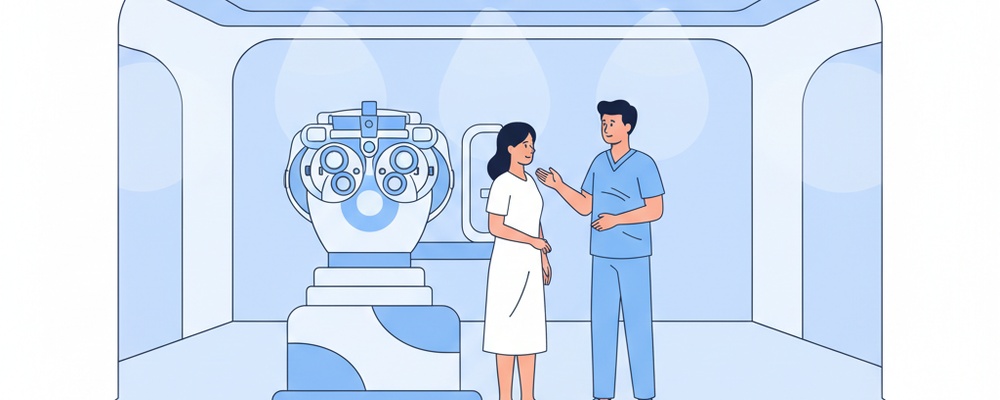
Beyond the standard eye chart, a Visual Quality Analysis provides an in-depth look at how your eye processes light. This advanced diagnostic test is a crucial step in our refractive surgery workup at Pristine Eye Hospitals, ensuring the best possible outcomes for procedures like Contoura LASIK. It objectively measures your eye’s optical quality to create a highly personalized treatment plan.
What is a Visual Quality Analysis?
A Visual Quality Analysis is a sophisticated, non-invasive diagnostic procedure that uses a double-pass light technique to assess your eye’s optical system. Think of it as a high-definition quality check for your vision. The instrument sends a harmless beam of light into the eye and measures how it scatters and reflects off the retina. This data is then used to generate an Objective Scatter Index (OSI) and a Modulation Transfer Function (MTF) curve, which give our specialists a precise, objective measurement of visual clarity, contrast sensitivity, and the presence of higher-order aberrations that a standard eye exam might miss.
Why is this test performed?
To Determine LASIK/Contoura LASIK Candidacy: It helps us confirm if you are an ideal candidate for refractive surgery by ensuring your eye’s optical system is healthy enough for a successful outcome.
To Personalize Your Treatment: The data gathered allows our surgeons to create a highly customized treatment profile, leading to superior visual results post-surgery.
To Diagnose Underlying Conditions: The test can detect subtle issues like early-stage cataracts or corneal irregularities that might cause symptoms like glare, halos, and poor night vision.
To Objectively Track Vision Changes: It provides a reliable baseline to monitor the quality of your vision over time, both before and after any treatment.
How to Prepare for Your Visual Quality Analysis
Preparing for your Visual Quality Analysis is straightforward as the test is quick and non-invasive. However, to ensure the most accurate results, please follow a few simple guidelines.
Contact Lens Wearers: If you wear soft contact lenses, please discontinue use for at least 3 days prior to your appointment. For hard or RGP lenses, please stop wearing them for at least 1-2 weeks.
Bring Your Glasses: Please bring your current prescription eyeglasses with you to the appointment.
Avoid Eye Drops: Do not use any non-prescribed eye drops on the day of your test.
The Procedure: What to Expect Step-by-Step
1. You will be seated comfortably in front of the diagnostic machine and asked to place your chin on a chin rest and your forehead against a bar to keep your head still.
2. Our technician will ask you to look straight ahead at a small fixation target (a light or a dot) inside the machine.
3. The device will then quickly and painlessly project a point of light into your eye and measure its reflection. You will not feel anything during this process.
4. The procedure is then repeated for your other eye. The entire test for both eyes typically takes only a few minutes.
Understanding Your Results
After your test, our ophthalmologist will review the results with you. The main output is a report that includes an Objective Scatter Index (OSI). A low OSI value indicates a very clear optical system with minimal light scatter, which is ideal. A higher OSI value may suggest the presence of a cataract or other issue that degrades visual quality.
The report also includes a Modulation Transfer Function (MTF) curve, which represents your eye’s ability to see contrast and fine detail, much like the performance of a camera lens. By analyzing these objective metrics, our specialists can understand the true quality of your vision beyond what a standard ’20/20′ reading can show. This information is vital for determining the best course of action for your refractive surgery or addressing any underlying problems.
Frequently Asked Questions
Is the Visual Quality Analysis painful?
Not at all. The test is completely non-contact and painless; you will simply be looking at a light for a few seconds.
How long does the entire test take?
The actual measurement process is very fast, taking less than a minute per eye. Your total time in the testing room will be around 5-10 minutes.
Why is this test better than a standard eye exam?
A standard eye exam measures your prescription (how well you see the chart), while this test measures vision *quality* (how clearly you see). It detects subtle imperfections like light scatter that cause glare and halos, providing a more complete picture of your visual health.