
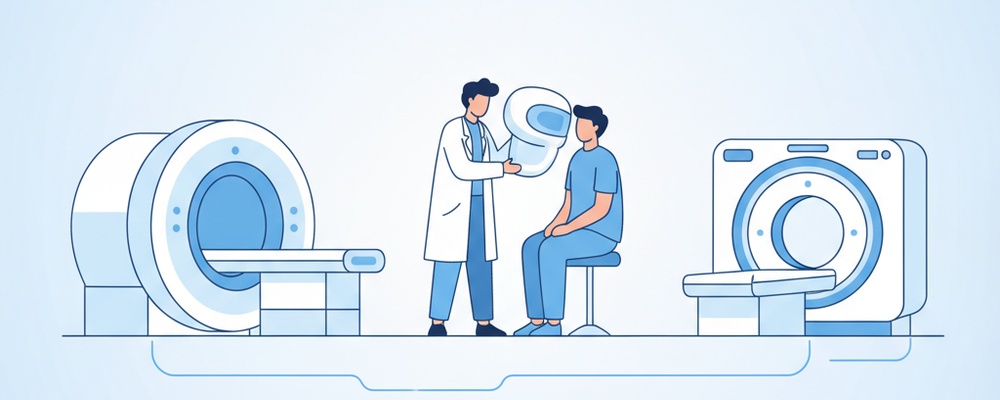
When a standard eye examination isn’t enough to see the full picture, your doctor may recommend orbital imaging. This advanced diagnostic step provides a detailed, cross-sectional view of your eye socket (orbit) and its surrounding structures. At Pristine Eye Hospitals, we coordinate referrals to premier imaging centers to ensure you get the clearest possible diagnosis.
What is a Orbital Imaging (CT / MRI referral)?
Orbital imaging is a non-invasive diagnostic procedure that uses either Computed Tomography (CT) or Magnetic Resonance Imaging (MRI) to create highly detailed images of the orbit. A CT scan uses a series of X-ray beams to produce images, making it excellent for viewing bones, fractures, and calcium deposits. An MRI scan uses powerful magnets and radio waves, which is superior for visualizing soft tissues like muscles, nerves, and fat, helping to identify inflammation or tumors. Your ophthalmologist at Pristine will determine which type of scan is most appropriate for your specific condition.
Why is this test performed?
This detailed imaging is crucial for diagnosing and managing a variety of conditions affecting the eye socket. Key reasons for a referral include:
To detect, locate, and assess the size of tumors, cysts, or other growths behind the eye.
To evaluate the extent of orbital fractures or damage following a facial injury or trauma.
To diagnose and monitor inflammatory conditions such as thyroid eye disease, orbital cellulitis, or orbital inflammatory syndrome.
To investigate the cause of unexplained eye bulging (proptosis), double vision (diplopia), or vision loss.
How to Prepare for Your Orbital Imaging (CT / MRI referral)
The imaging center will provide you with specific preparation instructions. In general, it is important to inform your doctor and the imaging staff about your complete medical history.
Tell them about any allergies, kidney problems, or if you are pregnant or breastfeeding.
For an MRI, you must inform them if you have any metal implants in your body, such as a pacemaker, aneurysm clips, or cochlear implants.
You will be asked to remove all metal objects, including jewelry, glasses, hearing aids, and dentures, before the scan.
The Procedure: What to Expect Step-by-Step
1. Check-in and Preparation: You will arrive at the referred imaging facility. In some cases, a contrast dye may be injected into a vein in your arm to enhance the visibility of certain structures.
2. Positioning: You will be asked to lie down on a cushioned, motorized table. The table will then gently slide into the center of the large, ring-shaped CT scanner or the tunnel-like MRI machine.
3. The Scan: A radiologic technologist will operate the machine from an adjacent room while communicating with you via an intercom. It is vital to remain as still as possible during the scan to ensure the images are clear. You may hear clicking, whirring, or loud thumping noises, especially during an MRI.
4. Completion: The scan typically lasts between 15 to 60 minutes. Once completed, the table will slide out of the scanner, and you are usually able to leave immediately and resume normal activities.
Understanding Your Results
After the scan, a specialized doctor called a radiologist will analyze the images and prepare a detailed report. This report will be sent directly to your oculoplasty specialist at Pristine Eye Hospitals. We will schedule a follow-up appointment with you to discuss these results in detail.
Your Pristine eye doctor will correlate the imaging findings with your clinical examination to establish an accurate diagnosis. They will explain what the images show, answer all your questions, and work with you to create a personalized and effective treatment plan.
Frequently Asked Questions
Is orbital imaging painful?
The procedure itself is completely painless. If a contrast dye is used, you may feel a brief, sharp prick from the IV needle and a temporary warm sensation as the dye enters your bloodstream.
How long does an orbital CT or MRI scan take?
A CT scan is typically very fast, often completed in under 15 minutes. An MRI scan is more detailed and can take longer, usually between 30 and 60 minutes, depending on the specific information your doctor needs.
Are CT and MRI scans safe?
Yes, both are considered very safe diagnostic procedures. A CT scan uses a very low dose of radiation, while an MRI uses magnets and radio waves with no radiation at all, making it exceptionally safe.