
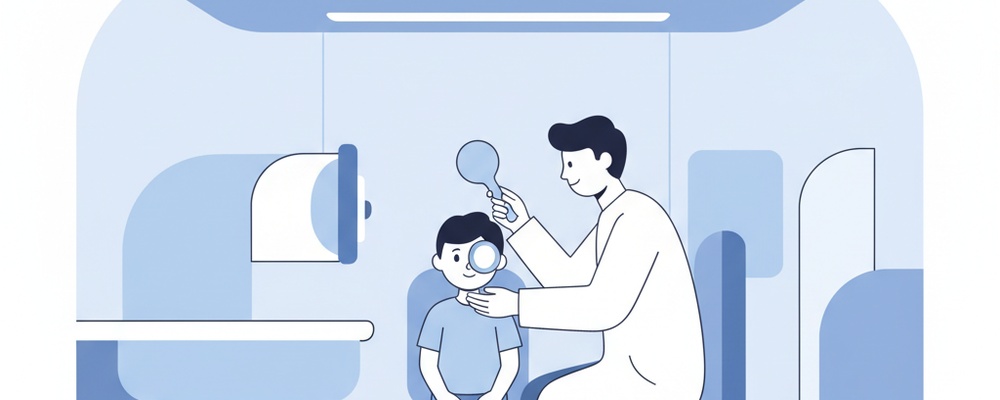
The Cover / Uncover Test is a fundamental, non-invasive diagnostic procedure used by ophthalmologists to check for eye alignment. It is a simple yet powerful tool for detecting strabismus (also known as squint or crossed eyes), a condition where the eyes do not look at the same object at the same time. This quick and painless test is a crucial part of a comprehensive eye exam, especially for children.
What is a Cover / Uncover Test?
The Cover / Uncover Test is an objective method for determining the presence and type of ocular misalignment. The test works by disrupting binocular vision (when both eyes work together). By covering one eye, the ophthalmologist can observe the behaviour of the other, uncovered eye. Any movement in the uncovered eye to pick up fixation indicates a manifest strabismus (tropia). The test then assesses the covered eye as it is uncovered, observing its movement as it re-establishes binocular vision, which helps identify latent strabismus (phoria).
Why is this test performed?
This test is essential for a thorough ocular motility evaluation. Your doctor at Pristine Eye Hospitals may perform it for several key reasons:
To definitively detect the presence of strabismus (squint) in patients of all ages.
To differentiate between a tropia (a constant, manifest misalignment) and a phoria (a latent misalignment that appears when the eyes are dissociated).
As a primary screening tool during routine pediatric eye exams to identify alignment issues that could lead to amblyopia (lazy eye).
To monitor the effectiveness of strabismus treatments, such as glasses, vision therapy, or post-surgical alignment.
How to Prepare for Your Cover / Uncover Test
Preparation for this test is minimal, as it is a straightforward observational procedure. However, to ensure the most accurate assessment, please follow these simple guidelines.
Bring any prescription glasses or contact lenses that you currently use.
Be ready to inform your doctor about any symptoms you’ve experienced, such as double vision, eye strain, or headaches.
No special eye drops, fasting, or other specific preparations are required for this test.
The Procedure: What to Expect Step-by-Step
The Cover / Uncover Test is a quick and simple process that involves no contact with your eye itself. Here is what you can expect during your appointment:
1. You will be seated comfortably and asked to fixate your gaze on a specific target, first at a distance (e.g., a letter on an eye chart) and then up close (e.g., the tip of a pen).
2. The ophthalmologist will use a small paddle-like instrument, called an occluder, to completely cover one of your eyes for a few seconds. During this time, they will intently watch your uncovered eye for any movement.
3. The occluder is then swiftly removed from the covered eye. The doctor observes both the eye that was just uncovered and the other eye to see how they coordinate as binocular vision is restored.
4. This entire process is repeated on the opposite eye and may be performed several times while you look in different directions of gaze to fully assess your eye muscles.
Understanding Your Results
After the test, your ophthalmologist will immediately be able to interpret the results and discuss them with you. If your eyes are perfectly aligned, neither eye will move during any part of the test. This is considered a normal result and indicates the absence of strabismus.
If movement is observed, it signifies a misalignment. If the uncovered eye moves to pick up fixation, it confirms the presence of a manifest strabismus, or tropia. The direction of this movement helps classify the squint (e.g., inward for esotropia, outward for exotropia). If the eye that was previously covered moves to re-align itself after the occluder is removed, it indicates a latent strabismus, or phoria. Your doctor will explain the specific type and magnitude of any detected misalignment and what it means for your vision health and potential treatment options.
Frequently Asked Questions
Is the Cover / Uncover test painful?
No, the test is completely painless and non-invasive. The doctor simply uses a small paddle to temporarily block the vision in one eye without ever touching the eye itself.
How long does the test take?
The test is very quick, typically taking only a minute or two to complete. It is often performed as one component of a more thorough and comprehensive eye examination.
Can this test be done on children?
Yes, this is a fundamental and crucial test for children to screen for amblyopia (lazy eye) and strabismus. Our pediatric ophthalmologists at Pristine Eye Hospitals are skilled at performing it on even the youngest patients using age-appropriate fixation targets.