
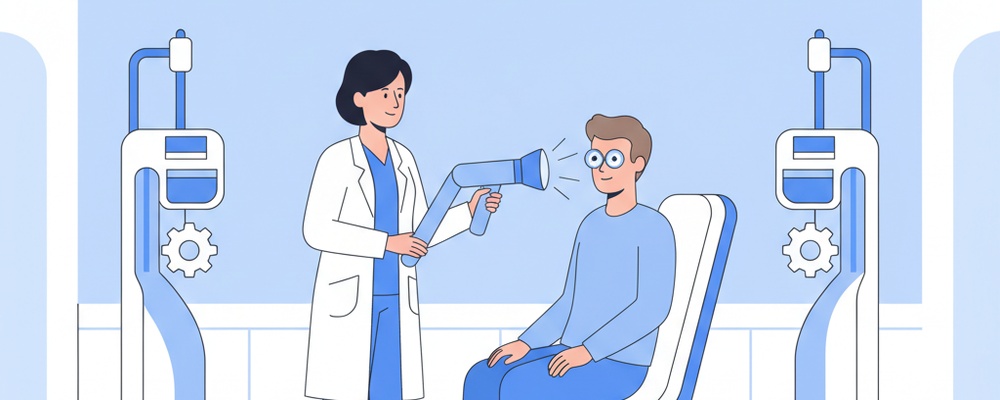
The Corneal Light Reflex test, also known as the Hirschberg test, is a simple, non-invasive screening tool used by ophthalmologists to check for eye alignment. It is a fundamental part of a pediatric eye exam and is crucial for the early detection of strabismus (squint). At Pristine Eye Hospitals, we use this quick diagnostic to ensure your or your child’s eyes are working together correctly.
What is a Corneal Light Reflex (Hirschberg Test)?
The Hirschberg test is an objective method for assessing ocular alignment. The principle is straightforward: a penlight is shone directly at a patient’s eyes, and the specialist observes the reflection of the light off the cornea, the clear front surface of the eye. In a person with normal eye alignment, the light reflection will appear in the same position on both eyes, typically in the center of the pupil. If the eyes are misaligned, the reflection on the turned eye will be displaced from the center, allowing the doctor to instantly identify the presence of a squint.
Why is this test performed?
This test is essential for several diagnostic purposes, particularly in the field of pediatric ophthalmology and strabismus management.
Early Screening for Strabismus: It is the primary method for detecting crossed eyes (esotropia) or outwardly turned eyes (exotropia) in infants and pre-verbal children who cannot cooperate with more complex vision tests.
Estimating the Angle of Misalignment: The degree to which the light reflex is off-center helps the ophthalmologist estimate the approximate angle of the eye turn, which guides further evaluation and treatment planning.
Identifying Risk for Amblyopia (Lazy Eye): Chronic misalignment of the eyes is a leading cause of amblyopia. Early detection with the Hirschberg test allows for timely intervention to prevent permanent vision loss in the weaker eye.
Monitoring Post-Surgical Alignment: After strabismus surgery, this test provides a quick way to check if the eyes have been successfully realigned.
How to Prepare for Your Corneal Light Reflex (Hirschberg Test)
One of the key advantages of the Hirschberg test is that it requires virtually no special preparation from the patient. It is a quick and simple observation performed during your consultation.
No fasting, eye drops, or any other specific preparation is necessary.
For young children, it is helpful if they are calm and can briefly focus on the light or a nearby toy.
Be sure to inform your doctor of any previous eye conditions, surgeries, or concerns you have about your or your child’s eye alignment.
The Procedure: What to Expect Step-by-Step
The procedure is completely painless, non-contact, and takes only a few seconds. Our specialist will ensure you or your child feels comfortable throughout the process.
1. You will be asked to sit in the examination chair, facing the ophthalmologist. If the patient is a child, they may sit on a parent’s lap.
2. The doctor will hold a small penlight approximately two feet away from your eyes.
3. You will be instructed to look straight ahead at the light. For children, a toy may be used near the light to attract their attention.
4. The ophthalmologist carefully observes the position of the light’s reflection on both of your corneas simultaneously to check for symmetry.
Understanding Your Results
The results of your Hirschberg test are available immediately. Your ophthalmologist will explain the findings to you during your appointment.
A normal result means the reflection of the light is positioned symmetrically, typically centered in the pupil of each eye. This indicates that your eyes are properly aligned, a condition known as orthotropia.
An abnormal result indicates the presence of strabismus. The light reflex in one eye will be displaced from the center of the pupil. The direction of this displacement tells the doctor the type of squint:
Inward Turn (Esotropia): The reflex is seen on the outer part of the pupil.
Outward Turn (Exotropia): The reflex is seen on the inner part of the pupil.
Upward/Downward Turn (Hypertropia/Hypotropia): The reflex is displaced vertically.
If a misalignment is detected, your doctor at Pristine Eye Hospitals will recommend further, more precise tests to quantify the deviation and develop an appropriate treatment plan.
Frequently Asked Questions
Is the Hirschberg test painful?
No, the test is completely painless and non-invasive. A simple penlight is used, and the light is no brighter than a common flashlight.
How long does the test take?
The test itself is extremely fast, typically completed in under a minute. It is one of the most efficient methods for screening for eye misalignment.
Can this test be done on babies?
Yes, the Hirschberg test is an ideal screening tool for infants and young children. It does not require any verbal feedback or complex cooperation, making it perfect for the youngest of patients.