
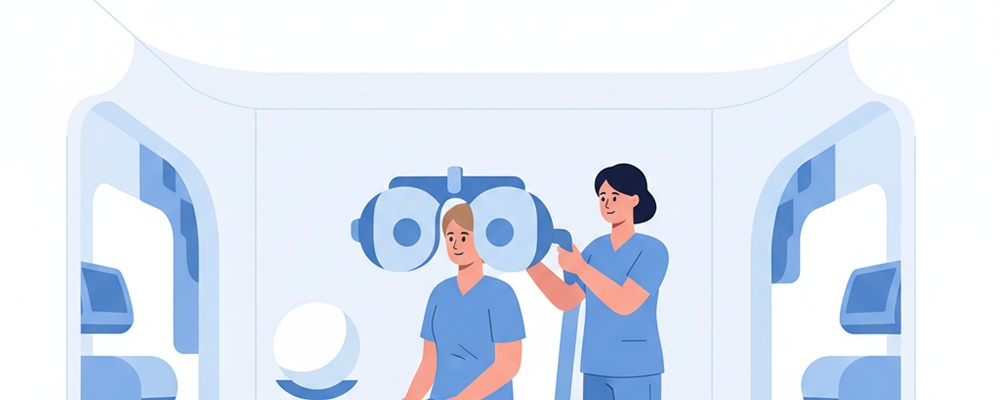
The Alternate Cover Test is a fundamental and essential part of a comprehensive eye examination, particularly for evaluating eye alignment and binocular vision. It is a simple yet powerful diagnostic tool used by ophthalmologists to detect and measure latent strabismus, a type of eye misalignment that is not always visible. This test helps uncover how your eyes work together as a team.
What is an Alternate Cover Test?
The Alternate Cover Test is a non-invasive procedure designed to reveal a “phoria,” or a latent tendency for the eyes to misalign. Under normal viewing conditions with both eyes open, your brain fuses the images from each eye to maintain straight alignment. This test works by breaking that fusion; the ophthalmologist rapidly switches a cover (an occluder) from one eye to the other, preventing the eyes from working together. This disruption forces the covered eye to move to its natural resting position, revealing any underlying misalignment which the doctor can then observe and measure.
Why is this test performed?
This test is crucial for a complete assessment of ocular motility and binocular function. Key reasons for performing it include:
To detect and quantify latent strabismus (phoria): It accurately measures the degree of hidden eye turn, whether inward (esophoria), outward (exophoria), or vertical.
To diagnose the cause of asthenopia: It helps determine if symptoms like eye strain, fatigue, headaches, or intermittent double vision are caused by the effort your brain exerts to keep misaligned eyes straight.
To assess binocular vision health: The test evaluates how well your eyes are teaming up, which is vital for depth perception and comfortable vision.
As part of a comprehensive squint evaluation: It is a standard component in the work-up for both children and adults suspected of having any form of strabismus.
How to Prepare for Your Alternate Cover Test
Preparation for the Alternate Cover Test is minimal as it is a straightforward, in-office procedure. There are no special drops, fasting, or restrictions required beforehand.
Bring your current eyeglasses or wear your contact lenses to the appointment.
Be ready to inform your doctor about any specific symptoms you’re experiencing, such as double vision or eye strain.
Relax, as the test is completely painless and quick.
The Procedure: What to Expect Step-by-Step
The Alternate Cover Test is a simple and interactive process that takes only a minute or two. Here is what you can expect:
1. You will be seated comfortably and asked to fixate your gaze on a specific target, which could be an object far away or up close.
2. The ophthalmologist will place a small paddle-like instrument called an occluder over one of your eyes.
3. After a few seconds, the occluder will be moved swiftly and directly to cover your other eye, without any interval where both eyes are uncovered simultaneously.
4. The doctor will closely observe the eye that has just been uncovered, watching for any movement it makes to pick up fixation on the target. This process is repeated multiple times to ensure accuracy.
Understanding Your Results
The results of the Alternate Cover Test reveal the presence and type of phoria. If the uncovered eye needs to move to focus on the target, it indicates a latent misalignment. The direction of this movement tells the doctor the type of phoria: an inward movement indicates exophoria (eyes tend to drift out), an outward movement suggests esophoria (eyes tend to drift in), and a vertical movement indicates hyperphoria or hypophoria.
Your ophthalmologist at Pristine Eye Hospitals will interpret these findings in the context of your overall eye health and symptoms. The presence of a small phoria can be normal, but a larger one may explain symptoms of eye strain and may require treatment, such as corrective glasses with prisms or vision therapy. Your doctor will discuss the results with you and explain what they mean for your vision.
Frequently Asked Questions
Is the Alternate Cover Test painful?
No, not at all. The test is completely non-invasive and painless; it simply involves covering and uncovering your eyes with a small paddle.
How long does the Alternate Cover Test take?
The test is very quick and is usually completed in less than two minutes as part of your comprehensive eye examination.
What is the difference between the Cover Test and the Alternate Cover Test?
The standard Cover Test (or Cover-Uncover Test) is used to detect manifest strabismus (tropia), which is a misalignment that is always present. The Alternate Cover Test is specifically designed to break eye fusion and reveal latent strabismus (phoria), a tendency to misalign that is normally controlled by the brain.