
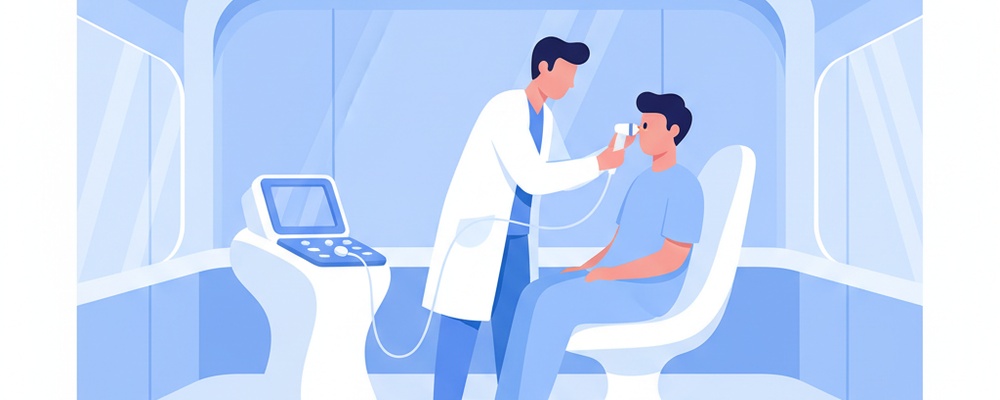
An A-Scan Ultrasound Biometry is a routine, non-invasive diagnostic test that provides critical measurements of your eye’s internal structures. Using high-frequency sound waves, this scan accurately determines the length of the eye, which is a vital step in planning for successful cataract surgery. At Pristine Eye Hospitals, we use this advanced technology to ensure precise outcomes for our patients.
What is an A-Scan Ultrasound Biometry?
A-Scan Ultrasound Biometry, also known as an A-scan, is a type of ophthalmic ultrasound. The ‘A’ stands for amplitude, as the test produces a one-dimensional graph showing spikes of different heights (amplitudes) that correspond to various eye structures. A small probe sends sound waves into the eye, and the echoes that bounce back are used to calculate the distance between these structures, primarily measuring the eye’s total length from the front (cornea) to the back (retina). This measurement is called the axial length.
Why is this test performed?
This test is essential for several clinical reasons, the most common being:
Calculating Intraocular Lens (IOL) Power: It provides the primary measurement needed to calculate the correct power of the artificial lens (IOL) that will be implanted during cataract surgery.
Measuring Eyes with Dense Cataracts: When a cataract is too dense for light-based measurement tools (like an optical biometer) to penetrate, the A-scan’s ultrasound waves provide a reliable and accurate alternative.
Diagnosing and Monitoring Eye Conditions: It can help in characterizing other eye abnormalities or tumours and is sometimes used to monitor eye growth (axial length) in children with progressive myopia.
How to Prepare for Your A-Scan Ultrasound Biometry
Preparation for an A-Scan is minimal and straightforward. It is a quick and painless outpatient procedure that requires no fasting or special diet. To ensure the most accurate results, please follow these simple guidelines:
If you wear contact lenses, you may be asked to remove them before the test.
Inform your ophthalmologist about any eye drops or medications you are currently using.
No anaesthesia is required, though numbing drops are used for your comfort.
The Procedure: What to Expect Step-by-Step
The entire A-scan process is completed in just a few minutes. Our trained technicians will guide you through each comfortable and simple step.
1. You will be seated comfortably in a chair, and anaesthetic (numbing) eye drops will be applied to your eye to prevent any discomfort.
2. You will be asked to look straight ahead at a fixed target to keep your eye steady.
3. A small, sterilized ultrasound probe will be gently and briefly placed on the front surface of your eye (the cornea).
4. The probe will emit harmless sound waves, and the device will instantly record the measurements. The process is then repeated for the other eye if required.
Understanding Your Results
The main result from your A-Scan is the “axial length” of your eye, a precise measurement given in millimetres. This number is a critical piece of data that your cataract surgeon will input into advanced mathematical formulas (such as the SRK/T or Hoffer Q formulas).
Along with other measurements like corneal curvature (keratometry), this axial length allows the surgeon to calculate the exact power of the intraocular lens (IOL) needed to replace your cloudy natural lens. Choosing the correct IOL power is the key to achieving clear vision after cataract surgery and reducing your dependence on glasses. Your doctor at Pristine Eye Hospitals will discuss these calculations with you as part of your surgical planning.
Frequently Asked Questions
Is the A-Scan test painful?
No, the test is completely painless. Numbing eye drops are applied before the procedure to ensure you feel no sensation from the small probe touching your eye.
How long does an A-Scan take?
The entire procedure is very quick. The actual measurement process for both eyes typically takes less than five minutes from start to finish.
Why is an A-Scan needed if I have a dense cataract?
Standard light-based scanners cannot pass through a very dense or mature cataract to measure the eye’s length. A-Scan uses ultrasound, which can easily penetrate the cloudy lens to get the accurate measurements required for IOL power calculation.